
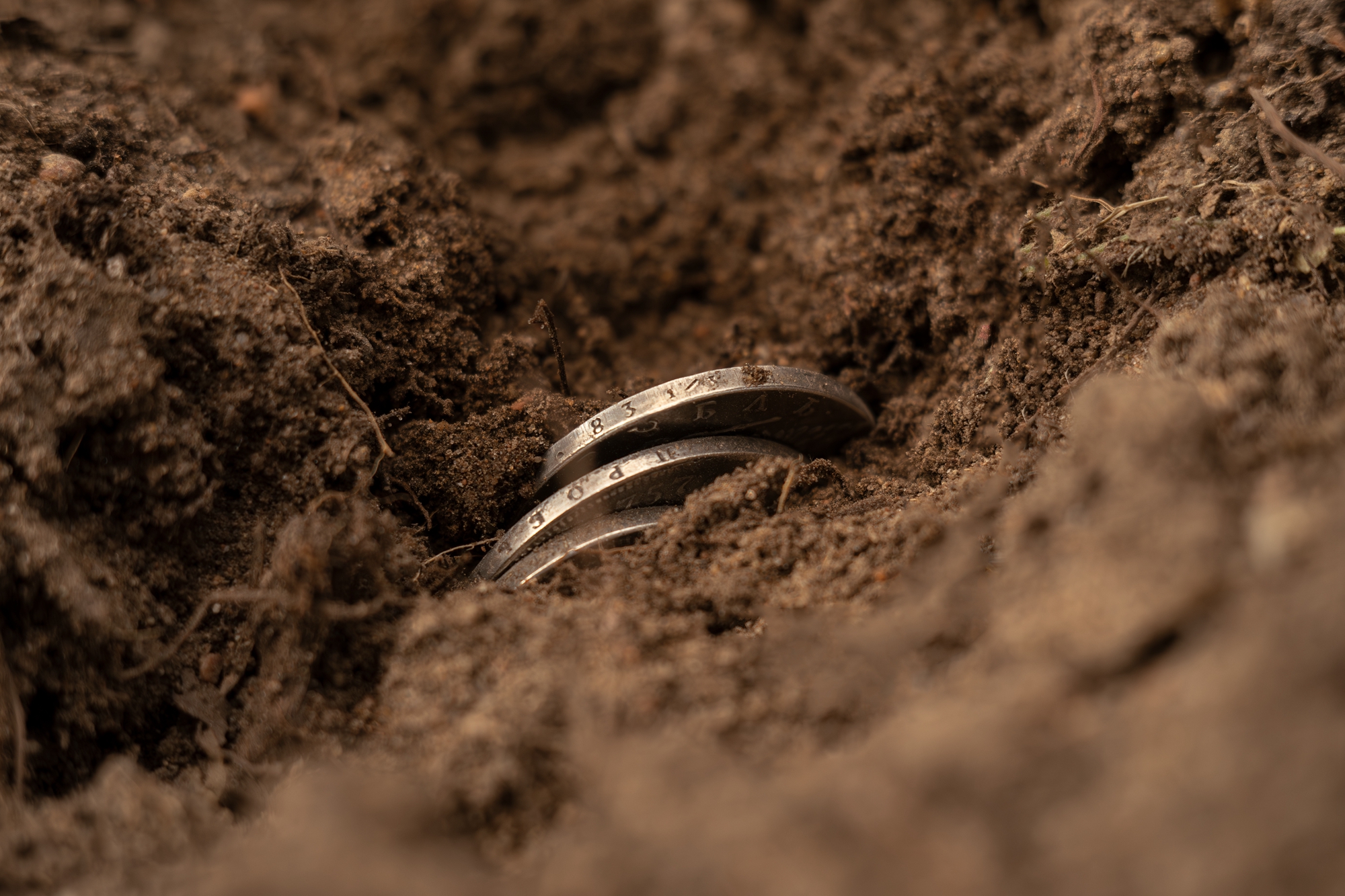
In a field in Wesseling, south of Cologne in western Germany, the dense buzzing sound of a metal detector led to the discovery of a massive treasure weighing 6.8 pounds (approximately 3.1 kilograms) – a total of 934 ancient Roman silver coins. This find has brought to light a historical treasure that had been asleep for nearly 2,000 years.
According to the official announcement by the Regional Association for the Preservation of Archaeological Sites in the Rhineland (LVR) at the end of September, this astonishing wealth was accidentally discovered by an amateur metal detector enthusiast named Oliver Riedl, who holds a valid license. Experts confirmed that this is the largest known cache of ancient coins from the reign of Roman Emperor Hadrian (reigned AD 117-138) found within Germany, ranking fifth globally in related finds from the same period.
As Riedl’s detector continued to buzz intensely in the same area, he unearthed a total of 15 ancient Roman silver coins in a row. However, realizing that the buzzing sound of the detector persisted, he became aware that the land beneath his feet was far from ordinary. “I was well aware that there was more buried here.” Riedl recalled in an interview with the Associated Press.
Out of respect for historical relics and compliance with regulations, he promptly ceased his personal excavation and voluntarily contacted the local department of cultural heritage and archaeology. A professional archaeological team then took over the excavation work and uncovered these 934 silver coins in the soil – initially stored meticulously in a ceramic vessel packed with straw as a cushion, which had deteriorated over time.
Riedl’s honest and proper handling of the situation earned high praise from the LVR, with officials publicly commending it as a perfect example of collaboration between amateur detector enthusiasts and official institutions.
After a meticulous cleaning by LVR experts, these ancient Roman denarii silver coins regained their luster, with the emperor’s portraits and inscriptions still clearly visible. The research team indicated that these coins were intentionally buried between AD 125 and 150. Coins from the Hadrian period contained a high silver content, belonging to the “golden age” of the Roman monetary system, rather than the later debased alloy coins due to economic collapse.
The timespan of this treasure is remarkable. The oldest coin dates back to as early as 148 BC (during the Roman Republic era). By the time it was buried underground in the mid-2nd century AD, it had been in circulation in the market for nearly 300 years. Interestingly, although the treasure was buried during the reign of Emperor Hadrian, studies showed that over half of these silver coins actually belonged to the earlier Flavian dynasty (AD 69-96), perfectly illustrating the enduring purchasing power and accumulation process of high-purity Roman silver coins across centuries.
Johannes Wienand, professor of ancient history at the Technical University of Brunswick, told Fox News that this find is undoubtedly a “huge treasure” and a perfect “time capsule,” preserving the conditions of everyday currency circulation at that time.
Who could have buried such a massive fortune here? Professor Wienand analyzed that the area was near the Rhine River frontier of the Roman Empire, with the Roman city of Cologne nearby, as well as a legionary fortress in Bonn. Hence, these artifacts are highly likely to be associated with military personnel. During the Roman Empire, an ordinary legionnaire’s annual gross income was roughly 300 silver coins, meaning the 934 coins represent the total earnings of a soldier for three full years.
Considering daily expenses and deductions, “a Roman soldier may need to save for six, seven, eight years, or even longer to accumulate this amount of money, perhaps as his retirement fund.” He further speculated that, “This seems to be a lifetime savings of an individual, who buried these treasures in a jar in the ground for future use, but evidently the owner never returned.”
Under the North Rhine-Westphalia Cultural Heritage Protection Law, these precious ancient silver coins legally belong to the state (the state government). However, due to the discoverer Oliver Riedl holding a valid license and honestly reporting the find, he is entitled to a substantial cash reward bestowed by the authorities.
Today, these ancient Roman silver coins, now once again brought to light, are publicly displayed at the LVR State Museum in Bonn, allowing people to witness firsthand this mysterious treasure buried for nearly two thousand years and experience the economic pulse of the Roman border from nearly two millennia ago.