
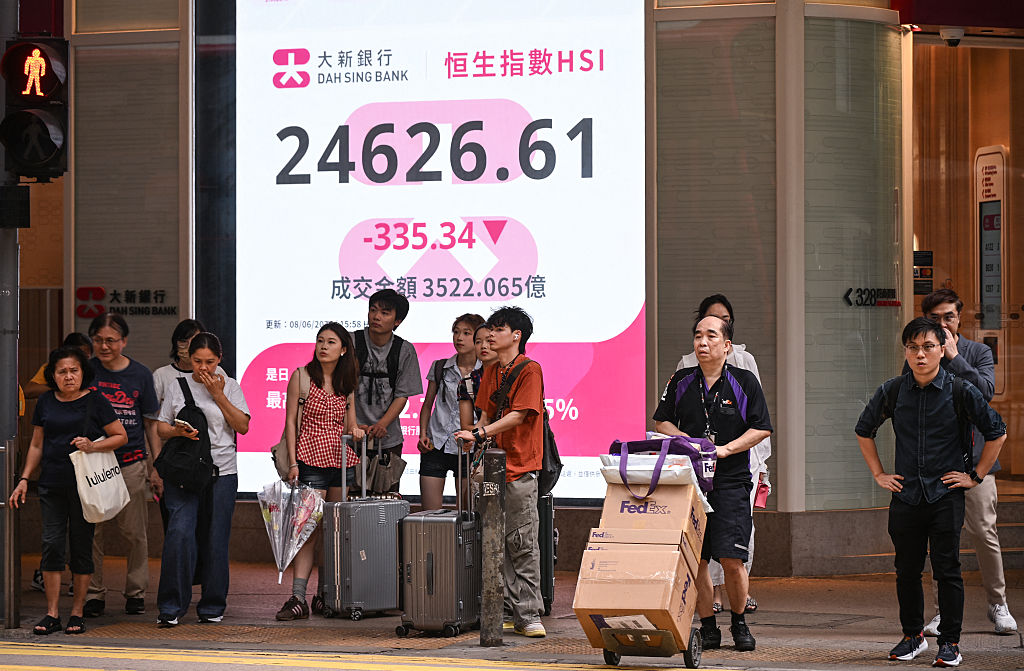
In October, the Hong Kong stock market showed unusually bleak performance. On October 7th, the turnover of the Hong Kong stock market was only about 94.7 billion Hong Kong dollars, falling below 100 billion Hong Kong dollars.
Although on that day, the Hong Kong stock market volume dipped due to the Mainland China holiday from October 2nd to 7th, after the Mainland market resumed trading on October 8th and northbound funds re-entered, the turnover of Hong Kong stocks rebounded to around 207.3 billion Hong Kong dollars. Despite the increase in turnover, the market did not become stronger as a result.
The Hang Seng Index fell by 344.71 points, a decline of 1.43%, closing at 23,785.79 points, hitting a low for about three months. The Hang Seng Tech Index plummeted by 2.89%, reaching a low for about two years, and the Hang Seng China Enterprises Index also dropped by about 0.89%.
It’s worth noting that on October 8th, even with the return of northbound funds, southbound capital recorded a net inflow of about 6.477 billion Hong Kong dollars. However, the Hang Seng Index continued to decline, even breaching the 24,000-point mark.
This indicates one thing: what the Hong Kong stock market lacks is not just funds (trading volume). When funds re-enter the market, the market is still on a downtrend. So, where is this money flowing to? And how much of it is willing to stay in the Hong Kong stock market?
As of the end of September 2026, the Hong Kong stock market had around 2,772 listed companies with a total market value of about 45.48 trillion Hong Kong dollars.
The average daily turnover in September was about 201.9 billion Hong Kong dollars, a decrease of about 20.3% from August’s approximately 253.4 billion Hong Kong dollars. From January to September, the average daily turnover in the Hong Kong stock market was about 272.9 billion Hong Kong dollars.
Meanwhile, the supply of IPO new stocks in the Hong Kong stock market continues to increase rapidly. In the first nine months of 2026, 118 companies were listed, marking an annual increase of about 71%. IPO fundraising amounted to around 388 billion Hong Kong dollars, up about 106% annually. Overall equity financing reached about 724 billion Hong Kong dollars, a 60% increase annually. As of the end of September, approximately 590 listing applications were still under review. This dual trend — liquidity pressure on the one hand and increasing stock supply on the other — is one of the reasons for the widening decline in the Hong Kong stock market today.
A market value of 45 trillion does not mean there is 45 trillion in cash. The total market value of the Hong Kong stock market at 45.48 trillion Hong Kong dollars may seem like a massive number, but market value is not equivalent to a cash pool. A company’s market value being high does not mean there is a large amount of money trading daily, and high stock valuations do not automatically translate to investor willingness to buy in on a given day.
The most crucial question is: how much money is willing to enter the market every day? How much new capital is willing to take on new stocks?
Without sufficient incremental funds, a market will clearly show the phenomenon of funds withdrawing from many stocks and concentrating on a few leading and popular sectors. Therefore, it is apparent that some large tech, financial, and energy stocks still have trading volume.
However, this does not mean that the entire Hong Kong stock market is attractive. On the contrary, if funds are increasingly focused on a few stocks, many other stocks will gradually lose buyers. The decrease in trading volume is just a surface indication; what is really happening is that more and more stocks are losing funds.
The money is not disappearing entirely but rather exiting. It may choose a few large companies or even other markets.
What is truly being lost is not just funds but also confidence in Hong Kong. A decline in Hong Kong stock market funds does not mean there is no global capital; it means the funds are making new choices.
When investor confidence in Chinese assets decreases, the first step is to reduce allocations to Hong Kong stocks, H-share stocks, and other Chinese assets. After funds exit, they do not sit idle but seek more worthwhile destinations. With expectations of a rise in the US dollar, USD assets become a crucial destination.
As of the end of September 2026, Mainland Chinese companies accounted for approximately 77.3% of the total market value of the Hong Kong stock market and about 88.8% of stock turnover. This high level of integration between the Hong Kong stock market and Chinese assets means that when investors reduce Hong Kong stock allocations, what they are primarily considering is not just Hong Kong itself.
They are also increasingly concerned about the deteriorating policy environment in China, the continued ripple effects of the real estate and local debt crisis, and worrying economic development prospects, leading to an investor exodus.
Investor confidence in the Hong Kong market is declining, and the appeal of the Chinese assets represented by the Hong Kong market is also diminishing. This is not solely a liquidity problem; it is a crisis of confidence.
(Investment carries risks, and caution is advised when entering the market. This article is for reference only and should not be considered as investment advice.)