
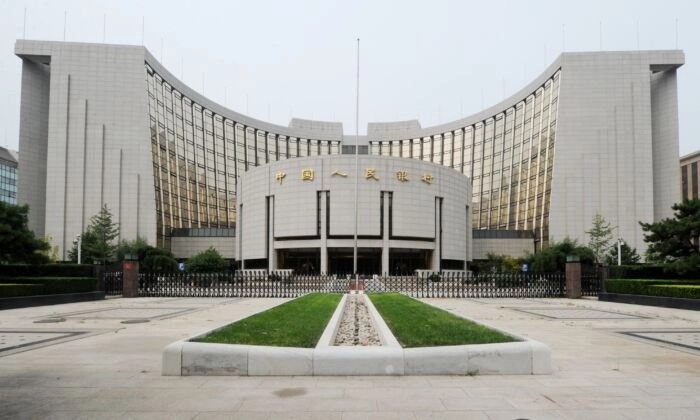
On Thursday, October 8th, marked the first day of crucial trade negotiations between the European Union and China. The People’s Bank of China released a document that day, attempting to defend its renminbi management policy and hinting at the continued strengthening of the currency. Currently, more EU officials are attributing significant trade imbalances to the issue of the renminbi exchange rate.
As the central bank of the Chinese Communist Party, the People’s Bank of China issued a renminbi policy document along with an English translation on Thursday. The document stated, “China has neither the need nor the intention to gain a competitive advantage through currency devaluation.”
This statement was released during the trade negotiations in Beijing between the EU’s Trade Commissioner Maros Sefcovic and China’s Minister of Commerce Wang Wentao.
The renminbi exchange rate policy has become an increasingly sensitive topic in Europe. European policymakers believe that the renminbi’s weakness gives Chinese exporters an unfair advantage and exacerbates the EU’s trade deficit with China.
Against the backdrop of this exchange rate debate, significant changes have occurred in the foreign exchange market. Since 2026, the renminbi has strengthened against most major currencies. Due to weak economic growth in Europe and fiscal issues in France, the euro has depreciated against the renminbi by over 10% since January.
According to Bloomberg, as highlighted by Geoffrey Yu, a strategist at the Bank of New York Mellon, the People’s Bank of China’s latest argument simply aims to align with the developments in the foreign exchange market. Yu suggests that the more critical issue may be whether Beijing allows the renminbi to appreciate not just nominally but also through inflation-generated growth and widening price differentials with other economies, achieving actual or inflation-adjusted exchange rate appreciation.
The IMF estimates that by 2025, China’s real effective exchange rate (measured against a basket of partner currencies and adjusted for inflation) is underestimated by 12% to 20%.
In its document, the People’s Bank of China attempts to provide a broader defense of the Chinese Communist Party’s non-market exchange rate system, stating that there is currently no universally accepted method to determine the equilibrium currency value. It also mentions that a current account surplus does not necessarily imply currency undervaluation. Although the People’s Bank of China pledges to enhance transparency by reporting foreign exchange operation data to the IMF starting in 2027, it does not specify whether this information will be made public or provide details on the scope of the report.
The People’s Bank of China reiterates that it does not set specific target levels for the renminbi exchange rate or attempt to determine its long-term trends.
According to the South China Morning Post, Xu Tianchen, a senior economist at The Economist Intelligence Unit, stated that the People’s Bank of China’s report is a direct response to the IMF’s allegations of the renminbi being undervalued.
He noted that the authorities seem eager to promote China’s structural rebalancing but also do not want to leave the impression externally that they are “forced to do so.”
For a long time, Europe has accused China of manipulating its currency to boost exports. Earlier this week, France and Germany proposed giving the EU the power to swiftly cut off access to the European market for a third country causing significant market distortions (such as “restrictions on currency exchange or currency manipulation”).
French President Macron and German Chancellor Merkel both mentioned the renminbi exchange rate issue at a joint press conference in July, stating that the renminbi is undervalued by 25% to 30%. Merkel had previously proposed a plan similar to Japan’s “Plaza Accord.”