
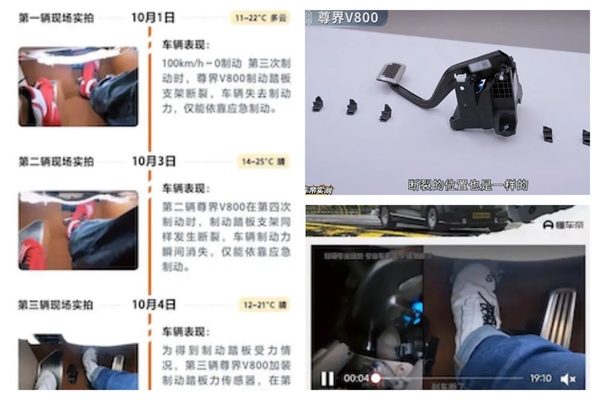
On October 8, 2026, a partnership between Chinese tech giant Huawei and Jianghuai Automobile to create the luxury brand “Zunjie” with a price tag of over a million yuan has sparked controversy. A test video released by the car information platform “Understanding Cars Emperor” on October 8 showed that during an emergency braking test at 100 kilometers per hour, all three Zunjie V800 vehicles experienced brake pedal bracket fractures, causing a stir online.
The test video revealed that the three brand-new Zunjie V800 vehicles underwent an emergency braking test from 100 kilometers per hour to a complete stop in a closed area. After multiple rounds of heavy braking, the brake pedal brackets all experienced physical fractures.
Following the fractures, the vehicles lost their foot brake functions completely and could only rely on the emergency brake in the P gear. The test showed that the stopping distance increased from approximately 38 meters in normal conditions to 140 meters. The Zunjie V800 user manual also indicates that the emergency brake in the P gear is mainly for deceleration and cannot fully replace regular braking, posing a risk of losing control of the vehicle.
According to a report by “Daily Economic News” on October 8, the three test vehicles came from different batches but had the same fracture location and nearly identical fracture patterns. The first two test cars were leased by Understanding Cars Emperor, while the third was a newly purchased vehicle. The first two test cars were manufactured in August, and the third in September of this year.
Regarding the cause of the fractures, the head of automotive safety content at Understanding Cars Emperor, Takamori Higashimado, analyzed the dismantled braking pedal assembly of one of the test vehicles and suggested that the bracket material might have suffered brittle overload damage, likely due to insufficient structural redundancy under instantaneous peak braking loads. He noted that the issue might not lie with the material itself but rather in the structural design and safety redundancy.
The dismantling data showed that the distance from the center of the Zunjie V800 braking pedal to the bracket pivot was about 130 millimeters, with the pivot area supported by only a single vertical plate, indicating stress concentration areas and injection molding fusion marks. In comparison, some other car models using the same material, even from the same supplier, reinforced the structure with 2 to 3 layers in the corresponding location.
Higashimado mentioned that top luxury brands also use similar modified plastic materials, but with significantly greater structural redundancy designed to withstand levels of force ranging from 2700N to 4500N and even require resistance up to 3000N at 80°C without fracturing.
Notably, the reading of the force on the pedal at the moment of the third test vehicle’s bracket fracture was 1612N, while the current mandatory national standard GB 21670-2025 “Technical Requirements and Test Methods for Passenger Car Braking Systems” specifies a static load requirement of 2000N to be maintained for 5 seconds without failure.
The Zunjie V800 is a super luxury large MPV under the Zunjie brand, launched in August of this year. It is priced between 766,000 yuan and 1.016 million yuan, with the highest configuration exceeding a million yuan, targeting the high-end business market.
Zunjie, created through cooperation between Huawei and Jianghuai Automobile, adopts the HarmonyOS Intelligent Driving Collaboration Model. Jianghuai is responsible for the overall vehicle engineering, intelligent manufacturing, and vehicle quality control, while Huawei provides HarmonyOS cabin, intelligent driving, and electric drive intelligent automotive solutions. The brand was once described by Yu Chengdong as “far superior to Maybach and Rolls-Royce Phantom.”
The incident quickly became a hot topic online. Netizens believe that as a luxury car with a price tag of millions of yuan, the brake system’s bracket fracture issue deserves high attention. They urge Jianghuai Automobile and Zunjie to investigate promptly, with some calling for a recall of related vehicles.
However, some netizens questioned the intensity and method of the test, debating whether continuous full-force emergency braking is a normal road condition and if the pedal force in the testing process reflects typical driving scenarios. Regardless, many users emphasized that brakes are a critical safety component, and no matter how much force is applied, they should not fail.
Microblogger “Little Bicycle” noted the significance of the 1600N and 4589N readings, stating that the recorded force on the pedal of the third Zunjie V800 before the fracture was about 1612N, below the 2000N required by the standard. The blogger highlighted that other vehicles tested alongside, including Huawei’s SmartTravel, passed the same test, urging a factual examination.
Amid negative news, the stock price of Jianghuai Automobile hit the limit down during trading on the same day, closing at 24.72 yuan with a 10.01% drop, shrinking the company’s market value by about 6.2 billion yuan. Previously, Jianghuai Automobile’s stock price had shown continuous strength, with a cumulative increase of over 40% from September 22 to 30, and three consecutive daily limit up movements.
In response to public attention, Jianghuai Automobile stated on October 8 that it’s aware of the incident, currently conducting an investigation and various tests, with plans for official explanations once results are obtained. The company’s investor relations department also noted that quality control processes are in place for vehicles before leaving the factory.
(Translation from Chinese to English)