
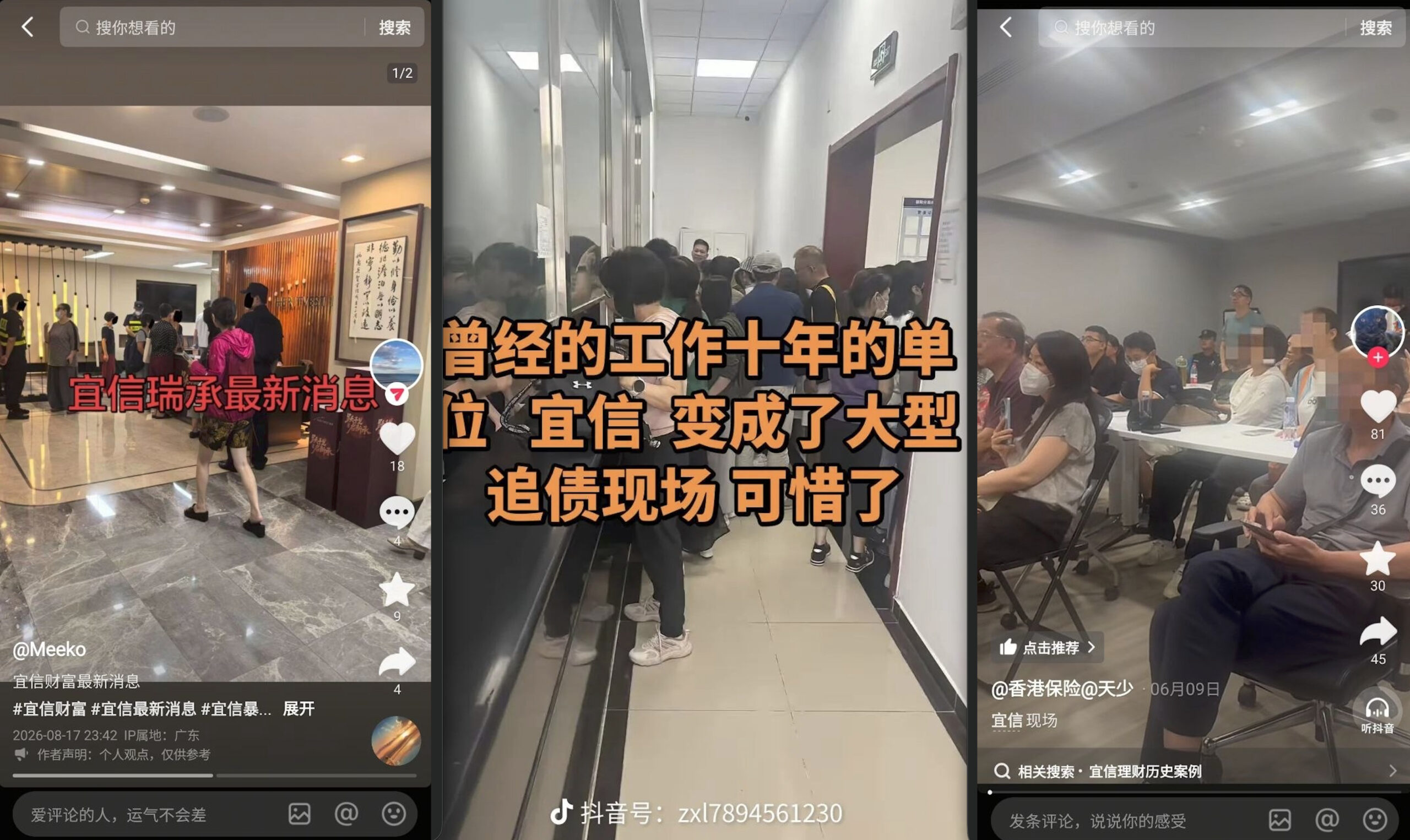
China’s leading peer-to-peer lending institution “Yixin Wealth” recently announced the suspension of its fixed-income products and halted payments, affecting hundreds of thousands of investors. Many investors interviewed expressed that the trust built over more than a decade collapsed overnight, with official WeChat groups being blocked. Some investors are planning to form groups to seek justice in Beijing.
According to reports from Caixin and “Caijing,” Yixin Superior Wealth Investment Management Co., Ltd. (Yixin Wealth/Rui Cheng) announced on May 22 this year the “orderly withdrawal” of all its fixed-income products (including the previously issued “Guangdong Rui” series of debt transfers and non-standard products), involving billions of yuan.
Fixed-income products refer to investment products with relatively stable returns, lower risk than stocks but higher than traditional savings, and without a guaranteed principal.
Some investors have received notices from their customer managers regarding the “orderly withdrawal” of fixed-income products, with expected returns not being received.
As the former “number one P2P stock in China,” Yixin transitioned to peer-to-peer lending and wealth management after the comprehensive closure of the P2P industry in 2020. Its fixed-income products, with a track record of “15 years of zero default,” attracted hundreds of thousands of high-net-worth investors.
Founded by Tang Ning in 2006, Yixin launched the online lending platform “Yirendai” in 2012 and went public on the NYSE in 2015. Due to regulatory policies in 2018, Yixin ceased its P2P business and shifted to peer-to-peer lending and wealth management. According to a report from China News Network, despite several name changes, the company’s main business remains in peer-to-peer lending. There are rumors that Yixin’s founder, Tang Ning, is the son of the former Chinese Foreign Minister Tang Jiaxuan, but the authenticity of this information has not been verified.
Regarding the sudden halt in payments, some investors recently expressed that past long-term operations and consistent payments were crucial reasons for establishing trust.
A Shenzhen investor, Wu Zhiming (pseudonym), told a reporter, “I started investing in Yixin in 2015, initially purchasing related products starting at 1 million yuan, which was the minimum threshold. Later, I continued to add investments, totaling over 3.4 million yuan.”
He mentioned that he was initially cautious about investing but gradually let go of concerns due to the platform’s long operation time, friends’ participation, and continuous product recommendations from Yixin staff. At that time, the platform offered a return rate between 3% and 5%.
Shenzhen has a higher number of financial investors, and many initial investors were locals.
According to him, Yixin used investors’ funds for lending but delayed the retrieval of related funds, eventually leading to the collapse of the fund chain, causing payments at maturity to be unfulfilled.
A Wuhan investor, Chen Huijun (pseudonym), told the media that she began investing in Yixin’s online financial products around 2015, and payments were normal until issues arose on May 22 this year.
She mentioned that until the issues arose, most of the information she saw publicly was positive. The trust built over the years made her and other investors unprepared for the sudden suspension of payments.
After May 22, Yixin did not provide investors with a clear reason for the suspension. Chen Huijun stated that a large number of investors are now in anxiety and panic, actively seeking solutions through various means.
Currently, investors have very limited contact channels and the relevant receptions and customer service channels cannot provide specific solutions. She said, “Basically, there is no information. They just make you wait endlessly without a specific time frame or solution.”
In Chen Huijun’s view, the long-term lack of clear information is a significant factor accelerating investors’ “extreme anxiety and panic.”
After being unable to withdraw funds, Wu Zhiming and other investors communicated for rights protection through WeChat groups. He said, “We have two groups for rights protection, all victims from our local area.”
However, he mentioned that some groups had members’ accounts restricted afterward. “There were sensitive words mentioned in the group, some people spoke unpleasantly, and then WeChat accounts were blocked.”
As some groups became inactive, communication among investors also became challenging. Wu Zhiming said, “Now we cannot find those victim groups anymore.”
With official blockages on WeChat groups, it is difficult for some investors to unite even with a shared willingness for rights protection.
Regarding the current scale of funds involved and the number of investors, Chen Huijun stated that figures circulating online vary from hundreds of billions to trillions of yuan, and there are different estimates for the number of investors. “It is said that there are approximately tens of thousands of investors, but we cannot obtain statistical data.”
She emphasized that the above information mainly comes from investors and online channels, and investors still lack clear answers on the specific situation.
Wu Zhiming mentioned, “As far as I know, some investors have mortgaged their cars and homes. Some people have even sold their houses to invest in Yixin.”
He said that some investors originally aimed to gain stable returns through investment, but with funds unavailable for withdrawal, they not only face asset losses but also bear debt pressures.
Though he runs a company in Shenzhen, his Yixin investments cannot be retrieved, affecting his family’s lives because the overall economy is currently struggling.
“When my wife found out about this, she opposed my investment, but I didn’t listen to her. Now that I can’t withdraw the money, she constantly brings it up at home, and we argue almost every day. Who could feel comfortable in this situation?” he said.
For Wu Zhiming, who has invested over 3.4 million yuan, the most realistic expectation now is to receive some level of refunds from his previous Yixin investments. “We just want to know if we can get this money back, if it can be paid out,” he said.
Chen Huijun concluded by stating that for ordinary investors, this financial crisis not only affects investment figures on paper but also relates to years of savings and future life arrangements.
“After all, it’s about so much money, our lives.,” she said.
Wu Zhiming had not previously gone to Beijing for rights protection, but now he is considering such a plan. However, he believes that going alone might not yield practical results. He said, “If I go to Beijing alone now, the authorities may see me as an illegal petitioner and take me away. Unless friends for rights protection go together, strength lies in numbers.”
He emphasized that if investor contacts could be re-established, they could count participants in the group and collectively agree on a time to travel.
Chen Huijun also mentioned that facing a situation where there is no clear solution, some investors have taken various rights protection measures, including going to Beijing to report the situation and submitting materials to relevant departments and contacting the media.
“I am just an ordinary salaried worker, and my monthly income is not high. The over 300,000 yuan I invested was accumulated over many years. We must persist in rights protection; this is undoubtedly half a lifetime of effort.” she said.