
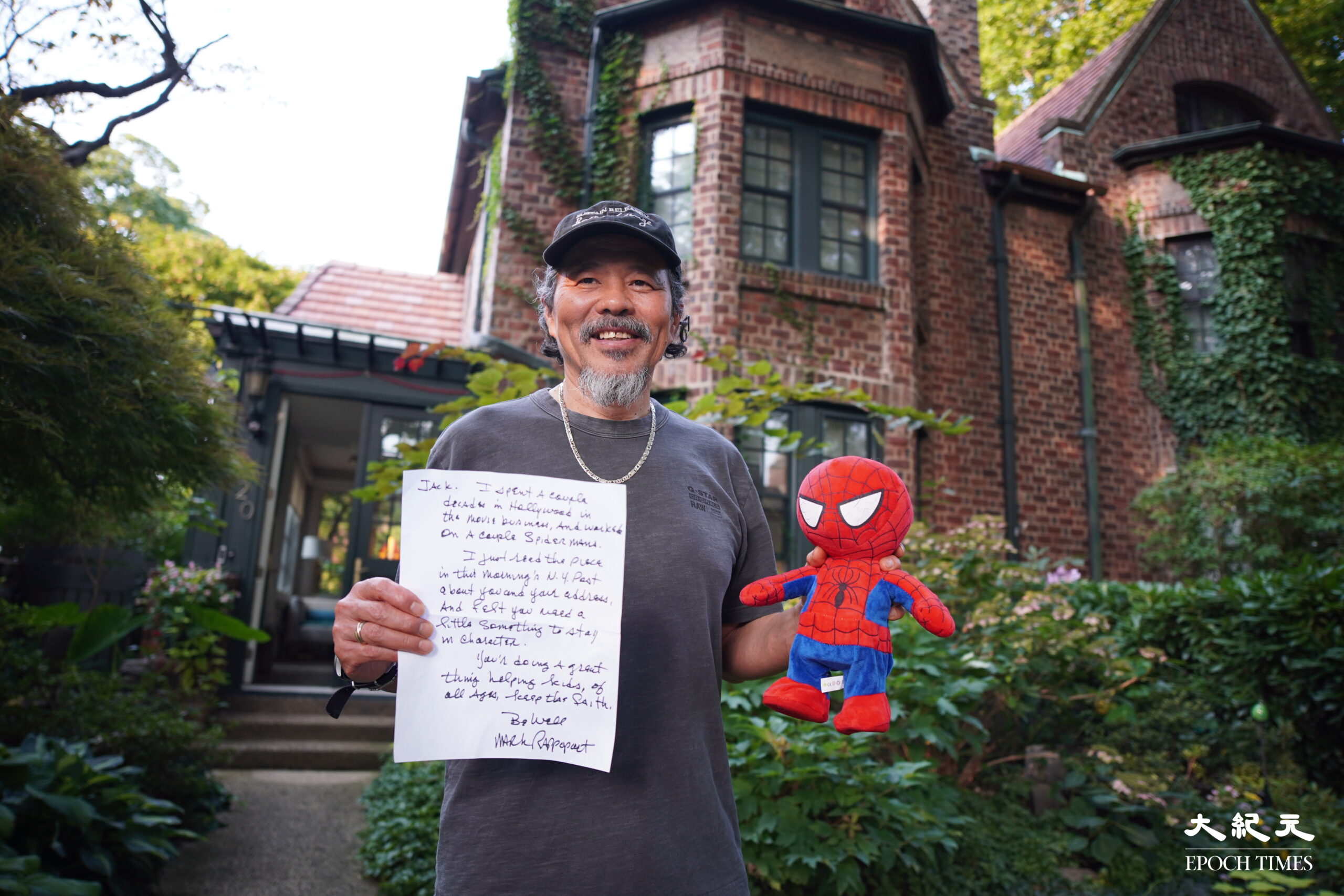
In the news on August 20, 2026, a Chinese man named Jack bought a house in Queens, New York. After moving in, strangers from around the world began visiting him. They stood outside taking pictures, lingering, while people from all over the United States sent letters from afar.
Jack was initially puzzled, but later found out that the house he stepped out of every day shared the same address as the on-screen home of the American hero, Spider-Man.
But the truly interesting story may have just begun from there. This Chinese immigrant who unexpectedly lived in Spider-Man’s home waters the neighbors’ flowers, warmly greets passersby, and picks up trash he sees on the ground. When asked about his beliefs, he said, “The hardest thing for a person is to do the right thing.”
Following the trail of the movie, searching for Spider-Man’s traces in New York, we ended up encountering another story about “heroism” within this house.
64-year-old Jack sold his house in rural Georgia a few years ago and purchased a semi-detached Tudor-style old mansion located at 20 Ingram Street in Forest Hills, Queens. Before finalizing the purchase, no one informed him of the connection between the house and Spider-Man.
Yet, this house continuously attracts visitors from all over the world. People from different countries stand at the door taking photos, searching for the non-existent teenage hero.
After residing for a while, Jack started receiving fan mail for Spider-Man sent from all over the United States, realizing he had become Spider-Man’s landlord.
What’s even more coincidental is that the previous owner of this house had the surname Parker, just like Peter Parker, Spider-Man’s alter ego. Among the neighbors, there was also someone with the surname Osborne, reminiscent of the Marvel villain Norman Osborn, adding a touch of the “Spider-Man universe” to the street.
Jack began chatting with the Spider-Man fans who visited, saying, “In interacting with them, I found that people aspire to the Spider-Man spirit of responsibility, kindness, doing the right thing, and above all, courage.” He paused and stressed, “I discovered these qualities are the most valuable and necessary in any society.”
Upon moving into the house, Jack started thinking, “Perhaps I should follow in Spider-Man’s footsteps and be kind to the people I encounter, see what I can do for my neighbors first.”
When Jack first moved to the street, he went door to door delivering flowers. He told his neighbors, “I am the new neighbor, please take care of me!” Mutual care and assistance among neighbors are the spirit of traditional Chinese society.
He knew that some neighbors had lived there for ten years without ever speaking to each other. He wasn’t quite comfortable with that and greeted each neighbor warmly every time they crossed paths.
When he saw newspapers thrown in front of a neighbor’s door, he picked them up; when the flowers in front of a retired New York professor’s house were left unwatered, he helped with watering every day; when he walked down the street and saw trash, he stopped to pick it up. Now, when neighbors renovate their yards, replace boilers, or even sell their houses, they seek his help. In his free time, he often goes to the school to play soccer and basketball with the kids.
He happily said, “Now we all talk to each other. At least five neighbors have told me I am their best neighbor, and I realize I have truly been accepted by this land.”
He believes that in any environment, people must learn to trust and help each other. He didn’t realize that these actions aligned with Spider-Man’s spirit of responsibility until he inadvertently moved into Spider-Man’s house, where he discovered that the beliefs he had always held regarding life were surprisingly similar to those of the American comic book hero.
Jack has maintained a volunteer habit of picking up trash for many years – keeping the environment clean. When exploring in Tibet before, he spent nearly a year picking up roadside trash, even joined by local monks. Now in New York, he continues this habit.
He said, “I’ve found that many things are actually simple to do, but can instantly make the world a better place.”
Some Indian residents often see Jack picking up trash at the sports field, and the barriers between ethnicities gradually fade. Eventually, when spotting him from afar, they greet him proactively, becoming friendly individuals.
He said, “One’s dignity is not granted by others but by oneself.” He began talking about the Chinese people: “We Chinese must be dignified individuals, starting with our words and actions, possibly by being a good neighbor.”
“Chinese people should strive to contribute to society, enhancing the strength and honor of American society. Only then can Chinese people truly gain the position and respect they deserve.”
These thoughts on responsibility and dignity, when implemented in daily life, often start with a smile, a simple gesture, a patient wait. When goodness becomes a habit, the atmosphere of a street or a community can slowly transform.
Laughing, Jack said, “However, buying this house does indeed seem to live up to the title of Spider-Man.”
He likened his life to “Robinson Crusoe”, relying on belief as his greatest support. In the face of difficult choices, Spider-Man’s spirit of being willing to sacrifice oneself and bravely save others is highly motivational for him. He always remembers the words: “The hardest thing for a person is to do the right thing, especially when it comes to interests and life and death, you have to choose.”
From the spirit embodied by Spider-Man – “with great power comes great responsibility”, Jack thought about the responsibilities Chinese immigrants in America should bear. He raised a thought-provoking question: “We come to America to enjoy its freedom, but the real consideration should be: Do we deserve this freedom?”
Continuing, he said, “The greatest freedom comes with the greatest responsibility. Chinese people must have a sense of responsibility, hoping for true enlightenment and rejuvenation from this.”
At that moment, the spirit of Spider-Man was no longer confined to the screen but returned to the real world, manifested through Jack.
Even after leaving China, Jack did not leave Chinese values behind. He said, “Many Chinese believe that immigrating to the United States marks the end, but it is only a beginning.” Leaving an unfree environment doesn’t mean one can live only for oneself, nor does it imply, “We’ve left, therefore we have no responsibility to China.”
Having freedom also entails more responsibility – not only towards the local community but also towards the place one originated from.
His tone grew firmer, saying, “We are born with a mission. Even if China falls, we need to go save it. It is our sense of morality and conscience.”
Despite many feeling disillusioned or even hopeless about China’s future, he believes change is possible. He hopes that one day, China will move towards a normal society of freedom, democracy, and the rule of law, and also believes that Chinese dignity cannot be solely reliant on others but ought to be fought for and preserved by themselves.
The movie and reality reflect each other. Sometimes, the most enchanting stories in New York are like this – you seek one world, but eventually stumble upon another.
That afternoon, seated in Spider-Man’s home, we listened to this Chinese man talk about the Spider-Man spirit, freedom, responsibility, Chinese dignity, and the enlightenment and revival of a nation.
This reminded me of a familiar image among Chinese people – the hero. Americans draw heroes in comics, while the Chinese depict heroes in the world of martial arts. Both cultures answer the same question: how should a person treat others and face responsibilities once they possess abilities?
Just as Jack understood Spider-Man’s spirit: “At the most difficult moments, a person should prioritize courage, morality, and faith over self-interest, because these qualities are divine.”