
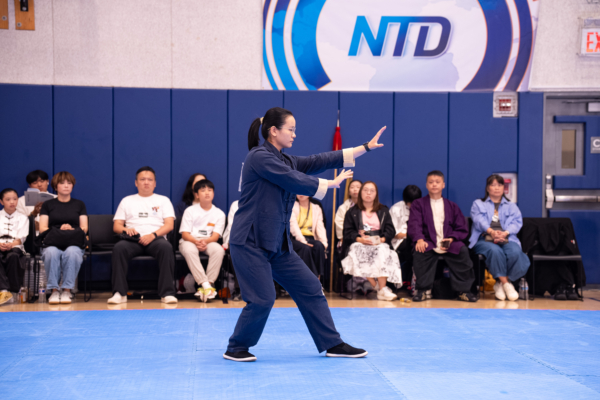
In the past seven or eight years, Wei Lai has been consistently practicing what seems to be a “dry” activity – mastering the two sets of “Mother Fist” from Xingyi Quan. In August this year, Wei Lai participated for the first time in the 9th “NTD World Chinese Traditional Martial Arts Competition” where she showcased her skills in Xingyi Quan routines and won the bronze medal in the women’s boxing category.
“I’m not practicing boxing, I’m practicing solitude,” Wei Lai recalls her feelings at the beginning of her martial arts training. However, gradually she found her path, “I knew how to practice, had insights, and then persisted.”
Wei Lai is a doctoral student majoring in human kinetics. During her university years, she briefly encountered Xingyi Quan but did not continue. A few years later, she had the opportunity to witness the efforts to revive traditional martial arts at the NTD World Chinese Traditional Martial Arts Competition, which deeply moved her and motivated her to continue practicing traditional martial arts.
After years of practicing martial arts, Wei Lai feels the greatest change has been the improvement in her skills. She says, “Kung Fu is something you cultivate, practice is the most basic foundation.” When one becomes proficient in the techniques of a set of boxing, where does one go next? Wei Lai’s realization is that “it all depends on cultivation,” much like the emphasis on martial virtue highlighted at the NTD World Chinese Traditional Martial Arts Competition, “How virtue comes about is through cultivation, there is no other way.”
As a woman, Wei Lai believes that practicing martial arts is not about striving for strength, but about elevating martial skills on the basis of traditional morals. She points out that historically, Ban Zhao was a representative of female virtue, with her “Admonitions for Women” beginning with the phrase “humility is paramount.” Wei Lai admires these four words as “extremely valuable,” stating, “This is what I aim to pursue on the path of practicing martial arts.”
She notes that nowadays, young people tend to be more impulsive and arrogant, easily domineering. She believes that it is a precious character to be able to place oneself at the lowest position, “In the midst of everyone, always seek the lowest position, then you can see the big picture clearly.”
Wei Lai recalls a small incident that deeply touched her regarding “martial virtue.” Due to work commitments, she would practice boxing in a forest around 10 PM. At one point, she heard sounds resembling wild boars in the woods, initially worried about being attacked by the animals. As she practiced her boxing, she thought, “If it comes to ‘challenge’ me, I definitely can’t resist!”
She considered asking her teacher to teach her a set of techniques to defeat wild animals, but then she remembered the story of Gautama Buddha moving a poisonous snake with compassion and avoiding an attack. “I should cultivate a compassionate heart, I shouldn’t think about striking it down.” Wei Lai realized she was still youthful and aggressive, prone to resorting to violence easily. Astonishingly, as she abandoned her fighting spirit, the sounds in the forest gradually disappeared.
During another boxing practice session, Wei Lai received guidance from a martial arts master, which greatly benefited her. She explains that the master taught her a more traditional boxing style and corrected the routines she had learned before. Initially, she felt “particularly refreshing, particularly smooth” when practicing with her familiar boxing style, but with the new, more traditional style, it felt “very constrained, very awkward.”
“After every punch, the force was completely guided by my hand,” Wei Lai discovered that only by following the traditional method of practicing boxing could she understand the subtleties of martial arts. She no longer clung to her original routines but trusted her teacher’s guidance, repeatedly practicing with the correct methods.
Wei Lai also realized the significance of why traditional martial arts emphasize respecting teachers and traditions. It is not just about respect in words and actions but more about “faith.” She explains, “Your every move is rooted in something, every action is based on a principle.” She adds, “Your every thought should be grounded in the truth you deeply believe in, the thing you aim to practice.”
She has gained a deeper understanding of the inner essence of “virtue” in traditional martial arts. She mentions that many people nowadays think martial virtue is a vague concept. However, she argues, “Can you see force? We cannot see force, we can only see the application of force.” Yet, few deny the existence of force.
Thus, Wei Lai has come to realize that although martial virtue may not be as visually apparent as physical techniques, “this is where the distinction lies.”