
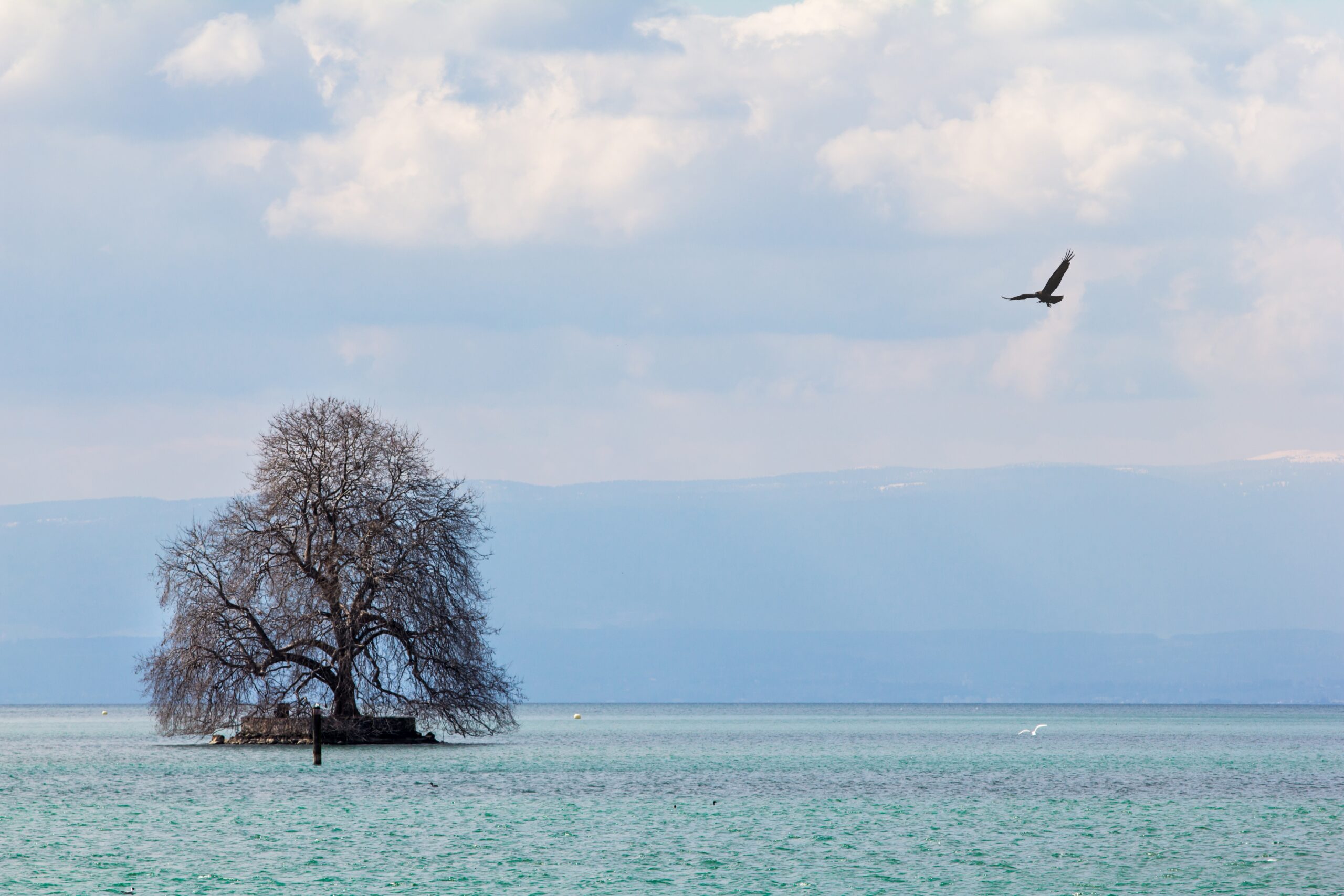
In Lake Geneva, Switzerland, there is a small island with an area of only a few tens of square meters, which is one of the most popular landscapes for photographers in the lake. The famous Danish writer Hans Christian Andersen was inspired by this island, writing a tragic fairy tale.
The picturesque island is called Île de Peilz, not far from the neighboring town of Villeneuve. It is often described as the smallest island in Lake Geneva, and possibly the only natural island in the lake.
Standing on this small island is a lonely London plane tree, with its broad canopy clearly visible from passing boats and the lakeshore, making it a popular subject for photographers.
Legend has it that before 1797, Île de Peilz was just an ordinary rock. Residents of Villeneuve expanded and shaped the island to its current form by covering it with soil and building surrounding walls. Although there is no historical documentation as to why they carried out this costly project, it is evident that the island underwent artificial shaping.
In the 19th century, the protective walls on the island were repaired several times. By 1851, a few trees were planted on the island. Over time, except for one, the rest of the trees have disappeared. It is this surviving London plane tree that gives the island its unique silhouette.
There are various legends surrounding the origin of Île de Peilz. One from the 19th century tells the story of a young British man and his fiancée. He tragically drowned while they were swimming in the lake. This left his fiancée grief-stricken.
She established a memorial at the spot where his body was found, naming it “Île de Paix” (meaning “Island of Peace”). It is said that this name gradually evolved into “Île de Peilz,” which is the present-day name of the island.
Inspired by this legend, Danish writer Hans Christian Andersen incorporated this small island into his fairy tale “The Ice-Maiden” written in 1861. This tragic tale involves star-crossed lovers and an ice fairy symbolizing the ruthless power of nature, known as the Ice-Maiden.
When the British poet Lord Byron visited Lake Geneva in 1816, this small island also deeply captivated him, leading to his depiction of the island seen from the prison window in his narrative poem “The Prisoner of Chillon.”
For generations, residents along Lake Geneva have passed down a story that Île de Peilz was once gifted to Queen Victoria of England. Some claim that upon learning of the taxes associated with owning the island, the Queen returned it, while others insist that legally, the island still belongs to her descendants.
However, researchers examining government archives found no evidence to suggest that the island was transferred to Queen Victoria or the British royal family. Local records management officials pointed out that such a gift would have been legally impossible, as the island has never been federal property.