
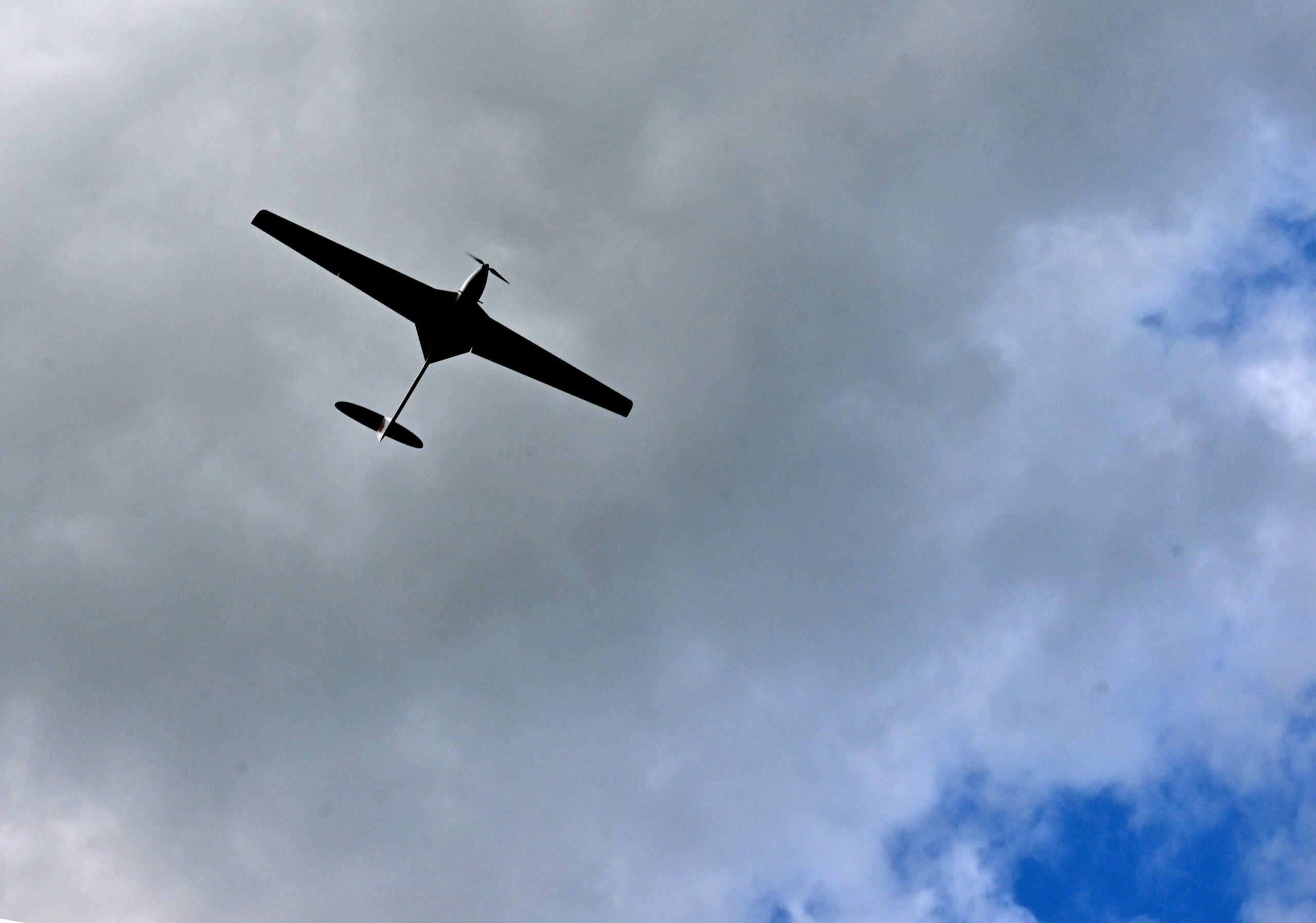
On Friday morning, August 14th, a NATO fighter jet shot down an unmanned aerial vehicle that entered Latvian airspace in the eastern part of the country. Latvian military officials stated that this “foreign drone” was influenced by Russian electronic warfare and entered Latvian airspace. Finland also temporarily restricted airspace and maritime traffic in the eastern part of the Gulf of Finland as a precaution against drone threats.
The incident occurred around 4 AM local time. The Latvian armed forces reported that after the unmanned aerial vehicle entered the Balvi region in northeastern Latvia, it was intercepted and shot down by NATO fighter jets on a mission.
Latvian regions such as Augšdaugava, Preiļi, Rēzekne, Balvi, and Alūksne briefly issued orange air alerts. Residents received mobile alerts urging them to take precautionary measures and seek shelter. The alert was lifted approximately an hour later.
The Latvian military stated, “As long as Russia’s aggression against Ukraine continues, cases of foreign drones entering or approaching Latvian airspace may occur again.”
Military forces have increased air defense units along the eastern border of Latvia and stated that they will continue to monitor the airspace.
Vilmantas Vitkauskas, Director of the Lithuanian National Crisis Management Center, stated that the NATO fighter jets scrambled from the Šiauliai Air Base in northern Lithuania to carry out the interception mission. The nationality of the fighter jet has not been disclosed yet.
Vitkauskas told Lithuanian National Broadcasting LRT that this incident is similar to a drone event in May when a drone, allegedly affected by Russian electronic warfare systems, deviated from its original course and entered NATO airspace.
He said, “Based on the information we currently have, the object likely changed its course on Russian territory or crossed the border from Belarus or Russia – this is still being confirmed.”
Vitkauskas further stated, “To our knowledge, only one object was detected in Latvia. It changed its course, originally heading towards a legitimate target in the Leningrad region, but then deviated into NATO territory.”
This indicates that the drone may have initially been heading towards a target in Russian territory, but its exact origin is still under confirmation.
Vitkauskas mentioned that there have been no reports of damage so far, and relevant search operations are ongoing.
On the same night, the Russian regions of Leningrad oblast and St. Petersburg faced a massive drone attack, leading to a fire at the Ust-Luga oil port along the Baltic Sea coast. Governor of Leningrad oblast, Alexander Drozdenko, stated that over 50 Ukrainian drones were shot down by the Russian forces around St. Petersburg.
While Latvia issued alerts, Finland, bordering Russia, also took preventive measures.
The Finnish Defense Forces restricted airspace and maritime traffic in parts of the eastern Gulf of Finland around 4 AM, lifting the restrictions after 8 AM.
The Finnish Defense Forces stated on social media: “This is a preventive measure aimed at ensuring civilian safety and ensuring authorities have the capability to respond to potential drone operations.”
In recent months, Finland has temporarily restricted parts of its airspace multiple times due to drone threats. On May 15th, the most populous Uusimaa region advised residents to stay indoors due to drone threats, with approximately 1.8 million inhabitants in the area.
The Latvian incident is the latest in a series of recent drone events on NATO’s eastern flank.
According to Euronews report, Romania shot down three drones in three days in July, one of which was identified as the “Shahed” type drone used by the Russian military in the Ukraine conflict. Earlier this week, Romanian forces destroyed two Gerbera drones in the Black Sea, and last week, an explosion from a drone occurred near a gas pipeline compression station in Bulgaria.
NATO allies recently discussed airspace violations in Poland and Romania and the recent drone incidents.
In a statement, NATO reiterated that Russia bears full responsibility for these airspace violations. These actions are deemed both dangerous and unacceptable, indicating an increasing Russian tolerance for risk.
NATO also stated readiness to “deter and defend against any aggression.”
The NATO Baltic Air Policing mission began in 2004, with allied nations deploying fighter jets in rotation to protect the airspace of Estonia, Latvia, and Lithuania. After Russia’s annexation of Crimea in 2014, NATO further strengthened relevant deployments.