
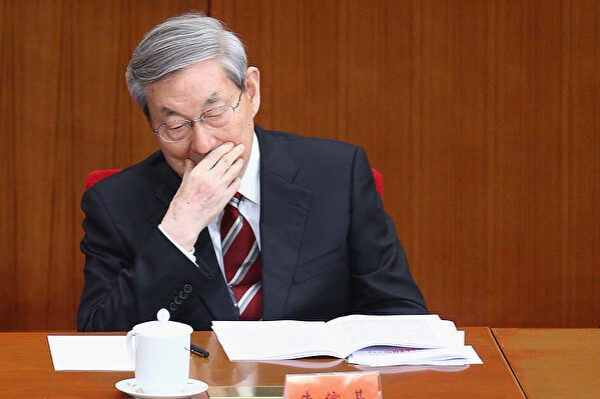
Former Chinese Premier Zhu Rongji passed away recently. During his tenure, he promoted economic reforms in China. Some believe that the Chinese Communist Party (CCP) may be concerned about his death, fearing it could spark a social movement similar to what happened after the passing of Hu Yaobang. Chinese activist Wei Jingsheng, in an interview with Epoch Times, expressed that the CCP’s biggest concern may not necessarily be public mourning for Zhu Rongji but rather the potential for a sudden event to trigger accumulated social discontent to erupt.
According to official media reports, former Chinese Premier Zhu Rongji passed away in Beijing on August 12 at the age of 98. The official obituary described him as someone “brave enough to speak the truth and unafraid to offend others.”
Zhu Rongji served as Vice Premier and Premier of the State Council of the CCP from 1991 to 2003. During his tenure, he led significant reforms in areas such as tax reform, finance, state-owned enterprises, and housing.
His passing coinciding with the CCP’s Beidaihe meeting and the upcoming Fourth and Fifth Plenums of the 20th Central Committee has drawn significant public attention. Analysts suggest that if Xi Jinping is planning for re-election, it is not ruled out that someone might seize on Zhu Rongji’s death as a pivotal moment to incite political turbulence, echoing the historical script of the 1989 Tiananmen Square protests triggered by Hu Yaobang’s death.
In response to this, Wei Jingsheng, Chairman of the Overseas Chinese Democracy Coalition, was interviewed by Epoch Times on August 13. He stated that there has been a significant shift in the social environment between 1989 and today. “People across the country no longer trust the Communist Party, and no one is speaking up for the Communist Party.”
He believes that the current society resembles a “powder keg,” with the CCP’s real concern not being Zhu Rongji’s personal influence but rather any event that holds symbolic significance, which could serve as a catalyst for releasing long-standing grievances within the population.
Regarding the reform legacy left by Zhu Rongji, Wei Jingsheng pointed out that from the era of Deng Xiaoping to Hu Yaobang and Zhao Ziyang, it had become clear that the planned economy system of the CCP was unsustainable. This realization gradually led to consensus internally on promoting market-oriented reforms, albeit facing resistance from certain interest groups. Zhu Rongji was just a significant participant in this reform process.
He believes that China’s transition to a market economy carries positive implications. “Market economy reform is generally correct. China can only truly develop through implementing a market economy.”
Wei Jingsheng noted that following the reform and opening-up era, China experienced rapid economic growth, showcasing the creativity and economic vitality of the Chinese people under suitable institutional conditions.
However, he argued that the issue lies not in the market economy itself but in the manner in which the CCP approached reforms. He criticized these reforms for being extreme, stating that alongside pursuing economic growth, serious social costs have also emerged.
Reviewing the reactions on his social media platforms, Wei Jingsheng observed that many people do not hold a favorable view of Zhu Rongji.
Discussing the wave of layoffs brought about by the CCP’s state-owned enterprise reforms, Wei Jingsheng expressed concern over the sudden loss of employment for millions of people and the impact on families. He highlighted that at the time of the reforms, the total number of employees in state-owned enterprises nationwide was only around two to three hundred million.
He pointed out, “The CCP blamed the crashed economy on the people, saying that the workers in the factories were not working hard.”
Regarding China’s accession to the World Trade Organization (WTO), Wei Jingsheng suggested that the CCP’s entry was based on deceit. “After joining the WTO, they did not abide by the WTO’s conditions.”
He argued that China flooding the international market with cheap goods post-WTO entry resulted in a significant surge in exports. However, simultaneously, the economic benefits were not equitably distributed among Chinese laborers.
Citing the impact on the United States, he claimed that the influx of Chinese products into the American market negatively impacted certain manufacturing sectors, leading to trade imbalances. “China subsidized a large amount of cheap products to the U.S. without tariffs, destroying many industries in the U.S.”
He also highlighted that the majority of economic benefits from China’s growth were siphoned off by the Communist Party and corrupt officials, leaving ordinary citizens with meager incomes.
Wei Jingsheng noted a contradiction in China’s economic development model: as the country relied on export-led growth, internal consumption and purchasing power remained insufficient, resulting in prolonged domestic consumption weakness.
Analyzing why the CCP has faced challenges after over thirty years of reform, Wei Jingsheng attributed it to a self-serving development model that proves unsustainable.
He stressed that with an increasing number of countries imposing restrictions on Chinese goods, China’s export-oriented model is encountering mounting resistance. “The entire world is pushing back now, not only developed countries gradually blocking Chinese goods, but even third world countries starting to block Chinese goods.”
Simultaneously, he pointed out that inadequate domestic consumption in China poses another constraint. “If foreign trade is not viable and internal consumption is insufficient, where is this economy heading?”
He warned that without the government’s focus on increasing household incomes to boost consumption, the economy will struggle to find new growth drivers. He concluded that China’s economy is now in a serious predicament, and the ordinary people will ultimately bear the brunt of the crisis.
In addition to economic issues, Wei Jingsheng highlighted another consequence of the CCP’s reform process – the erosion of social morality and trust.
He criticized the CCP for its extreme pursuit of economic benefits, leading to the decay of traditional Chinese morals and corrupting societal values. This erosion of trust among individuals within society indicates a fundamental breakdown of social trust, a crisis more severe than mere economic challenges.
In his view, the root of China’s current issues lies not in economic reforms but in the political system itself.
He argued that the political model adopted by the CCP, derived from Soviet-style authoritarianism, inherently breeds conflict between officials and the people. “It is a system that runs counter to the people, a totalitarian regime.”
Wei Jingsheng emphasized that as power becomes increasingly concentrated, the rift between officials and citizens will widen further. Drawing on the disintegration of the Soviet and Eastern European Communist regimes, he stressed that history has proven this system to have severe internal crises.