
【Epoch Times, October 9, 2026】
A US technology company has been deeply involved in the Ukraine war from the beginning, swiftly ushering the war into a new form of combat. Cyber warfare, artificial intelligence, and satellite communications have become the core combat capabilities of modern warfare.
On June 26, 2026, Microsoft announced at its headquarters in Redmond, Washington, USA, that since Russia’s full-scale invasion of Ukraine in 2022, the total amount of technical assistance, cybersecurity, and other aid provided by the company has exceeded $700 million. Analysis indicates that if Microsoft were considered a sovereign state, its support for Ukraine would rank among the top 25 global allies.
In fact, this digital war had already begun before the Russian military crossed the border.
Microsoft President Brad Smith revealed that as early as February 23, 2022, Microsoft had monitored 300 cyberattacks coordinated by Russia, with the aim of completely paralyzing the Ukrainian government systems.
Reflecting on the early cyber warfare, Microsoft faced Russian state-level cyber operations organizations, including those affiliated with the Russian Military Intelligence Directorate (GRU). The scale and destructive power of these operations far exceeded that of ordinary hacker groups.
In the second half of 2022, Microsoft’s threat intelligence reports indicated that Russian cyber actors had launched cyberattacks on Ukrainian government, information technology, energy, and financial institutions just before the full invasion. As the conflict continued, the scope of the attacks expanded to include critical infrastructure such as energy supply, transportation, and logistics.
These cyber operations, coupled with Russian military offensives, were clearly coordinated in time and objectives, aiming to disrupt the normal functioning of state institutions, interfere with essential public services, and undermine public trust in the government and public institutions.
Since then, Microsoft’s Threat Intelligence Center has been sharing information with Ukrainian cyber defense officials, assisting Ukraine in system updates, and intercepting attack codes. The Microsoft team in Seattle, USA, effectively operated on the front lines in eastern Ukraine, tracking, analyzing malicious software, and deploying protective measures.
Microsoft points out that artificial intelligence helps detect destructive attacks more effectively. These efforts have become a crucial part of Ukraine’s digital defense.
After the full invasion began, Microsoft collaborated with the Ukrainian government to migrate data from 16 out of 17 government departments in Ukraine to cloud infrastructures outside the country.
In a report released in June 2022, Smith stated that in the face of military invasions, countries must have the capability to disperse digital operations and data assets abroad.
This enabled the Ukrainian government to maintain civil and military operations during the war, reduce the impact of damage to a single data center, and avoid the collapse of the entire national machinery due to a single concentrated attack.
The cooperation between Microsoft and the Ukrainian government and national security teams resembled that of sovereign entities. Microsoft not only openly condemned Russia’s invasion but also suspended all product sales and services within Russia. This clear stance broke the traditional image of multinational companies trying to remain neutral in international conflicts.
Another US technology company, Palantir, provided Ukraine’s armed forces with AI-driven data analysis and battlefield intelligence support. In the early stages of the conflict, Palantir offered advanced data analysis services to Ukraine for free. Through deep collaboration with the Ukrainian military, Palantir developed AI systems specifically for screening and analyzing battlefield intelligence. These systems integrate data from satellite imagery, open-source intelligence, drone reconnaissance, and various data streams to assist military command personnel in pinpointing enemy positions, assessing strike options, and accelerating decision-making.
The battlefield intelligence support from Palantir’s systems broke down information silos between military branches and departments. In past operations, artillery units, aviation units, and reconnaissance units often relied on separate communication and intelligence networks, causing significant delays in data transmission and identification. Palantir constructed a unified digital platform for the Ukrainian military, allowing real-time access to frontline infantry reports on enemy coordinates, high-resolution infrared images captured by low-orbit satellites, and video feeds from reconnaissance drones. AI algorithms cross-reference, identify, and analyze this data in milliseconds, providing valuable target data such as enemy artillery positions and command centers, and transmitting optimized firing parameters to the most suitable fire support units.
This automated process, which combines intelligence collection, analysis, decision-making, and fire guidance, greatly enhances operational efficiency and maximizes troop response time.
Some cases have shown that the time required from target identification to actual execution of strikes has been reduced from several hours in the traditional process to 2 to 3 minutes.
Additionally, Ukraine’s self-developed Kropyva fire support software can calculate firing azimuths and distances based on target data and assist in assigning targets to appropriate fire units. These data analysis and fire coordination technologies have changed the way the Ukrainian military handles battlefield intelligence and executes strike missions.
Currently, Palantir’s technology applications cover tasks such as controlling drone swarms and accurately identifying targets for precision strikes.
At the Hague Military Artificial Intelligence Summit in the Netherlands on February 15, 2023, Palantir CEO Alex Karp stated that the ability to identify and deploy appropriate technology would directly determine the course of the battlefield. He even openly stated that Palantir was responsible for most of the target-locking work on the Ukrainian battlefield.
Incorporating artificial intelligence into the military strike chain compresses the time window from target discovery to destruction.
On May 12, 2026, Ukrainian President Zelensky met with Karp to discuss technical cooperation in military operations and civilian needs.
Reports indicate that Ukraine is advancing the “Brave1 Dataroom” project with Palantir, using real-world data to train AI to help intercept Russian drones; the collaboration also involves air raid analysis, intelligence processing, and deep strike planning.
With the successful validation of these technologies on the battlefield, Palantir’s market value has increased from about $13.35 billion in 2022 to an estimated $450 to $480 billion in October 2026.
The third US technology company supporting Ukraine is Elon Musk’s SpaceX, providing the Starlink satellite network. In this war heavily reliant on data transmission, Starlink has played a crucial role in maintaining the essential communication network for tactical operations in Ukraine, enabling the Ukrainian armed forces to maintain broadband communication, track enemy movements in real-time, and precisely target attack objectives in a complex electromagnetic interference environment.
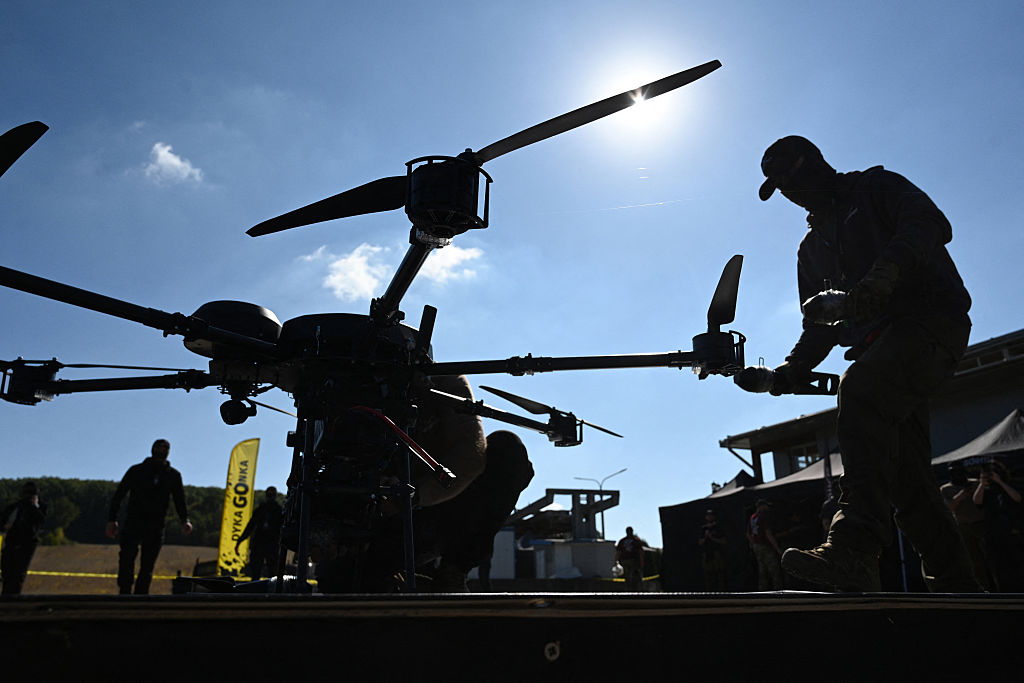
In the early stages of the war, the Ukrainian military’s dependence on the Starlink system even reached the point where “without Starlink support, military operations could not be conducted.” Particularly in drone warfare, Ukraine utilized Starlink terminals to control a large number of drones for reconnaissance and strike operations, fundamentally altering the course of the conflict.
However, this also exposed the vulnerability of the Ukrainian military, as the fate of the front lines could be in the hands of an individual decision maker in a foreign private enterprise.
As early as October 2022, Musk stated that SpaceX could not indefinitely bear the costs of providing Starlink services to Ukraine and requested the US government to take over the related expenses. In June 2023, the Pentagon confirmed signing a contract with SpaceX to cover the costs of providing Starlink services to Ukraine, while Poland assumed part of the Starlink service and terminal equipment costs.
On March 9, 2025, Musk mentioned at a conference that Starlink was the “backbone” of the Ukrainian military, and that if he decided to shut down the service, the entire Ukrainian front line would collapse. These remarks once again raised concerns about private companies controlling critical war resources and responsibilities. Musk opposed using Starlink satellite communication services for deep strikes by Ukraine against targets within Russia. On August 31, 2026, media reports cited three sources stating that Musk still opposed allowing Ukraine to use Starlink for such attacks.
These facts indicate that the role of Starlink in the Ukrainian war has surpassed the scope of general commercial communication services, becoming a crucial issue involving military and government needs. Ukraine has also begun to enhance its own communication infrastructure and cooperation with European allies through various channels to address the problem of excessive reliance on a single private enterprise.
In conclusion, the intervention of these tech giants is no longer solely driven by commercial interests but demonstrates characteristics and influence similar to those of sovereign states. This conflict, with the involvement of technology companies, is rapidly changing the nature of human warfare, where controlling a joystick largely replaces pulling the trigger, and traditional rifles and tanks are becoming as outdated as medieval swordsmanship and cavalry charges in the face of modern technology.