
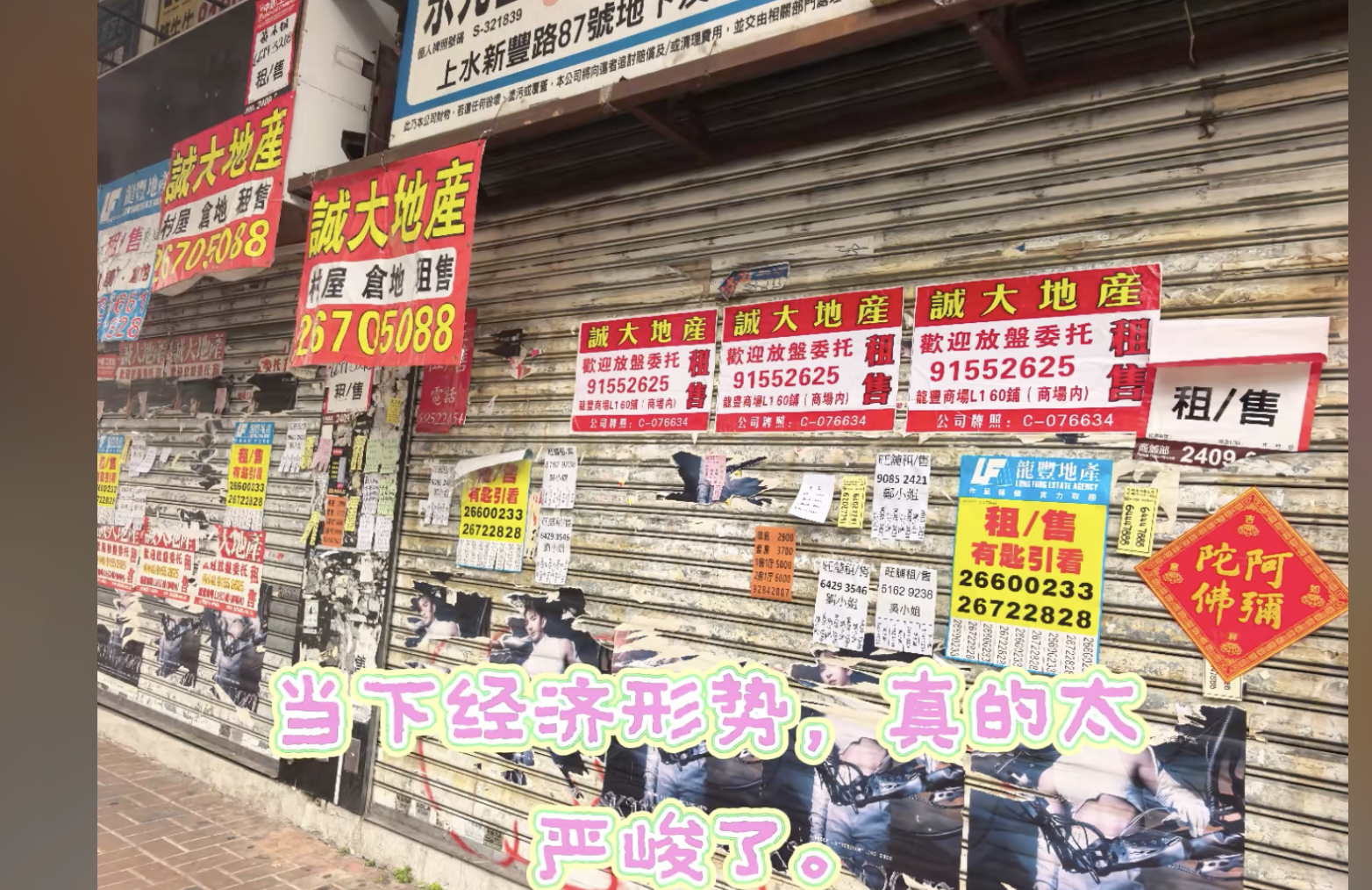
In recent years, Hong Kong has been facing a wave of closures across various industries such as dining and retail. Many long-standing renowned establishments have shut down, leading to a spike in unemployment rates. Meanwhile, for the first time, Hong Kong has officially introduced its first five-year plan, mirroring the Beijing model, which has sparked significant attention.
The recent wave of closures in Hong Kong has been roughly synchronous with mainland China, beginning to manifest and intensify post-pandemic unsealing from around 2023 to 2024 and continuing for about three years now.
In July 2026, the number of compulsory liquidation cases soared to 104, a 35.1% increase year-on-year, reaching a 22-year high for a single month since September 2004, and surpassing the 100 mark for the first time within this period.
The food and beverage industry has been hit hard, with many well-known chain brands and longstanding landmark stores shutting down, such as “Kwong Kee Congee & Noodle” in Yuen Long, “Tai Mo House” in Kowloon City, “Sang Kee Congee Shop” in Quarry Bay, and “Han Court” in Taikoo.
Amidst the recent wave of closures in the Hong Kong dining sector, Pizza-BOX, in operation for 23 years, and “One Bowl of Minced Pork” under Tai Hing Sui Wo, have both closed shop entirely; neighborhood eateries like Ming’s Star Seafood Roast Goose in San Po Kong, Ming’s Star Seafood Restaurant in Kwun Tong, Lam Tin Wonderful Feast Seafood Restaurant, Tsing Yi Village Restaurant, Kwai Fong Dragon Treasure Restaurant, as well as Tsui Garden Restaurant’s Tseung Kwan O branch, under the Maxim’s Group, have also closed one after another.
According to a Legislative Council Research Office report in June, the total revenue of the Hong Kong catering industry in the first quarter of 2026 dropped by 7.2% compared to the same period in 2018, with the most significant decline seen in bars and Chinese restaurants at 28.3% and 27.9%, respectively.
Looking up the data on compulsory liquidation filings: 449 cases in 2020; 493 cases in 2021; 481 cases in 2022; 566 cases in 2023 (up by 17.7% year-on-year); 740 cases in 2024 (a significant increase of 30.7% year-on-year, reaching a new high since 2009); 831 cases in 2025 (a further 12.2% increase year-on-year, setting a record high since 2005); as of the first seven months of 2026, the number has already reached 595 cases.
The retail sector has also experienced a series of disruptions this year. Leading supermarket chain “ParknShop” closed several branches in residential areas within half a year; the flagship store of the British Royal household brand Fortnum & Mason in Tsim Sha Tsui, as well as the iconic “H&M Causeway Bay Flagship Store” in Causeway Bay, have closed down one after another; the century-old Sincere Department Store in Sham Shui Po’s West Kowloon Centre branch closed at the beginning of the year, while the Central branch announced its closure recently; the DFS duty-free store at Sun Arcade in Tsim Sha Tsui, and the well-known Hong Kong chain yoga center “Hotstone Yoga” closed on October 1st.
Restructuring advisory firms like Deloitte and FTI point out that retail, dining, construction, and local tourism remain heavily impacted sectors. These industries share a commonality in their reliance on local consumption. Factors such as Hong Kong residents crossing the border for consumption, mainland Chinese engaging in budget travel to Hong Kong, rising operational costs, and hiring of foreign labor have collectively contributed to this predicament.
Deloitte noted that banks no longer exhibit the same level of patience as before and are aware that selling properties may result in losses. Banks are also facing pressure on capital adequacy ratios, leading many to appoint receivers, recover collateral, and sell off assets. This indicates that future refinancing for companies will become more difficult, forming a vicious cycle.
Many videos circulating on social media reflect the current downturn in Hong Kong. In an August video, a blogger remarked on the significant changes in Hong Kong, expressing a mix of emotions.
Comments from internet users include: “Hong Kong has become just like any ordinary mainland city.” “After visiting, it feels like a rootless city, unable to find any remnants of old Hong Kong, it has become a museum.” “Hong Kong ceased to exist after 2019.” “Century-old foundations perish in a day.”
A Hong Kong blogger mentioned that some people simplistically attribute all of Hong Kong’s woes to residents crossing the border for consumption. However, the reality is that across all tiers of Hong Kong society, from young people in their twenties just beginning their work life, to middle-aged individuals with significant housing loans, to retirees in their fifties and sixties, all have unknowingly joined an unprecedented trend of defensive savings, with everyone looking to save money and carefully manage their expenses.
A Hong Kong local, using the alias Ding Yuan, told a reporter from Epoch Times, “There is less nighttime consumption now, unlike in the past when Hong Kong’s nightlife was vibrant. Hong Kong residents used to eat out frequently, hardly cooking at home, which meant restaurants could sustain themselves.”
“After the ‘Anti-Extradition Law Amendment Bill’ (protests), the government restricted nightlife activities, requiring people to return home by 9 p.m. If you were out later, you would be detained and your identification checked, causing a significant decrease in nighttime foot traffic. This was exacerbated by the pandemic later on,” he said.
In June 2019, the Hong Kong protests erupted following the Anti-Extradition Law Amendment Bill movement, with millions taking to the streets in protest. What began as peaceful demonstrations eventually evolved into large-scale street protests and intense clashes, ultimately ending under authorities’ strong suppression. On June 30, 2020, the Beijing authorities officially implemented the Hong Kong National Security Law.
A Hong Kong local, using the alias Xiao Lan, told a reporter that indeed many Hong Kong businesses have closed down, with local owners unable to continue operations. However, following closures, entrepreneurs from mainland China have quickly taken an interest in these locations and opened new businesses, creating an appearance of vibrancy. “But all the people managing these businesses have changed; they are no longer Hong Kong locals,” she added.
Xiao Lan noted that previously, Hong Kong residents would visit Shenzhen over the weekends due to the cheaper cost of goods, but recently, prices in Shenzhen have become comparable to those in Hong Kong, causing a decline in interest from Hong Kong residents to shop across the border.
She further mentioned that since the implementation of the National Security Law, Hong Kong’s night markets have dwindled in popularity. “During my recent visit to Hong Kong, friends invited me out to dinner at night, and I noticed that nearby tables were not fully occupied as they used to be before. Previously, it was difficult to secure a table due to high demand,” she said.
She observed that a substantial number of middle-class residents have left Hong Kong, including many young adults with children. While the Hong Kong government hoped to attract mainland Chinese visitors for consumption, many arrive on day trips, engaging in budget travel, which has not yielded significant benefits for Hong Kong.
Amidst the changing political environment in Hong Kong, Epoch Times reporters found that many residents were hesitant to speak out or express concerns about the economic impacts.
Hong Kong registered an unemployment rate of 3.7% in the first quarter of this year, which rose to 3.8% in the second quarter, reaching a high point in nearly five months with approximately 153,900 unemployed individuals. The youth unemployment rate surged to 9.1%, more than double the overall unemployment rate and reaching a new high in seven months.
The Hong Kong Census and Statistics Department typically releases the latest data in a rolling three-month window termed the “moving three-month period.” The temporary data covering June to August released by the department on September 17, 2026, already includes the first two months of the third quarter (July and August).
A 36-year-old unemployed single mother, Chun Xiao, from Hong Kong, with two children, informed a reporter that she lost her job in September and has not found employment since. Her previous employer was a local Hong Kong-owned company.
“The state of Hong Kong’s economy is tough right now. People are struggling to make ends meet, and the environment is challenging for everyone. When I worked at the clothing company, my monthly salary was just over ten thousand. The company closed due to poor business,” Chun Xiao shared. She noted the numerous closures of stores and the increase in unemployment. However, she added, “It’s not that I can’t find a job; it’s because I need to take care of my children, so I have to choose suitable job opportunities.”
According to official data, the cumulative number of individual bankruptcy petitions in Hong Kong reached 5,388 this year, with 835 cases recorded in July alone, marking a new high in four months.
Hong Kong’s real Gross Domestic Product (GDP) in the first quarter of 2026 grew by 5.9% year-on-year, followed by a 4.3% increase in the second quarter, totaling an increase of 5.1% in the first half of the year.
On one hand, there’s an increase in GDP growth, while on the other hand, there’s a record high in corporate liquidation cases and rising unemployment. Has Hong Kong’s economy truly recovered?
American economist David Huang analyzed and shared with the Epoch Times that while there’s growth in financial transactions, trade, and corporate business in Hong Kong that can boost GDP numbers, this growth is disconnected from the livelihoods of the common people. “Official records show growth, but regular individuals don’t see corresponding opportunities,” he explained.
YouTube blogger “Finance Teacher Sun” commented that despite the official rise in Hong Kong’s GDP, the actual economic sentiments among the public are dismal. This phenomenon is the result of what is termed as “phantom GDP.”
He noted that the Communist Party of China heavily falsifies data and relies on the construction of infrastructure to boost GDP growth, which does not translate to an increase in income for the regular populace. Hong Kong is slowly heading in this direction, and currently, both China, including Hong Kong, are in an economic downturn due to geopolitical factors. The confrontations between the Communist Party of China and the United States have dragged down Hong Kong as well, leading to a significant loss of premium Western clients and investors, causing rapid economic decline. This market has been stifled by the Communist Party. In the pursuit of boosting surface-level statistics and aligning politically with mainland China, Hong Kong has embarked on the socialist path of a five-year plan.
In September 2026, Hong Kong, once considered a stronghold of capitalism, introduced its first five-year plan, mirroring the Beijing model. This marks a significant shift following the 2019 Anti-Extradition Law Amendment Bill movement and the implementation of the National Security Law in Hong Kong.
Since the 1950s, the Communist Party of China has drawn inspiration from the former Soviet Union model, utilizing five-year plans to outline development goals and social priorities. Following Hong Kong’s sovereignty handover in 1997, boasting an allegedly independent economic and legal system to remain unchanged for 50 years, concerns have been raised externally that the introduction of the first five-year plan might lead to governmental intervention, potentially diminishing the city’s original economic vibrancy and adaptability.
Hong Kong Chief Executive Li Jia-chao claimed to the media the day before unveiling the five-year plan, “The five-year plan is not a planned economy.” He assured that the government would maintain Hong Kong’s capitalist system unchanged.
Huang highlighted that Hong Kong’s transition, aiming to retain financial and market functionalities while aligning these functions under political guidance, depicts a form of “Chinese characteristics of a free market economy.” This differs from mainland China’s “socialist market economy” and departs from Hong Kong’s past emphasis on market autonomy and administrative restraint, leading to inherent contradictions. “The trust upon which an international financial center relies requires stable rules, information flow, and constraints on power. However, increasing political influence seeks to retain more significant intervention space,” he noted.
This model poses a risk of deepening political control as Hong Kong, revered as an international gateway, risks eroding credibility gradually, ultimately maintaining its status as a financial center only while undermining the institutional foundation that supports it.
He mentioned that the introduction of the first five-year plan in Hong Kong has two objectives: to demonstrate loyalty to Beijing from the local government and for Beijing to continue utilizing Hong Kong as an external economic portal while enhancing political control over the region.
Hong Kong Secretary for Education Choi Yuet-lin previously described that young individuals play a vital role in the implementation of the five-year plan, acting as both beneficiaries of development and as builders and successors. However, on social media, some youths have begun discussing ways to leave Hong Kong due to concerns about the measures in the five-year plan. A post circulating social platforms reads, “You may have your five-year plan, but I have my emigration plan.”
Local Hong Kong resident Xiao Lan remarked that the policies set forth in the recent government reports in Hong Kong now align closely with the Chinese Communist Party. “How did it come to this? Though not entirely aligned with the mainland [Chinese Communist Party], it is definitely converging. They are trying to bring mainland [Chinese Communist Party] elements to Hong Kong and package them for international distribution, but the standards of the mainland are simply lacking,” she opined.
Recently, Hong Kong maintained its status as the world’s freest economy in a report by the Fraser Institute in Canada, but with declining scores. The Fraser Institute expressed negative views on the rule of law in Hong Kong and the promulgation of the National Security Law. The report highlighted a significant drop in economic freedom in Hong Kong since 2018; however, it still ranked first in the overall ranking in 2024. This ranking evaluates government size, law and property rights, monetary policies, international trade, and regulations comprehensively.
Huang noted that Hong Kong’s high scores in trade and other areas may continue to keep it at the top, masking the worsening severity of certain aspects. Furthermore, the assessment in the “2026 Annual Report on World Economic Freedom” is based on 2024 data, indicating that the results of this evaluation cannot prove that there are no negative impacts following the introduction of the five-year plan in Hong Kong.