
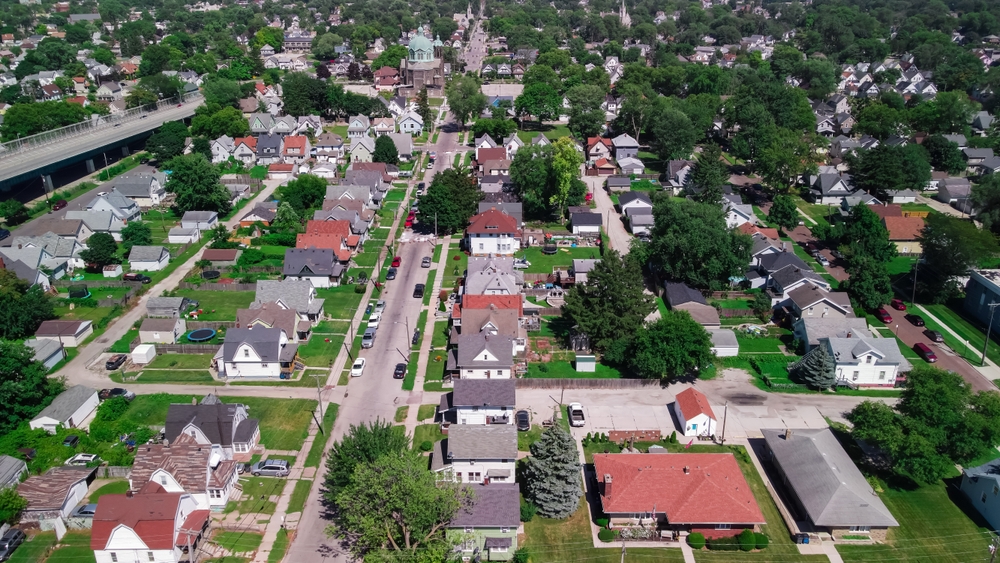
In recent years, housing prices in the United States have been continuously rising, making it increasingly difficult for first-time buyers to find affordable homes. However, according to the latest research released by the real estate website Realtor.com on Thursday (October 8), there are still many relatively inexpensive entry-level homes in some cities across America, with a wider selection in the Midwest.
The study analyzed data on homes for sale in approximately 8,300 postal code areas within the top 100 metropolitan areas in the United States. Homes with listing prices not exceeding 80% of the local median listing price were classified as “entry-level homes.”
In August 2019, the threshold price for entry-level homes in the U.S. was around $260,000, and by August 2026, it had increased to $340,000, marking a 30.8% rise over seven years.
During the same period, the proportion of entry-level homes among all homes for sale decreased from 38.1% to 36.2%, with the decline mainly occurring during the pandemic. By August 2022, this proportion had dropped to 36.3% and remained relatively stable over the next four years.
The types of available homes also changed over time. In 2019, apartments and townhouses accounted for 18.0% of entry-level homes, increasing to 27.1% by 2026. The study estimated that if this housing type maintained the same proportion of overall listings as in 2019, there could be an additional 21,000 entry-level homes available in the current market.
Based on the proportion of entry-level homes among all homes for sale in the area, Toledo, Ohio led the nation with 42.1%, followed by St. Louis, Missouri at 40.7%, Detroit, Michigan at 39.8%, and Akron, Ohio at 39.3%.
Cities like Toledo, St. Louis, and Detroit have seen lower housing price increases compared to the national average since 2019.
However, having a higher percentage of entry-level homes in a city does not necessarily mean that first-time buyers have the same level of choices in all areas. Further comparison of these homes across different postal code areas revealed that Kansas City and St. Louis offer particularly diverse options.
In Kansas City, entry-level homes accounted for 37.7% of all homes for sale, with 39 postal code areas mainly featuring this type of housing. In St. Louis, the proportion was 40.7%, spread across 36 such areas.
In contrast, while Toledo had the highest proportion of entry-level homes in the U.S., only 8 postal code areas were predominantly composed of this housing type, and Akron had 10 such areas.
In another report by Realtor.com on the same day, more specific pricing information was provided. In August of this year, the median listing price for entry-level homes in Kansas City was around $312,000, while in St. Louis, it was approximately $231,000.
Local real estate agents mentioned that in some parts of Kansas City, a budget of $312,000 could afford a home with two to three bedrooms, and some even come with garages. In certain older neighborhoods in the city, smaller vintage detached houses can also be found.
In St. Louis, buyers may find homes that have been partially renovated and are in good structural condition at a lower price. However, if they aim for better school districts, they may need to increase their budget or settle for smaller, simpler homes.
Compared to 2019, Columbia, South Carolina saw the largest drop of 8.3 percentage points in the proportion of entry-level homes, followed by Winston-Salem, North Carolina at 7.5 points, Cape Coral-Fort Myers, Florida at 6.9 points, and Augusta, Georgia at 6.5 points.
Although housing prices in Columbia, Cape Coral, and Augusta have returned to their 2022 levels, the proportion of entry-level homes among local listings has not recovered.
On the other hand, some cities experienced the opposite trend. Compared to 2019, Boise, Idaho saw a 4.7 percentage point increase in entry-level homes, Portland, Oregon saw a 4.0 point increase, Des Moines, Iowa saw a 3.7 point increase, San Jose, California saw a 2.9 point increase, and Denver, Colorado saw a 2.5 point increase.
However, the definition of “entry-level” varies based on each location’s own price levels, so an increase in the proportion does not necessarily mean that homes are cheaper.
The study also analyzed the housing structure in around 8,300 postal code areas. 18.3% of areas primarily consisted of entry-level homes, 20.3% were dominated by trade-up homes, and the remaining 61.4% were considered mixed housing markets.
Homes priced below 80% of the local median listing price were categorized as entry-level homes, while homes priced at least 125% of the median were classified as trade-up homes.
If one housing type accounted for at least 60% of listings in a postal code area, it was categorized accordingly. Areas where neither housing type reached the 60% threshold were classified as mixed markets. Among the top 100 metro areas in the U.S., 81 were identified as mixed housing markets.
The study also found that many entry-level homes were not concentrated in areas dominated by entry-level housing but were spread across mixed markets and even in areas predominantly featuring trade-up homes.
This suggests that first-time buyers should not only compare housing prices across different cities but also explore the variety of options within different areas of the same city.