
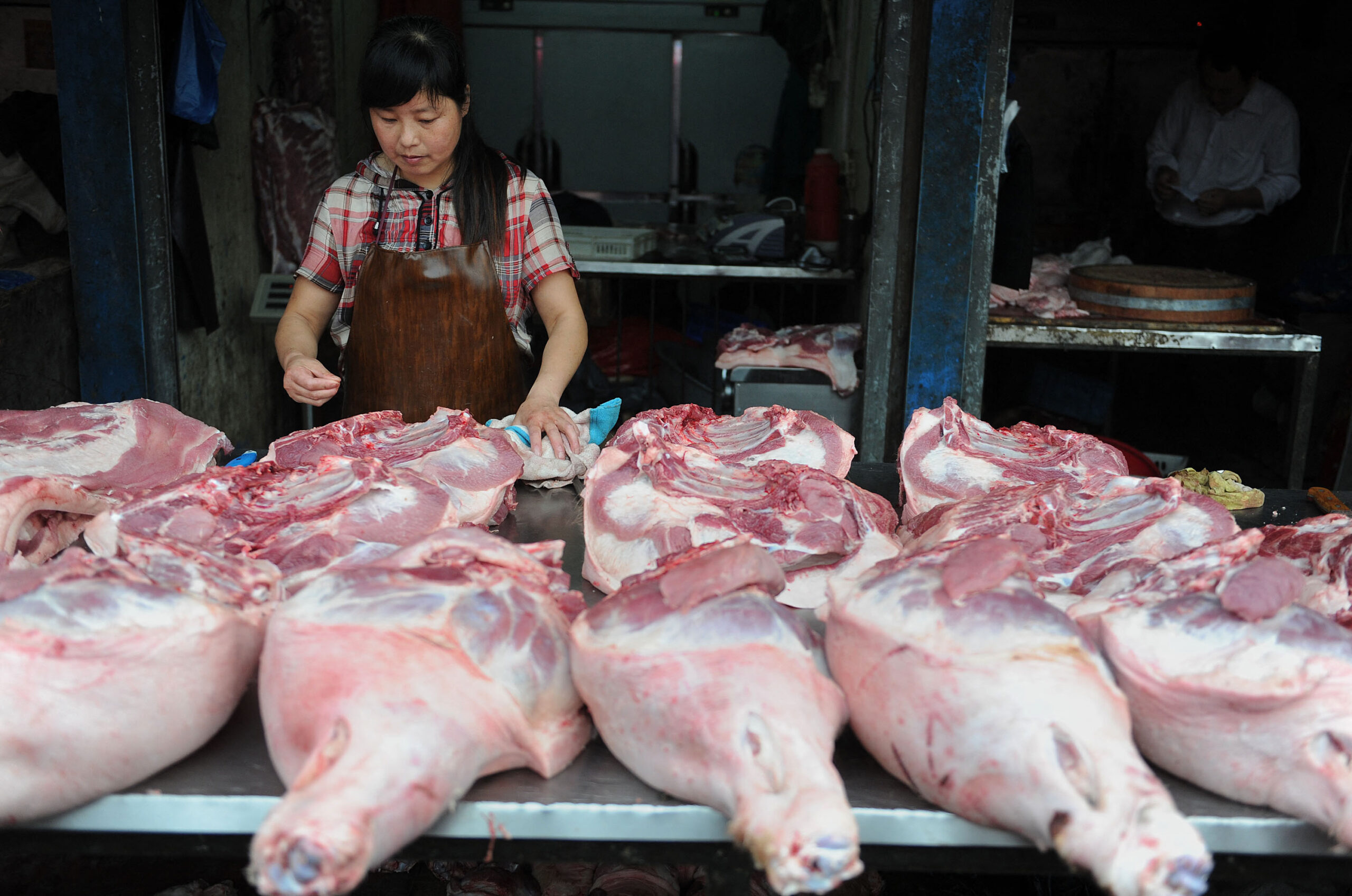
Recently, during the peak sales season of “Golden September” in China, the prices of live pigs have seen a decline both month-on-month and year-on-year, with the price dropping by nearly 10% since the beginning of the month. Industry experts indicate that the live pig market will continue to operate at a low level this year. Some pig farming enterprises have started to use futures to hedge against price fluctuations and risks.
September and October are traditionally considered peak months for commodity sales in China, known as “Golden September and Silver October”. However, this year, September disappointingly did not live up to market expectations, with the anticipated market boom not materializing.
Data from the China Pig Farming Network on September 30th showed that the national average price for live pigs of foreign three-element breed was 10.06 RMB per kilogram, representing a 6.33% decrease compared to the previous period and a 17.81% decrease from the same period last year. The price has dropped by nearly 10% compared to the beginning of the month. In Xinjiang, prices fell to 9.25 RMB per kilogram, hitting a new low. The main contract of live pig futures 2611 experienced a monthly decline of over 9%, with market sentiment remaining pessimistic.
According to an analysis by Zhang Xiaojun, an agricultural products researcher at Green Dahua Futures, the current state of the live pig market is under pressure due to strong supply and weak demand, leading to a continued downward trend in pig prices in September.
Looking at the first three quarters of this year, the price of live pigs in China has shown a consistent downward trend. According to a report by The Paper on October 5th, data from the National Bureau of Statistics of China indicates a gradual decrease in the price of live pigs (foreign three-element breed) from 12.5 RMB per kilogram in early January to around 9.5 RMB per kilogram in September. Despite some fluctuations, the overall trend has been downward. In the second half of the year, as the supply and demand situation for live pigs improved, prices fluctuated. In July, prices saw a small rebound, but by the end of August, they weakened again. During the Mid-Autumn Festival and the National Day holiday, ample market supply continued to pressure pig prices, leading to a further decline in September.
Xu Qingsong, who has conducted market research for several listed pig farming enterprises, stated to Southern Weekend, “Pig prices are currently at a record low in the past twenty years, persisting below 12 RMB per kilogram for a year now, with no indication of improvement.” Xu added that the current industry cost price is around 12 RMB per kilogram, meaning that the industry has been experiencing continuous losses for a year. According to data from Boya Information Consultancy, in the first half of 2026, the average breeding cost of leading pig enterprises in China was around 12.4 RMB per kilogram.
Regarding the future trends of the live pig market, Qu Guona, a pig industry analyst at Shanghai Steel Union, predicts that the price of live pigs in the fourth quarter is expected to show a pattern of “weakening in the beginning and strengthening later, with a mild rise in the center of gravity”. However, the potential for rebound is limited, making it challenging for the industry to restore profitability throughout the quarter. Turning the industry losses around poses significant difficulty, and a genuine trend reversal will require further digestion of production capacity.
Southern Weekend cited an analysis from South China Futures, stating that the confirmation of a market supply turning point would require a more in-depth digestion of production capacity and full clearance of frozen products. The expected time frame for this confirmation may be postponed to the first half of 2027.
As live pig prices continue to decline, pig farming enterprises are facing ongoing losses, with the industry as a whole deeply in the red. The Hua Xia Times reported that in the first half of 2026, out of 22 listed pig companies, 21 were in the red, with total losses exceeding 23.3 billion RMB. Among them, three major companies reported significant losses: Muyuan Co., Ltd. with a loss of 6.078 billion RMB, Wens Foodstuffs Group Co., Ltd. with a loss of 4.366 billion RMB, and New Hope Group with a loss of 1.702 billion RMB – totaling 12.146 billion RMB in losses for the three companies.
Meanwhile, these three major companies are under pressure regarding their cash flow, with their debts remaining at high levels. Half-year reports indicated that in the first half of 2026, Muyuan had a net operating cash flow of -2.224 billion RMB, a rare occurrence in recent years.
An article from Southern Weekend on October 6th revealed that by the first half of 2026, New Hope Group had a monetary fund balance of 7.963 billion RMB, a net operating cash flow of 1.646 billion RMB (a 68.05% decrease compared to the same period last year), total liabilities of 82.681 billion RMB, and an interest coverage ratio dropping from 2 in the same period last year to -0.36 in the first half of this year. This indicator generally represents the multiple of operating income to interest expense. A negative value implies that the company’s earnings are insufficient to cover interest payments. Wind data also revealed that New Hope Group’s asset-liability ratio had surged from 31.66% a decade ago to 70.7% in the first half of 2026.
In response to the deteriorating business conditions, New Hope Group announced plans to use futures linked to its core businesses such as live pigs and soybean meal to hedge against commodity price fluctuations.
On September 28th, New Hope Group issued a public notice regarding the commencement of hedge operations. The announcement stated that the company and its subsidiaries intend to engage in hedging operations with a maximum capital occupation of no more than 3.3 billion RMB (excluding physical delivery payments of futures underlyings) using futures related to the company’s core operations such as live pigs, soybean meal, corn, soybeans, and soybean oil. They also intend to manage interest rate risks through over-the-counter options products. The validity period of the hedging operations will be 12 months from the date of approval by the shareholders’ meeting.
Southern Weekend reported that based on previous announcements, New Hope Group has engaged in five hedge operations since 2013, without disclosing specific amounts, with collateral ranging between 100 million and 800 million RMB, reflecting a minor scale. The current maximum capital occupation of 3.3 billion RMB marks a fourfold increase.
A securities practitioner highlighted that the purpose of corporate hedging operations is not primarily for arbitrage gains but rather to mitigate risks.
Regarding the current state of the live pig market, Jiang Han, a senior researcher at the Pangu Think Tank, believes that everyone in the industry is struggling, and there is reluctance among participants to actively exit on a large scale. With widespread losses in the industry, profitability is nearly non-existent, implying that the market’s bottoming-out phase will continue for a while without an immediate significant rebound.