
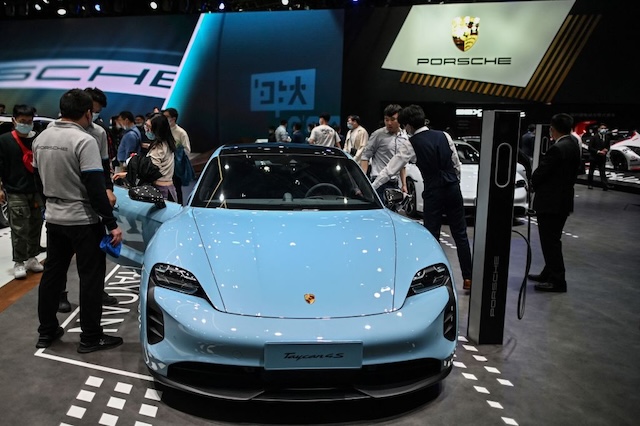
In 2026, the luxury car market in China continues to experience a wave of price cuts, attracting attention as the topic of “luxury car prices plummet” repeatedly trends on the mainland’s social media platforms.
According to Chinese media reports on Tuesday (October 6th), during the “National Day” holiday period, traditional luxury brands such as Porsche, Mercedes-Benz, BMW, Audi, and others have once again significantly reduced prices on multiple car models. For instance, the Porsche Cayenne saw a price drop of over 200,000 yuan (RMB), while the Audi A8 experienced a price reduction of over 300,000 yuan.
Reportedly, a salesperson at a Porsche 4S dealership in Wuhan’s Optics Valley mentioned that the 2026 Cayenne Dream Edition has a base price of 918,000 yuan, with additional optional accessories costing around 100,000 yuan. The full payment offers a discount of 23%, a financing discount of 26%, and some vehicles, inclusive of taxes and insurance, are priced at around 860,000 yuan.
An experienced salesperson of 10 years noted that although it may be challenging to close deals on the rumored “Cayenne drops by 300,000 yuan”, the current discount of over 200,000 yuan is considered unprecedented in recent years, given that from 2020 to 2023, the model generally sold for over 1.2 million yuan.
The report highlighted that another Porsche fuel-powered vehicle, the Macan, also experienced a significant price drop. Certain models have seen price reductions exceeding 200,000 yuan, with final prices ranging from 470,000 to 500,000 yuan. For example, the Macan T with a base price of 628,000 yuan, some units are now available for less than 500,000 yuan, with a 5-year interest-free payment option.
Back in August of this year, the Porsche Panamera hit the hot searches as it broke the news of the official base price falling below 1 million yuan.
The price reductions at Audi also caught attention. During the “National Day” promotion at Wuhan’s Hengxin Handy 4S dealership, the Audi A8L 50 TFSI quattro Luxury model as priced at 898,900 yuan, was discounted to around 580,000 yuan, a reduction of 318,900 yuan; while certain Audi Q3 models, originally priced at 266,800 yuan, are now offered for as low as 149,000 yuan.
Mercedes-Benz and BMW were not left out of the price cuts. Dealers in Wuhan reported that the Mercedes-Benz GLC 260L Classic Edition had a base price of 351,800 yuan, and with financing, can be acquired for less than 300,000 yuan; the E 260L Classic Edition with a base price of 378,800 yuan, has been discounted by around 100,000 yuan, bringing the final price to approximately 310,000 yuan.
As for BMW, the 530Li with a base price of 408,000 yuan now sells for around 320,000 yuan after discounts; the 330Li with a base price of 308,000 yuan is being sold for approximately 230,000 yuan; and the X5, with a base price of 598,000 yuan, is now available at around 500,000 yuan for certain models.
On the other hand, the rapid iteration of new energy vehicles is causing new challenges. According to a report by the French newspaper Le Monde on October 4th, the Chinese new energy vehicle market is facing a new issue: the rapid technological iterations are leading to cars becoming “outdated” quicker.
The report highlighted brands like XPeng and NIO, pointing out that some models, even after just a few years or months on the market, may witness a rapid decline in sales; some models lose market appeal quickly after the introduction of a new version.
The report mentioned that the update cycle for some Chinese new energy vehicle models has shortened to between 12 to 24 months, with some companies even conducting software updates every six months and hardware improvements every quarter.
Consumers are increasingly concerned that the cars they purchase will become “outdated” soon after.
Data cited in the report showed that the car complaint platform 12365auto recorded around 39,000 disputes in 2025, a significant increase from the previous year, with “disputes over new and old models” becoming one of the frequently reported issues. Furthermore, as of June this year, 23 new energy vehicle companies in China are undergoing bankruptcy or liquidation processes, with a total of approximately 850,000 new energy vehicles sold.