
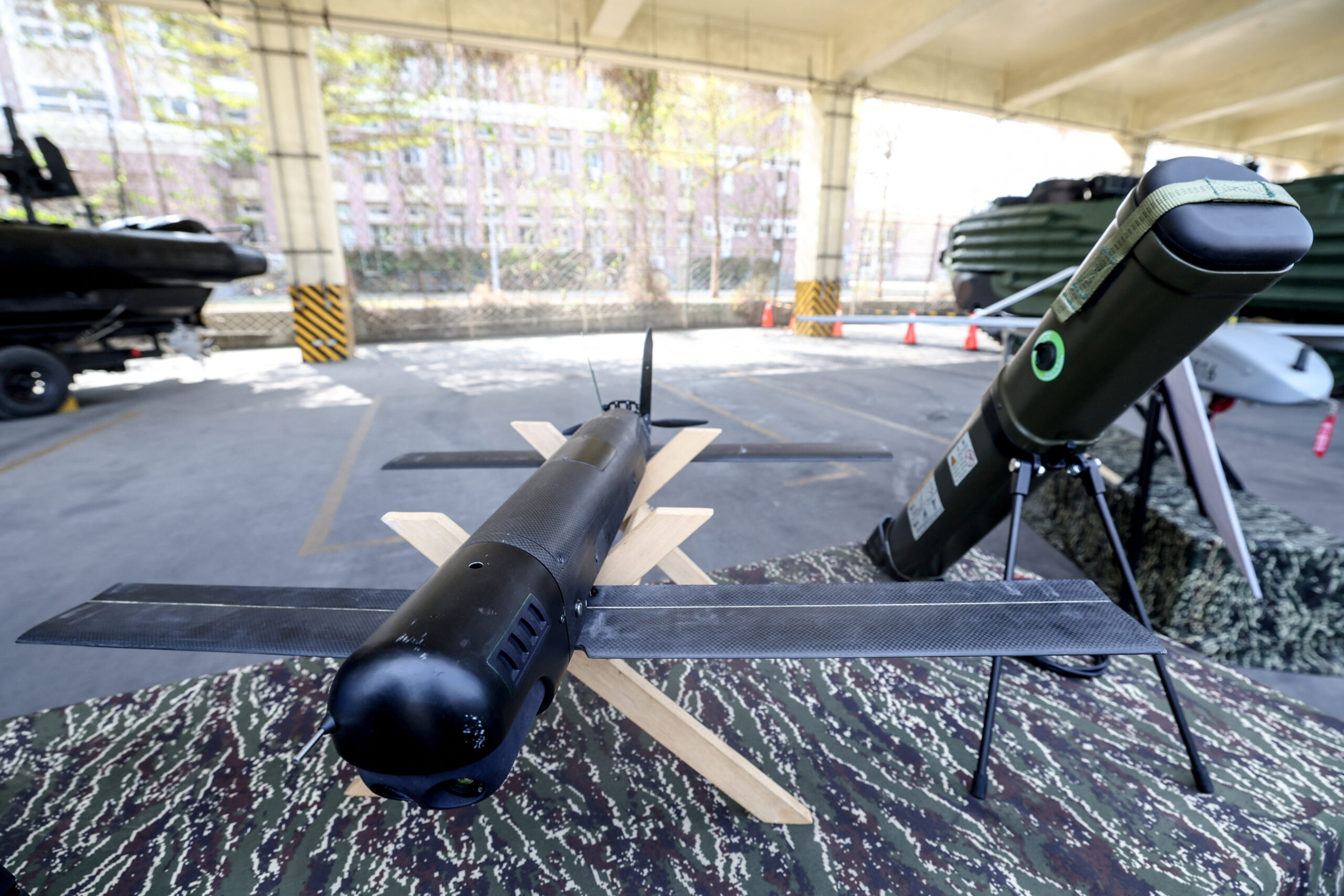
【Epoch Times, October 06, 2026】Taiwan is seeking to build a military “unmanned drone shield,” and two long-standing American drones are expected to become part of Taiwan’s expanding unmanned drone arsenal.
California-based defense technology company Aevex Aerospace is working with Taiwan’s CIRC (中光電智能機器人公司) to locally produce the Vandal and Onyx drones in Taiwan. This collaboration incorporates lessons learned from the conflict in Ukraine along with Taiwan’s electronic and manufacturing capabilities.
Aevex also provides top-notch drones for U.S. Special Operations Forces.
The company stated that both drones to be produced in Taiwan have been tested under real combat conditions in Ukraine, where intense electronic warfare played a crucial role in their development.
The Vandal is the smaller of the two drones, designed for intelligence, surveillance, reconnaissance missions, as well as electronic warfare and precision strikes.
According to Aevex, the Vandal drone can carry an effective payload of 4.5 kilograms (10 pounds) and has a range of over 460 kilometers (286 miles). Its low-observable design aims to counter hostile environments.
The larger Onyx drone can carry a payload of 13.6 kilograms, has a range of over 270 kilometers, and a flight time of up to 2.8 hours. Its modular payload bay can accommodate sensors and equipment for surveillance, target identification, communication, or precision strikes.
Both drones are designed to operate in situations where satellite navigation signals weaken or fail, which could be crucial in Taiwan Strait conflicts where electronic warfare is expected to be heavily used.
Analysts point out that the significance of these drones for Taiwan lies not just in their aerial combat capabilities but also in their practical production methods.
The chairman of CIRC, Wu Xiuhui, expects that with the combination of 3D printing and local production, the monthly production capacity could reach up to 4,000 drones in the future.
She stated that Taiwan will be responsible for developing and supplying flight control systems, edge computing, and payload for locally produced drones, while motors and batteries will also be procured locally in Taiwan.
Lu Deyun, former spokesperson for Taiwan’s Ministry of National Defense, stated that “Aevex-CIRC’s production model could be particularly useful in a conflict, as 3D printing technology allows Taiwan to rapidly manufacture replacement drones without relying entirely on overseas supplies.”
“During wartime, Taiwan can utilize 3D printing technology to rapidly produce thousands or even tens of thousands of drones,” he added.
He also mentioned that containerized 3D printing facilities could be moved between locations for decentralized production, supporting a combination of high-end weapons with a large quantity of cost-effective systems.
According to Aevex, its ForgeX 3D printer also allows for quick modifications of drones based on battlefield requirements.
Lu Deyun further stated that if the Chinese military were to blockade or cut off trans-Pacific supply lines, maintaining the resilience of drone production in Taiwan would become crucial.
This collaboration comes as Taipei pushes to establish Taiwan as a key hub for unmanned systems manufacturing, aiming to build a military “unmanned drone shield,” and hoping it can keep pace with Taiwan’s semiconductor industry to become another strategically significant technology sector.
Beijing regards Taiwan as part of China and is prepared to unify by force if necessary. Most countries, including the United States, do not recognize Taiwan as an independent country with autonomy. However, the United States opposes any unilateral use of force to change the status quo across the Taiwan Strait and has promised to provide weapons to assist Taiwan in self-defense.
Craig Anders, Senior Vice President for Growth at Aevex, said: “Some companies may claim to cooperate with Taiwan, but their real intention is to sell products to Taiwan, which is not our approach.”
“What we are doing is introducing technology to Taiwan and working with partners to apply these technologies locally in Taiwan,” he said.