
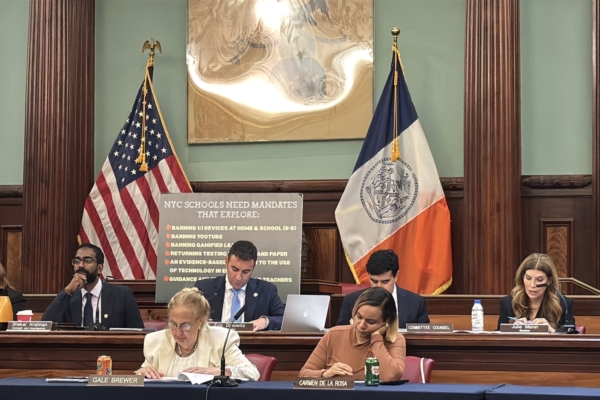
On Tuesday, September 15th, the New York City Council held a public hearing to examine the amount of time high school students in New York City public schools spend on screens and their use of digital devices. The Department of Education stated that they have blocked YouTube on student devices, but videos shared by teachers for specific educational purposes are not affected.
Before the hearing, Chair of the Council’s Committee on Oversight and Investigations Shekar Krishnan and Chair of the Education Committee Eric Dinowitz, along with Council Speaker Julie Menin, Chair of the Technology Committee Jennifer Gutiérrez, Council Member Phil Wong, and other officials gathered in front of City Hall. State senators, parents, educators, and children’s rights advocates were also present.
The council members presented four main requests: to limit the use of YouTube and gamified learning tools in classrooms, reduce one-to-one device usage for young students, and promote a partial return to pen-and-paper exams. Krishnan emphasized that while the new Department of Education policy is a crucial step, clearer city-wide rules need to be established in light of the massive influx of screens and educational technology into classrooms following the pandemic.
The new school year in New York City public schools has imposed strict restrictions on students’ screen usage: from pre-K to second grade, one-to-one screen usage is not allowed; for grades three to five, daily screen time is recommended to be no more than 30 minutes; and for grades six to eight, it should not exceed 45 minutes.
The issues brought about by excessive screen time resonate with many council members who are also parents. Gutiérrez shared that when she tried to limit her 12-year-old child’s screen time at home, the child said, “I need it for homework.” She emphasized that her concern is not against technology but rather about establishing boundaries for use between schools and parents.
Dinowitz, a former special education teacher in New York City public schools, mentioned that over six years ago, the pandemic forced schools to shift to screen-based teaching almost overnight. While students and teachers have now returned to the classrooms, screens have remained. He believes that technology can aid special education students, English language learners, and certain teaching methods, but every tool introduced in the classroom should be backed by evidence. During the hearing, he demanded the Department of Education to provide evidence for a tool, a study supporting the tool, and what professional training teachers received before using it.
Minority Leader of the City Council David Carr described how technology shifted from being a “tool in the classroom” to becoming the “classroom itself” after the pandemic. He urged the Department of Education to track the actual time students spend on screens and to clarify whether digital tools truly enhance learning.
Danielle Giunta, Deputy Director of Education at the Department of Education, stressed that technology should not be the primary teaching method, nor should it be used to keep students busy, entertained, or quiet; digital devices must have clear educational purposes and be teacher-guided.
Exceptions are made for assistive technology required for Individualized Education Programs (IEPs) or 504 plans, as well as for assessment, diagnostic tools, among others. Regarding the “recommended” wording for the 30 and 45-minute limits for grades three to eight, the Department of Education clarified that these standards are “required,” not optional, and have been clearly communicated to district superintendents, principals, and teachers. Currently, as the new school year has just begun, schools are not facing punitive measures but are given time to implement and monitor compliance.
As for pen-and-paper assessments, the Department of Education has mandated schools to use them where possible, but some reading, math assessments, and state exams still need to be conducted digitally. Regarding other requests like gamified learning tools, the Department of Education has not fully adopted them. The availability of empirical support for various educational technologies and how schools will implement the new screen restrictions remain key areas for the Council’s continued oversight.