
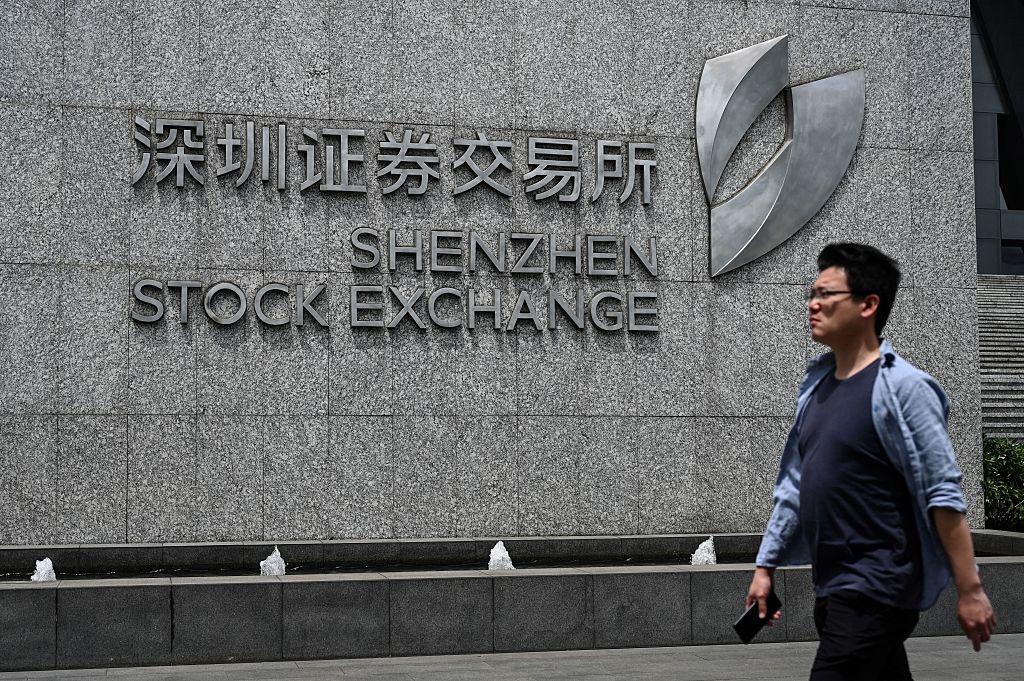
The A-share market continued its downward trend in volatility on September 15. A-shares continued to consolidate on reduced trading volume, with all three major indexes collectively closing lower, and the turnover in the Shanghai and Shenzhen markets hitting a new low for the year.
By the close of trading, the Shanghai Composite Index fell by 0.54% to 3864.28 points, the Shenzhen Component Index dropped by 0.72% to 13287.97 points, and the ChiNext Index decreased by 1.15% to 3247.92 points. The total turnover in the Shanghai and Shenzhen markets amounted to 1.61 trillion yuan.
A total of over 4300 individual stocks in the A-share market declined, with only approximately 1120 stocks posting gains.
The combined turnover in the Shanghai and Shenzhen markets was 1.6127 trillion yuan, a decrease of 16.5 billion yuan from the previous trading day’s 1.6292 trillion yuan, and lower than the record low turnover of 1.6143 trillion yuan on April 7, marking a new low for the year.
According to data from “Securities Times Data Bao,” the net outflow of main funds in the Shanghai and Shenzhen markets was 10.387 billion yuan, with a net outflow of 8.944 billion yuan in the ChiNext market and 9.464 billion yuan in the Shanghai-Shenzhen 300 index.
Galaxy Securities stated that short-term market volatility and differentiation trends may continue, with some concerns already reflected in the pricing of risk assets. To restore investor confidence, further easing of overseas pressures, improvements in domestic policy expectations, and an expanding trend in trading volume need to work together.
Leading up to the 2026 Phoenix Bay Area Financial Forum and the “2026 Phoenix Star” listed company selection event, Li Daxiao, former chief economist of Yingda Securities, pointed out that the current A-share market is in an adjustment phase, showing a clear polarization: on one hand, the large-cap blue-chip stocks will continue to slowly move upward as the focal point; on the other hand, sectors and stocks that had previously undergone significant valuation expansion have entered a phase of volatile adjustment. Li Daxiao cautioned that pressures such as divestment, IPO, and underperforming company earnings are expected to gradually manifest in the future.