
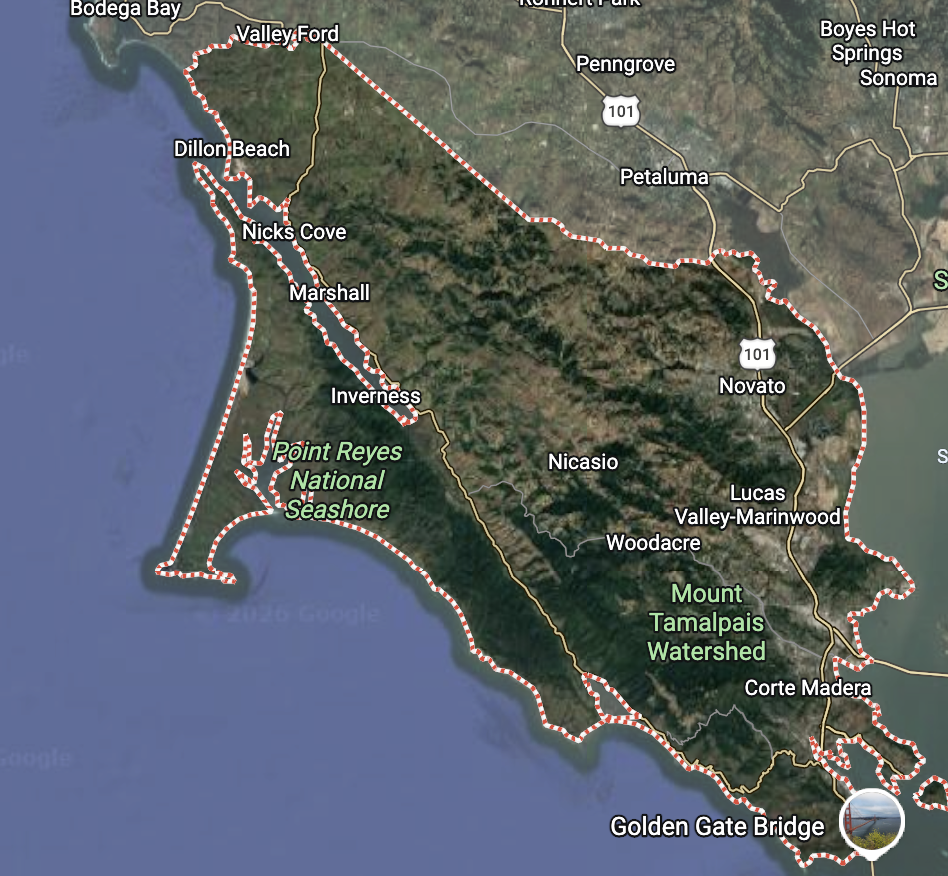
According to the latest data from the Internal Revenue Service (IRS) in the United States, the Bay Area in San Francisco has a high proportion of high-income tax-paying households, with Marin County and Santa Clara County ranking first and second in the nation, respectively.
This analysis by the San Francisco Chronicle is based on IRS tax data for the 2023 tax year (the most recent available data), focusing on counties with over 100,000 tax filings for comparison. The results show that Marin County leads the nation with 28% of households reporting total incomes exceeding $200,000, followed closely by Santa Clara County at 27%. San Mateo County (25%) and San Francisco County (23%) in the Bay Area rank fifth and sixth in the country, respectively.
In comparison, the average percentage of households in California reporting incomes over $200,000 is only 11%, significantly lower than the Bay Area counties. Overall in the United States, the average is just 8%. Among the nine counties in the Bay Area, except for Sonoma County (approximately 11%, on par with California) and Solano County (approximately 9%, below California’s average), the proportion of high-income households in the remaining counties is higher than the state average, with all nine counties surpassing the national average.
It is noteworthy that the income sources of these high-income tax-paying households display significant differences compared to general households. In Marin County, for example, wages only account for 52% of the total reported income in the county, the lowest among the nine Bay Area counties. Meanwhile, capital gains, dividends, and income from partnerships or S-corporations each make up 11%, 7%, and 11% respectively, the highest in the Bay Area.
The analysis in the report points out that these income structure differences to some extent reflect a common characteristic of high-income groups in California and the United States: for households reporting incomes over $200,000, the proportion of capital gains, dividends, and partnership/S-corporation income is usually higher than that of general households.
Partnerships and S-corporations are common tax structures for small business owners, law firms, medical groups, real estate investment groups, and independent consultants. The profits of these entities can be attributed directly to individual shareholders and are taxed at personal tax rates rather than corporate tax rates.
The report also highlights that due to the smaller base of tax filers in Marin County, a few high-income partnership or S-corporation taxpayers may significantly influence the overall ratio of the county.
While Napa County and Sonoma County have relatively lower proportions of high-income tax-paying households in the Bay Area, the percentage of income from partnerships or S-corporations is similarly high. Santa Clara County presents a different profile: wages have the highest proportion in the Bay Area, capital gains are also relatively high, but the proportions of dividends and partnership/S-corporation income are relatively low.
The IRS data, although considered the most accurate way of income statistics based on actual tax filings, is currently only available for 2023 and may not fully reflect the recent wealth growth driven by the AI industry boom in the Bay Area. The actual proportion of high-income tax-paying households may be even higher.