
China’s real estate industry, once seen as the “strongest growth engine,” faced the most thorough administrative suffocation in 2026. With Evergrande Group founder Xu Jiayin sentenced to life imprisonment, the golden era of private real estate development came to an end. The Chinese government once again introduced a new round of real estate policies, including promoting existing home sales and extending mortgage terms in an attempt to revive the market.
Scholars interviewed noted that this crisis was not simply due to corporate greed but was a result of a “high-leverage growth machine” built on land finance, bank credit, pre-sales funds, and household savings, which was forcibly dismantled by the Communist Party as the demographic and urbanization growth neared its peak. To understand its collapse, one must understand how the system created and then punished the balance sheet.
This series of reports is divided into three parts, exploring how China’s real estate industry fell into a debt quagmire, how the era of private real estate enterprises came to an end, and how the middle class was ensnared in debt. These dimensions unravel the final outcome and the political and economic costs of China’s real estate.
China’s real estate: From wealth creator to debt quagmire (Part 1)
The real estate sector was the most active and wealth-generating field for private capital in China over the past twenty years, and the drastic transformation in ownership structure is striking. Contrasting the top ten real estate sales rankings seven years apart reveals the clear trajectory of industry reshuffling.
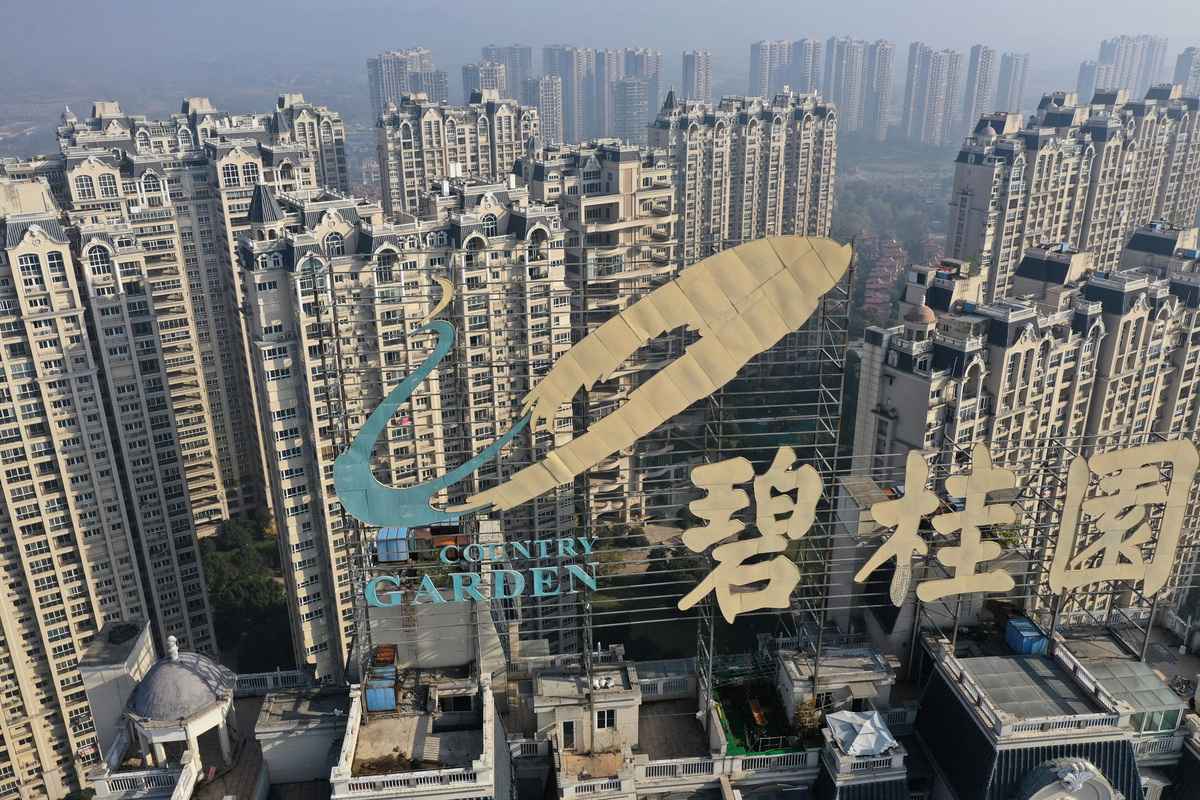
According to the sales rankings released by CRIC in 2019, where the top 10 included 5 private enterprises such as Country Garden (1st, with sales of 771.5 billion yuan) and Evergrande (3rd with 601 billion yuan), followed by Sunac China, New World Development, and Shimao.
However, by January to July 2026, the latest rankings by China Index Research Institute showed that only one private enterprise, Hangzhou’s Binjiang Group (9th), remained in the top 10. The remaining 9 positions were completely replaced by state-owned and central enterprises, including Poly Development (1st, 150 billion yuan), China Overseas Land & Investment, China Resources Land, China Merchants Shekou, Greenland China, China Fortune Land Development, China Jinmao, Yuexiu Property, and Vanke.
The former private quartet of “Country, Garden, Evergrande, and Sunac” saw all but Vanke shifted to state control, with the others dropping out of the top ten due to debt crises.
Taking Country Garden as an example, its default process had a clear timeline. According to reports, in August 7, 2023, Country Garden failed to pay around $225 million in USD bond interest that was due, entering a 30-day grace period. Subsequently, on August 11, Chairman Yang Huiyan and CEO Mo Bin jointly issued a public statement admitting an expected significant loss in the first half of 2023 and underestimating the depth and intensity of the market downturn.
In that month, Country Garden’s equity sales amounted to only 12.1 billion yuan, a 59% year-on-year decrease, which became the crucial turning point from topping the 2019 sales list to facing a debt crisis and ultimately falling out of the 2026 top ten.
Sun Hongbin of Sunac China faced a similar predicament. According to reports, the Hong Kong court accepted a liquidation petition against Sunac from China Sinda Corporation on January 10, 2025, involving $30 million in principal and interest, with the first hearing scheduled for March 19. Sunac’s stock plummeted by 25.7% on that day, with a market value of only about 12 billion Hong Kong dollars remaining.
This was Sunac’s “second crisis” after completing a 90 billion yuan debt restructuring at the end of 2023, indicating that even after restructuring, private real estate enterprises could not escape the risk of liquidation.
Seasoned media figure Mike Li summarized: “In six years, private enterprises have basically been kicked out.”
Li further speculated that the reshaping of the real estate landscape implied a deep-seated political and decision-making transfer within the Communist Party.
On July 4, 2016, Xi Jinping explicitly stated at a national state-owned enterprise reform symposium that state-owned enterprises “must grow stronger and better.” In the 19th Communist Party Congress report in 2017, this was adjusted to “promote the strengthening, improvement, and expansion of state capital.”
In Li’s view, this adjustment meant the policy scope shifted from specific state-owned enterprises to any field where capital can flow. As the largest industry with the most active private capital at the time, real estate naturally became a crucial sample for the policy shift, essentially swallowing the vitality of private enterprises with state-centralized resource control, aiming for absolute resource centralization for the nation.
Simultaneously, there was a structural shift in economic decision-making power within the central leadership. An article published in the March 2025 issue of the British academic journal China Quarterly analyzed that economic decision-making power under Xi Jinping had shifted from the State Council system to the party central.
The article specifically cited the 2016 national state-owned enterprise reform symposium indicating discrepancies between the decision-making layer and Premier Li Keqiang’s consistent advocacy of market-oriented reforms.
A report by the Center for Strategic and International Studies provided further evidence, describing the Central Comprehensive Deepening Reform Commission meetings presided over by Xi Jinping as a “shadow State Council.” The restructuring of the “Central Financial and Economic Leading Group” in 2018 to the “Central Financial and Economic Commission” was seen as a systemic sign of economic decision-making power shifting to the party center.
Li’s analysis revealed an “economic struggle of two lines” within the central leadership: one being the “Li Keqiang line,” leaning towards market-oriented reform and simplification of administration, advocating for “the market to determine resource allocation, the government to oversee and provide social security”; the other being the “Xi Jinping line,” favoring “the state determining industry direction, with the market and capital as tools to achieve national goals,” emphasizing top-level design dominance in resource allocation, and striving to strengthen state-owned economy.
With decision-making authority fully centralized to the party center, the constitutional amendment in March 2018 removing the presidential term limit ensured the long-term policy continuity of “national centralism,” marginalizing Li Keqiang’s market-oriented thinking.
In this grand transformation, it was not only private real estate developers but also the political roles and fates of entrepreneurs that underwent profound changes, as public records documented their path toward compliance under political pressure.
On August 27, 2015, Alibaba’s founder Jack Ma led a team of partners to visit and learn in Yangjiaping, Yan’an. In early June 2018, Tencent’s Pony Ma and JD.com’s Liu Qiangdong visited the revolutionary sacred site of Yan’an in Red Army uniforms. In 2019, the All-China Federation of Industry and Commerce officially established the “National Private Economic Individuals’ Ideological and Moral Education Base” in Yan’an, providing institutionalized training to over 100,000 private entrepreneurs.
By February 17, 2025, Xi Jinping convened a symposium for private enterprises attended by individuals like Jack Ma and Pony Ma, showcasing their absolute political compliance to the public.
According to Li, the fate of private entrepreneurs can be summarized as: “Either end up in prison or lean towards the CCP.”
Economist Davy J. Wong provided deep political economic analysis, stating that the current policy aimed to prevent “uncontrolled capital expansion,” with the underlying logic being: “Capital can exist and profit, but it cannot have independent direction separate from the party and state strategy, nor form independent economic power and rule-making ability.”
The reason why private real estate developers were at the forefront of this political overhaul, as analyzed by Wong, was twofold: First, the massive wealth of private developers did not stem from technological innovation but was heavily reliant on state-owned land, state bank credit, and local relationships – something the top Communist leadership viewed as wealth essentially granted by the state.
Second, the real estate industry concentrated land, finance, local officials, and private wealth, easy forming an independent network of local capital and social influence, posing a potential threat to central authority.
Wong analyzed that it was not merely about the “rich” themselves but whether entrepreneurs began to use wealth to form independent judgments, public reputations, and challenge state regulatory rules. This reform was essentially about enforcing political compliance of private entrepreneurs in the name of preventing uncontrolled capital expansion. As Wong stated: “Capital can be rich, but it can’t be powerful; entrepreneurs can manage, but can’t dictate how the state sets the rules.”
Jack Ma’s experience was a typical example of “challenging regulatory rules.” On October 24, 2020, Ma criticized China’s financial regulatory system at the Bund Financial Summit in Shanghai, likening it to a “pawnshop mentality,” and stating “good innovation is not afraid of supervision, but afraid of yesterday’s supervision.” Subsequently, the People’s Bank of China, China Banking and Insurance Regulatory Commission, China Securities Regulatory Commission, and State Administration of Foreign Exchange on November 2 summoned top executives at Ant Group, a company with a planned dual listing in Shanghai and Hong Kong worth $34.5 billion, announcing its suspension simultaneously.
In contrast, the case of Ren Zhiqiang, former chairman of Beijing Huayuan Group, was more severe. Ren was once the highest-paid executive in a listed company, with nearly 37 million followers on Weibo. In a February 2020 article, he compared the system’s early handling of the epidemic to “the clown who insists on being emperor.”
Ren’s political provocation immediately led to harsh system penalties. He went missing on March 12 of the same year, expelled from the party on July 23, and sentenced to 18 years in prison with a fine of 4.2 million yuan for embezzlement, bribery, and fund misappropriation by the Beijing Second Intermediate People’s Court on September 22. Ren accepted the judgment in court and did not appeal.
Wong bluntly stated that this transformation was both an “economic structural adjustment and a social power restructuring.” It weakened the independence influence of private developers, local capital networks, and wealthy entrepreneurs while greatly reinforcing the central government, state-owned banks, and state capital’s absolute control over national resource distribution, with the cost being the loss of vitality in the entire real economy.