
【Epoch Times September 14, 2026】Audience friends, hello everyone, welcome to watch “The Truth of a Century”.
April 1, 2017, the April Fool’s Day in the West. On this day, the Central Committee of the Communist Party of China and the State Council jointly issued a notice, announcing the establishment of a national-level new area in Hebei Province – Xiong’an New Area. The official statement called it a “millennial plan, a national affair”, and a “historic strategic choice” personally planned, decided, and promoted by Xi Jinping.
Nine years have passed, in March 2026, Xi Jinping visited Xiong’an again. He said to the three members of the Political Bureau Standing Committee, Li Qiang, Cai Qi, and Ding Xuexiang, who accompanied him, “The central government’s decision to build Xiong’an New Area is completely correct.”
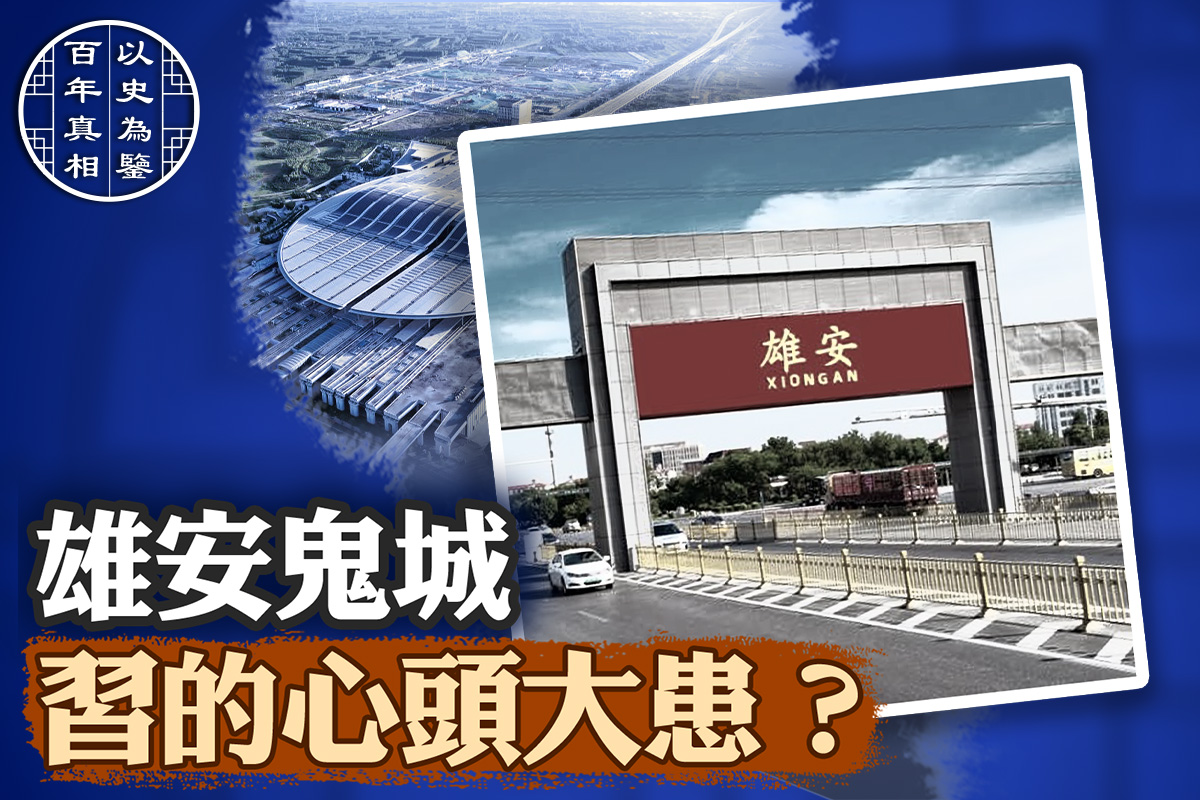
But at the same time he said this, a video circulating on the internet showed the real scene of Xiong’an, with Asia’s largest high-speed railway station deserted, neatly arranged residential buildings resembling toy blocks, and almost no one on the streets. A tourist filmed a video saying, “It’s almost a ghost city, like a place at the end of the world.”
Hundreds of billions of yuan were poured in, but what was obtained was a ghost town. Today, let’s talk about where the problem lies with Xi Jinping’s “millennial plan,” Xiong’an New Area.
The story begins in 2014.
That year, shortly after Xi Jinping took office, he proposed the concept of “collaborative development of Beijing-Tianjin-Hebei.” He wanted to solve a big problem – Beijing was too congested. At the time, the permanent population of Beijing had exceeded 21 million, with traffic congestion, air pollution, and water shortages, exacerbating the so-called “big city sickness.”
According to official statements, it was planned to relocate Beijing’s “non-capital functions” elsewhere. The so-called “non-capital functions,” according to the Beijing Municipal Development and Reform Commission, mainly include four categories: general manufacturing, regional logistics bases, regional wholesale markets, and some educational and medical institutions that are not necessary to remain in the capital. In simple terms, factories, wholesale markets, low-end service industries, in addition to some schools and hospitals that do not have to stay in the capital.
Where to relocate to?
In theory, it should have been Tianjin. A former director of the National Development and Reform Commission once said, “Arranging Tianjin as the deputy center of the capital is the most appropriate, and there is simply no need to arrange Xiong’an as a special zone.” Tianjin is a directly-controlled municipality with complete port, transportation, and industrial infrastructure, and it is close to Beijing.
However, Xi Jinping unexpectedly chose Xiongxian, Rongcheng, and Anxin, under Baoding City in Hebei Province.
Why here? The official explanation is very mysterious, saying: “The Baiyangdian has a beautiful ecological environment,” “the geographic location is just right,” and “the deep historical and cultural heritage.”
However, just by taking a quick look at the map, it becomes apparent that this place has a fatal problem – it is the lowest part of the entire North China Plain.
The average elevation in the Xiongan area is only 7 to 19 meters, while the neighboring Zhuozhou ranges from 20 to 70 meters. Baiyangdian under the jurisdiction of Xiongan is the largest freshwater lake in North China and is a natural flood storage area. In other words, this is a “basin.”
Wang Weiluo, a water conservancy expert in Germany, has written many times that building a metropolitan city on the lowest point of the North China Plain is like carrying a basin of water on top of one’s head. Once there is heavy rain upstream, this city will be submerged.
Then why choose this place?
It is widely believed that there are two reasons behind this. Firstly, this place was originally rural, with cheap land and low relocation costs, making it a good “achievement” for the CCP leaders; secondly, the three counties together have a large enough area for centralized planning, in line with Xi Jinping’s preference for the grandeur of “concentrated efforts to do big things.”
As for scientific evidence, feasibility studies, and public consultations – none were conducted.
Once the establishment of Xiongan New Area was announced, the whole country was abuzz. Official media quickly followed suit, touting it extensively.
“The city of the future,” “model smart city,” “world-class city cluster”… various glittering labels were affixed one after another. At the time, the official news hinted: the total investment would reach 30 trillion yuan.
As soon as the news came out, the real estate speculators in Wenzhou were the first to move. Housing prices around Xiongan skyrocketed overnight, with prices in Xiongxian and Rongcheng soaring from a few thousand yuan per square meter to tens of thousands. Many local farmers sold their land and houses, becoming rich overnight. However, not long after that, the authorities froze transactions and prohibited non-local residents from buying houses – many speculators were trapped and unable to escape to this day.
In the following years, Xiongan entered a phase of large-scale construction. In CCTV footage, cranes stood tall, and construction sites were sprawling, presenting a bustling scene. According to official data, by April 2024, over 670 billion yuan had been invested in more than 380 key projects in Xiongan; by 2026, this number had nearly reached a trillion.
But the money was spent, the city was built, and where are the people?
In April 2024, a netizen personally visited Xiongan and captured shocking scenes. In his video, he said:
“Now taking a stroll on the streets of Xiongan, it’s almost a ghost town. Like a place at the end of the world. Come and take a look, it’s like what the world would look like when everyone is gone, right? It has that kind of feeling.”
“Most of this huge city is empty. But the environmental and landscaping are very well done, the infrastructure is beautiful. I don’t know who footed the bill for this, but it’s quite pitiful. You see, only that one floor on the whole building has two lights on, the rest are empty.”
In October 2025, during China’s National Day vacation, tourist attractions across the country were crowded. But at the same time, Xiongan New Area was still eerily quiet. The grand and spacious high-speed railway station stood empty, and the residential buildings were dark.
In March 2026, after Xi Jinping’s personal inspection of Xiongan, the authorities once again urged relocation work. However, videos from netizens showed Xiongan still being a ghost city, with no signs of vibrancy.
Feng Chongyi, an associate professor at the University of Technology Sydney, aptly remarked:
“Xiongan lacks geographical advantages and favorable timing. So the only reason for its existence is a facade project, Xi Jinping wanted to do a ‘millennial plan,’ and everyone followed him to vie for favor.”
“This is definitely a dead city, with no prospects, no economic foundation, no economic laws. From all the rules of survival, it doesn’t have the essential elements – the right geographical and timing conditions, nor the people and resources.”
In late July 2023, Typhoon “Dusuiren” rapidly moved north from the southeast coast, bringing rare and massive rainfall to the Beijing-Tianjin-Hebei region.
On August 1, when Ni Yuefeng, the Secretary of the Hebei Provincial Party Committee, inspected flood prevention work in Baoding City and Xiongan New Area, he made a statement that sparked public outrage. He said: Hebei must “use flood detention areas in an orderly manner to reduce flood pressure on Beijing and resolutely act as the capital’s moat.”
The three words “capital’s moat” stirred up a national uproar.
What followed confirmed the worst fears of the people.
Late on August 1, Zhuozhou, neighboring Xiongan and having an altitude two to three times higher than Xiongan, suddenly received a flood discharge notice. Before the villagers could react, water had already arrived. A villager tearfully said, “We have evacuated, rescuing more than 100 people today. The water rose very quickly, we cannot bear it. All you hear are the calls for help from disaster-stricken people everywhere… sigh!”
Zhuozhou, a small city with a population of 650,000, was submerged overnight, with water levels reaching up to 12 meters at the deepest point. The entire city suffered water, power, and network outages, bookstores, warehouses, factories, and data centers were submerged.
There are many high-tech companies in the area. According to exclusive internal data obtained by Epoch Times, the losses are estimated at over 53.12 million yuan for the Zhuozhou Wave Big Data Industry Service Base, over 400 million for various projects in the China Shipbuilding Industry Group Zhuozhou Ocean Equipment Technology Industry Park, over 100 million for the China Steel Research Zhuozhou Base, over 200 million for the North New Group Building Materials Co., Ltd. Zhuozhou Branch, and nearly 200 million for the Hebei Zhongjiao International Adhesive Tape Co., Ltd.
The people are not fools.
Soon, a water system map began to circulate on the internet. It is clear from the map: Zhuozhou’s altitude ranges from 20 to 70 meters, while Xiongan’s altitude is only 7 to 19 meters. According to common sense, water flows from high to low ground. If the water is not stopped in Zhuozhou, then the floodwaters will inevitably rush into the downstream Baiyangdian, which is Xiongan New Area.
Cai Xia, a former professor at the Central Party School who has since disconnected from the CCP, angrily wrote on Twitter:
“The flood discharge from Zhuozhou is not to protect Beijing but to protect Xiongan! Facing the threat to over a million lives, they would rather destroy the homes of over a million people, vast tracts of good farmland, to protect that ghost city in the basin! Protecting the substance of the ghost city is actually about saving face, preserving the autocratic throne.”
While Zhuozhou was still submerged, a photo of Ni Yuefeng, the Secretary of the Hebei Provincial Party Committee, wearing leather shoes inspecting Xiongan began circulating on the internet. While the disaster-stricken people were calling for help, his attention was focused on the “millennial plan.”
Xiongan was built, but no one moved in.
As initially planned, this “city of the future” was supposed to take on the “non-capital functions” relocated from Beijing. However, the few who were willing to relocate there were almost none.
The first to budge were second-tier and third-tier subsidiaries of central state-owned enterprises. But this was clearly insufficient. What Xi Jinping wanted was the headquarters of central state-owned enterprises, universities, and top-tier hospitals.
On May 10, 2023, Xi Jinping visited Xiongan for the third time. During a discussion meeting, he unusually got upset and sternly said:
“If you need to move, you must move, regardless of your likes or dislikes!”
“We cannot have ‘paper relocation,’ or backflow in disguise – relocating on paper, but reverting in reality!”
“And even worse, setting up secondary units in Beijing for relocation, increasing them by moving out and replenishing!”
Behind these words, there were soft resistances of major central enterprises against relocation. For instance, China Huadian Group established the “Xiongan Branch” as early as in 2018, meaning: keeping the headquarters in Beijing and sending a branch over as a gesture. China Datang Group did the same by first registering two subsidiaries for appearances.
However, Xi Jinping remained unyielding. What he demanded was to move the “headquarters” altogether – people, assets, and taxes, all to be relocated.
Thus, a large-scale forced migration began.
In September 2024, the first compliant state-owned enterprise, the headquarters building of China Satellite Network Group, was delivered in Xiongan. This company, known as “China’s Starlink,” is a high-tech enterprise ranked 26th by the SASASAC, planning to launch 400 satellites by 2027.
The problem is that the core competitiveness of this company lies in attracting top talents. Relocating it from Beijing to a desolate ghost city is akin to cutting off its future.
Wang Weiluo, a water conservancy scholar in Germany, wrote in Epoch Times: “Including China’s ‘Musk Starlink Company’ in the non-capital functions slated for relocation, is a big joke. For China Star Network not to settle in Beijing but in Xiongan New Area, significantly reduces the company’s attractiveness to the best talent.”
Following suit, China State Power Corporation also yielded. In October 2025, the China State Power Corporation’s headquarters and five subordinate units with over 1000 personnel officially settled in Xiongan. This was followed by the State Grid Group of China, China Huadian Corporation, China National Chemical Corporation, China Minmetals Resources Corporation… a batch of super-large central state-owned enterprises that should never have been defined as “non-capital functions” were forcibly dragged into the low-lying plains of northern China.
According to Wang Weiluo’s analysis, the reason these central enterprises ultimately acquiesced was not because they agreed with the decision, but because “their leadership all had their shortcomings caught by Xi Jinping.”
The cost paid by Beijing was immense. In March 2026, the average transaction price of second-hand houses in Beijing was 38,600 yuan per square meter, a 23% decrease from a year ago. By forcibly driving out young, high-income employees of central enterprises from Beijing, it was like pulling out the pillar supporting Beijing’s property market – a hemorrhagic injury.
The story of Xiongan New Area is actually a very simple one.
It is the story of a paramount leader, by personal will, bypassing scientific arguments, public consultations, and economic laws to pour nearly trillions of gold and silver into building a deserted ghost city at the least suitable place in the North China Plain.
When this city couldn’t be established, he didn’t reflect on the decision itself, but instead used another misguided decision to cover it up – forcing state-owned enterprises, universities, and top-ranked hospitals to relocate, sacrificing Zhuozhou to protect Xiongan, and forcing the entire system to revolve around his “facade project.”
And the most ironic part is that, while Xi Jinping was still emphasizing the correctness of “central decision-making” in Xiongan in March 2026, behind the scenes of Zhongnanhai, there were already signs of a “cooling off.” The official document summarizing the achievements of the 14th Five-Year Plan in 2025 did not include Xiongan New Area as a major achievement – this was a very clear political signal. Behind the scenes, some were already beginning to “cut losses” for this project destined to fail.
In May 2025, the State Council issued regulations prohibiting “image projects” and “achievement projects” in various regions. Netizens began to ask: What about Xiongan New Area?
No one dared to answer this question.
Just standing on the streets of Xiongan in 2026 and looking at those deserted skyscrapers, those office buildings with only two lights lit on the top floor, that supposedly largest high-speed railway station in Asia with scant passengers every day, you will understand:
The CCP’s so-called “millennial plan” is nothing but a monument to the personal will of a tyrant.
When this person is gone, what will this city leave behind?
One must admit, all major policies of the CCP, from the Great Leap Forward to the Three Gorges Project, from the Belt and Road Initiative to Xiongan New Area, have ultimately confirmed an old saying –
“The will of heaven is hard to violate, the hearts of the people cannot be deceived.”
Well, that’s the end of today’s show. Thank you for watching, see you next time.
“The Truth of a Century” Production Team