
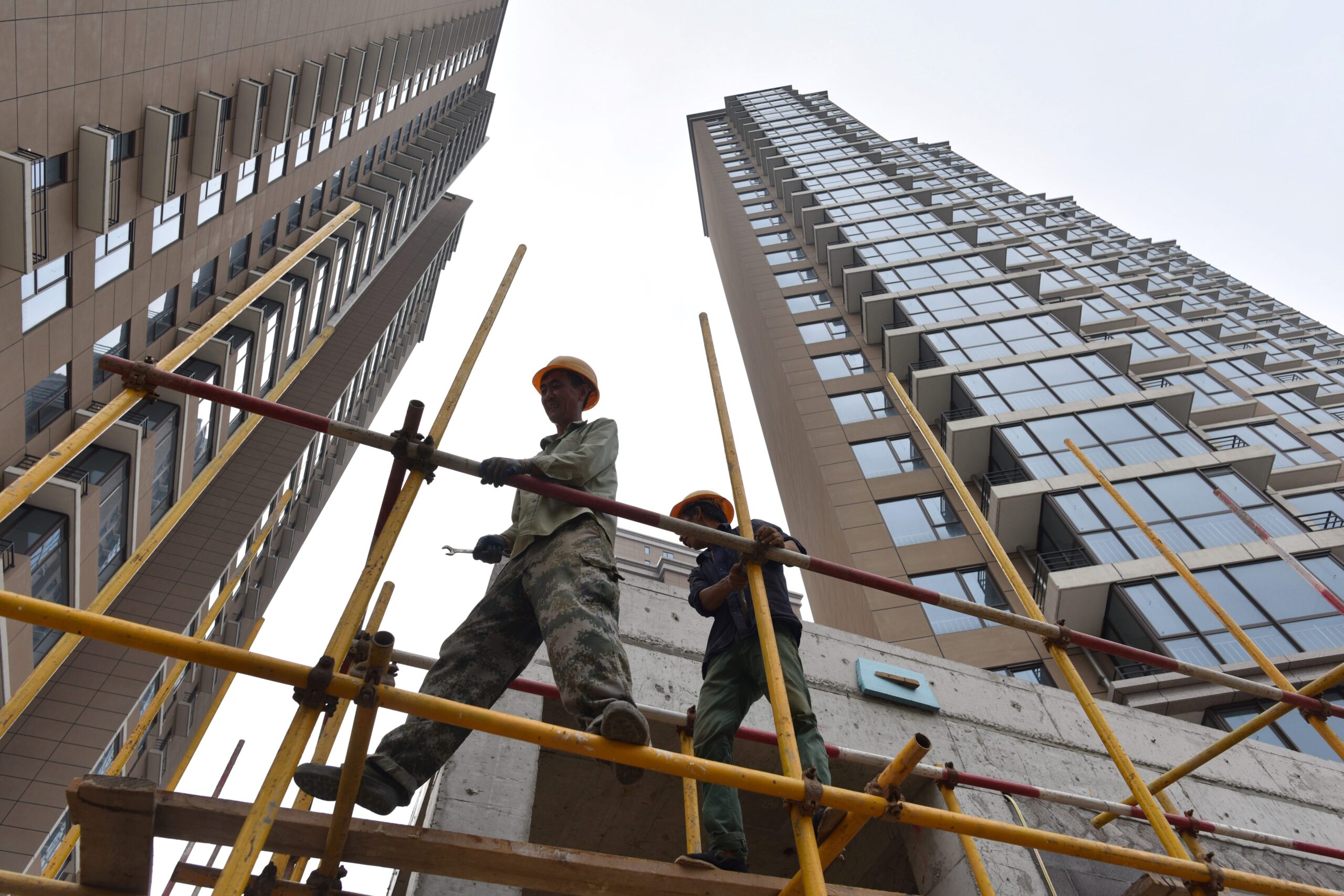
In 2026, the Chinese real estate industry, once seen as the “strongest growth engine,” faced the most thorough administrative suffocation. With the conviction of Hengda Group founder Xu Jiayin to life imprisonment, the golden age of private real estate soared to an end. The Chinese Communist Party once again introduced a new round of real estate policies to boost the market, including promoting existing home sales and extending mortgage terms.
Scholars interviewed noted that this crisis was not simply about corporate greed but a “high-leverage growth machine” built on land finance, bank credit, presale funds, and household savings, which was forcibly severed by the “deleveraging campaign” by the Chinese authorities after the population and urbanization reached a peak. Understanding the collapse of this system requires understanding how the system first created the balance sheet and then punished it.
This series of reports is divided into three parts, decrypting the endgame and political-economic cost of the Chinese real estate market from three dimensions: how did Chinese real estate sink into a debt quagmire? How did the era of private real estate companies come to an end? And how did the middle class become ensnared in debt?
The Chinese financial market experienced tremors again on August 31. The Shanghai and Shenzhen 300 real estate index dropped by 4.7%, while the China Developers Index and the Hang Seng HK Property Index listed in Hong Kong plummeted by 6.2% and 4.8%, respectively. Analysts pointed out that this real estate storm, now entering its sixth year, continues to deal heavy blows to the Chinese economy.
The direct trigger for market panic selling was the new regulatory measures issued by the CCP on the 28th, demanding that presold houses must wait until the “roof structure of the building is completed” before preselling can commence. Buyers’ down payments and mortgage loans must be deposited into designated “supervisory accounts” until the project is completed and passed inspection before being disbursed to developers.
For a long time, the “presale system” has been a dominant force for new home sales in China and a means for developers to recoup funds. Nomura Securities and official data show that in terms of floor area, presold houses accounted for as high as 68% of new home sales in 2025, and presale and mortgage loans together accounted for 40% of real estate developers’ funding sources.
A confidential executive from a development company told Reuters that the new rules mean that 40% of their cash flow is now frozen and cannot be used for business operations, instantly reducing their investment capacity by 40%.
Nomura Securities’ report stated that the new rules cut off the channel through which developers used advance mortgage funds to finance construction, forcing funding during construction solely to rely on developers’ own funds or commercial development loans.
The core of the new regulation, centered around “current house funding,” is essentially an administrative means used by authorities to transfer the credit risks of work stoppages and unfinished projects, leading to a secondary impact on developers’ cash flow, which was already extremely fragile.
Looking back at the policy trajectory of the past decade, American economist Davy J. Wong, who studies the Chinese real estate industry, said that Beijing’s control measures have been oscillating between extremes: in 2015, they launched the “monetization of shantytown renovation” (government compensation for relocated households to buy homes) and significantly relaxed credit, artificially inflating the market bubble. Then in 2020, they swiftly implemented the “three red lines” and centralized mortgage management, abruptly cutting off financing channels.
“This ‘deleveraging campaign’ crammed long-term structural adjustments into a short-term administrative task, directly leading to a chain crisis of developers’ fund chains breaking, widespread defaults, and project shutdowns,” Wong said.
As a result, leading private real estate companies in China, including Hengda, Huaxia Fortune, Jiazhaoye, Rongchuang, Sunac, Tahoe, and Shimao, have successively fallen into crises.
Hengda’s founder Xu Jiayin, once China’s richest man, was sentenced to life in prison on August 20 for fundraising fraud and embezzlement, marking the official collapse of the old model of real estate development known as the “three highs” (high debt, high leverage, high turnover).
The latest official data highlights a stark reality of the industry’s overall contraction. According to China’s National Bureau of Statistics, from January to July 2026, real estate development investment in China decreased by 19.2% year-on-year, a further expansion from the 17.2% decline seen in the entire year of 2025. New housing construction area decreased by a substantial 24%, with residential construction dropping by 24.6%; completed construction area also declined by 23.2% year-on-year. On the sales side, the area and value of new commercial housing sold contracted by 11.8% and 13.1%, respectively, while the funds received by development enterprises declined by 20.3% year-on-year.
Additionally, data from the Ministry of Finance showed that local governments’ revenue from the transfer of state-owned land use rights had plummeted by 30.8% to only 1.1731 trillion yuan.
A Reuters report at the end of August predicted a significant 20% contraction in real estate development investment for the whole of 2026, with sales volume expected to drop by 10%, indicating that the market has yet to stabilize.
Aside from policy intervention, the old development model of Chinese real estate has also encountered an unavoidable “physical limit.”
The International Monetary Fund (IMF) cited scholars’ estimates that in the industry’s peak year of 2021, real estate activities and related downstream demand accounted for approximately 24.4% of China’s gross domestic product (GDP). In the same year, the real estate industry directly employed around 15 million people and was associated with an additional 81.8 million people in the construction sector, supporting nearly 13% of the country’s employment.
However, this heavily land-dependent development model is unsustainable. Official Chinese data shows that as of the end of 2025, the urbanization rate in China had reached 67.89%, a marginal increase of only 0.89 percentage points from the end of 2024, with annual growth rates between 2021 and 2025 consistently below 1 percentage point.
Following the “Northam curve” theory of urbanization development, which suggests that after reaching a critical point of around 60%-70% urbanization rate, urban expansion naturally slows and stabilizes.
Veteran media professional Mike Li told Dajiyuan that the limit on the urbanization rate indicates that China has exhausted the physical space to drive the economy through large-scale urban development and blind expansion, which it relied on in the past.
One such example of blindly building cities is the Kangbashi New City in Ordos, Inner Mongolia, once famous in the media.
According to a NetEase report, the Ordos government started investing 6 billion yuan in 2004 to construct the Kangbashi New City on barren land with only two small villages and fewer than 1,400 residents, setting a goal of accommodating a million people. However, by 2018, the actual population in the area was just over 100,000, far below expectations, leading international media to call the area “ghost city” due to its numerous empty houses and public buildings.
While Kangbashi gradually “recovered” through local coal resources and saw housing prices surpassing ten thousand yuan starting from 2018, its initial resource allocation logic of “build the city first, then attract people” remains a microcosm of the development model in many third- and fourth-tier cities and new districts throughout China.
The collapse of real estate companies is often simplistically attributed to their greed, high debt, and blind expansion. However, according to Wong, the primary reason behind these companies’ rampant borrowing lies in the prolonged systemic suppression of normal equity financing channels.
“In China, real estate has long been prevented from being a sector where normal equity financing is feasible,” Wong analyzed. Historical policy data shows that since 2010, real estate companies’ IPOs, major asset restructuring, and refinancing in the A-share market have been significantly restricted.
The China Securities Regulatory Commission partially relaxed refinancing in 2014, but companies still needed to pass rigorous compliance checks from the Ministry of Land and Resources and the Ministry of Housing and Urban-Rural Development. After 2018, channels for real estate and property-related businesses to access A-share IPOs and increased financing were essentially blocked until partially reopened at the end of 2022 after the crisis erupted.
Wong explained that this institutional arrangement has resulted in a highly asymmetrical structure: on one side, local governments, driven by a need for land revenue, demand high land prices from developers as the entire economy relies on real estate to contribute to public finances and GDP. On the other side, the system restricts developers from bolstering their capital with equity financing methods like stock issuance.
Under pressure from the lack of equity financing channels, real estate developers have been forced toward an extreme reliance on debt financing, including bank loans, trusts, presales, supplier credits, and overseas dollar bonds.
He bluntly stated that this selective capital allocation has forced the real estate industry to seek high-cost funding in shadow banking, making high turnover and high debt the only survival means for private real estate developers and objectively creating extremely fragile balance sheets.
Since the Central Economic Work Conference of the Chinese Communist Party first proposed the policy orientation of “housing is for living, not for speculation” in December 2016, this slogan has become the guiding principle for the development of China’s real estate sector.
However, analysts point out that attributing the real estate fever solely to residents’ speculative behavior involves a cause-and-effect reversal.
“The reason why housing has become the largest investment for Chinese families is not because people naturally love speculation,” Wong emphasized: fundamentally, it is a “defensive asset allocation choice” made by ordinary families in response to inadequate social security, unstable pension expectations, and immense pressures on medical and education expenses.
He explained that under conditions of volatile capital markets, opaque information, and limited overseas investment channels, housing has been forced to bear multiple social security functions, including retirement security, education funding, marriage thresholds, and wealth inheritance simultaneously.
At the same time, Wong further analyzed that behind China’s high property prices lies intense extraction by local governments. At the front end of land development, local governments collect land transfer fees and various development taxes (such as deed taxes, land value increment taxes, and compulsory supporting construction fees) to plug their fiscal deficits. The industry presents characteristics of being “land-focused, development-centered, transaction-oriented, and minimalist in public services,” with local governments failing to establish a stable, prudent, and public service-matching fiscal system.
These exorbitant comprehensive tax costs shifted to enterprises inevitably got capitalized into housing prices and rents, ultimately passing on the burden to end-buyers. Wong criticized this profit distribution structure for not only depriving ordinary families of consumption capacity but also planting the seeds for the collapse of middle-class families’ balance sheets in the future.
In conclusion, Wong pointed out that China’s real estate sector fundamentally operates as a high-leverage growth machine built on land finance, bank loans, presale funds, local governments, and household savings. Understanding the collapse of this system requires understanding how the system first created the balance sheet and then used administrative measures to punish it.
With the enforcement of the new regulations on August 28, Everbright Securities’ report indicated that the new measures placed higher demands on developers in terms of financing and management capabilities. Given the widespread default situation among private real estate firms, financial resources are rapidly shifting toward state-owned-backed developers: the financing costs for state-owned developers remain at around 2% to 3%, while the surviving minority of private developers face financing costs as high as 5% to 6%.
Analysts point out that this asymmetrical financial condition has made banks more particular when issuing development loans, further concentrating funds towards state-owned industry leaders and central enterprises.
Critics like Li believe that the authorities’ hard-line intervention tactics, trying to forcibly steer the economy away from real estate without establishing alternative industrial engines or a robust social safety net, have led to a hasty brake. This approach not only fails to achieve economic transformation but also pulls the entire macroeconomic and employment market into deflation and balance sheet recession.
The death of China’s existing real estate machine is ushering in a fundamental reorganization of ownership structures, while ordinary families and private capital quietly bear the cost of balance sheet shrinkage and wealth evaporation in this monumental transformation.
(To be continued)