
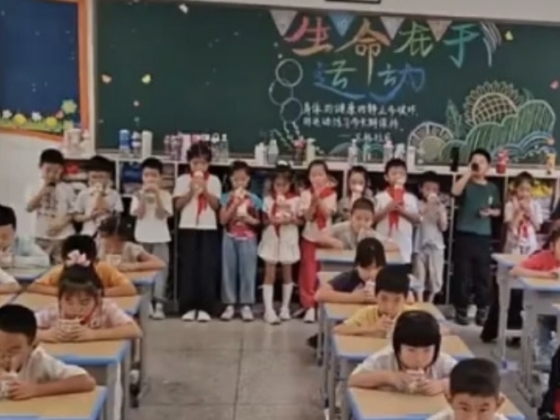
Recent video footage showing students at a school on Kangning Road in Jiangxia District, Wuhan, sitting down to drink milk while those who did not order have to stand at the back to drink water has sparked strong dissatisfaction among parents. In response, the local education bureau has called it a “misunderstanding,” triggering widespread criticism on social media.
According to information from an online platform, the “Student Milk Drinking Program” is a project implemented through cooperation between the Wuhan government and Mengniu Dairy. Jiangxia District was one of the earliest areas in Wuhan to pilot the promotion of student milk. To promote this program, the Jiangxia District Education Bureau even organized school principals to visit the Mengniu factory for inspection. Mengniu is a dairy company under the state-owned enterprise COFCO Group. Some netizens have questioned the possibility of profit-driven issues underlying this partnership.
On September 9, a homeroom teacher of a second-grade class at Kangning Road School in Jiangxia District shared a video in a parents’ group chat, captioning it, “Just finished the third class and the eye care exercises, students collectively drinking student milk.” The video showed over twenty children sitting at their desks drinking the distributed boxed milk, while the remaining ten children stood at the back of the classroom holding their own water cups to drink.
The video led to strong parental discontent, with many questioning why non-subscribers of milk were made to stand, stating, “What kind of education is this? For a little profit, embarrassing children like this is blatant discrimination.” After a parent shared the video online, it quickly gained attention.
As the situation escalated, on September 10, staff from the Jiangxia District Education Bureau responded that it was simply a misunderstanding. They clarified that during the incident, it was the time for dismissal, and the children who did not order milk went to the back of the classroom to retrieve their water cups to drink water, and the school or teachers did not request the children to stand.
The staff also mentioned that the milk subscription at the school was a unified deployment by the district education bureau, requiring all students and parents in the region to “voluntarily subscribe to healthy milk,” and there would be no discrimination based on subscription status.
However, the response from the education bureau failed to quell the controversy and was criticized for being facetious. Netizens expressed their doubt by saying, “Do you take us for fools? Even though I graduated from elementary school over ten years ago and missed subscribing for milk, I have never been forced to stand? Treating netizens and ordinary people as fools, when will you address the problem properly?” Another comment stated, “A light ‘misunderstanding’ cannot cover up the essence of this matter: using consumption to separate children into different groups. The primary mission of education is to safeguard the dignity of children. Discrimination in front of the whole class is damaging the self-esteem of children.”
In light of this, a commentary by The Paper stated that elementary school students are still in the process of mental growth and are especially sensitive to environmental differences. The act of sitting down to drink milk versus standing at the back to drink water creates a division in posture and space, which even without explicit criticism, generates subtle pressure. This undermines the notion of “voluntary,” indirectly guiding parents to subscribe to milk. Additionally, posting a video that features minors and showcases consumption disparities in a parents’ group chat could violate the privacy of children and damage their dignity. The group chat should serve as a communication channel, not a place for exerting pressure.
The report emphasized that “this incident is not just a trivial matter concerning water consumption during breaks but reflects long-standing hidden problems in campus management: some campus services, while verbally emphasizing voluntariness, create pressure through scenes, atmospheres, collective displays, and other means, effectively pushing for forced consumption. Many times there is no direct coercion, but the subliminal implications will still passively influence parents and children.”
The report urged the relevant authorities to thoroughly investigate the incident, clarify the original intentions of the teacher’s arrangements and the purpose of filming the video, and provide a detailed and credible investigation conclusion and resolution.
Nevertheless, the education bureau later changed its stance, acknowledging that the homeroom teacher’s action was inappropriate, the leadership had intervened for investigation and resolution, and emphasized that the school would not force students to subscribe to milk.
However, some netizens pointed out that the initial response claiming a misunderstanding, and then admitting to the teacher’s misconduct afterward, is not a sincere apology but rather a passive crisis PR response after being caught in a lie. This has led the public to suspect the existence of “unmentionable interests” behind the scenes.
Hubei Provincial Government Orders to Promote Mengniu Student Milk
According to an article on NetEase by the self-media account “Near History,” Wuhan’s “Student Milk Drinking Program” was established as early as 2020, through cooperation between the local government and Inner Mongolia Mengniu Dairy (Group) Co., Ltd., creating the largest student milk production base in the country. Jiangxia District was the first area in Wuhan to pilot the promotion of student milk. According to the China Food Safety Network, on December 14 and 22, 2021, the Jiangxia District Education Bureau organized school principals and kindergarten directors to visit Mengniu factories.
In a report by Changjiang Daily in 2023, it was mentioned that the Hubei Provincial Government, from 2020 to 2022, included in its government work reports a commitment to intensify the promotion of the “National Student Milk Drinking Program” for three consecutive years. The Wuhan Municipal Party Committee and Municipal Government issued three documents successively to expand the coverage of Mengniu student milk in Wuhan municipal schools and various districts. According to the plans announced by Hubei Province and Wuhan City, the target coverage rate of student milk in basic education from 2025 to 2028 is set to exceed 85%.
In response to revealing posts by informed parents, the student milk used in Wuhan is considered a “special supply” product without a bar code, making it unavailable on the market; its nutritional value is essentially the same as regular ambient milk on sale in terms of content, but it is one yuan more expensive than regular ambient milk of the same specification on the market (brands like Mengniu, Yili). Supposedly, if it were genuinely voluntary, parents would more than likely not purchase it.
Another netizen disclosed that the Education Bureau pressure school principals, who then pressurize teachers, leading teachers to pressure parents. They mentioned, “Homeroom teachers specifically shoot videos of collective milk drinking and send them to parent groups, clearly creating pressure on families that did not subscribe to milk.”
Information from the official Mengniu website reveals that Inner Mongolia Mengniu Dairy (Group) Co., Ltd. was established in 1999, headquartered in Hohhot, Inner Mongolia. On September 1, 2026, it was reported by Changjiang Net that Mengniu, as the only dairy company under COFCO Group, had established three large factories for ambient, chilled, and fresh milk in Dongxihu District, Wuhan.
The COFCO Group is one of China’s largest state-owned enterprises directly under the Central Committee of the Communist Party of China and the country’s largest grain and oil food enterprise, with absolute control by the State-owned Assets Supervision and Administration Commission of the State Council.