
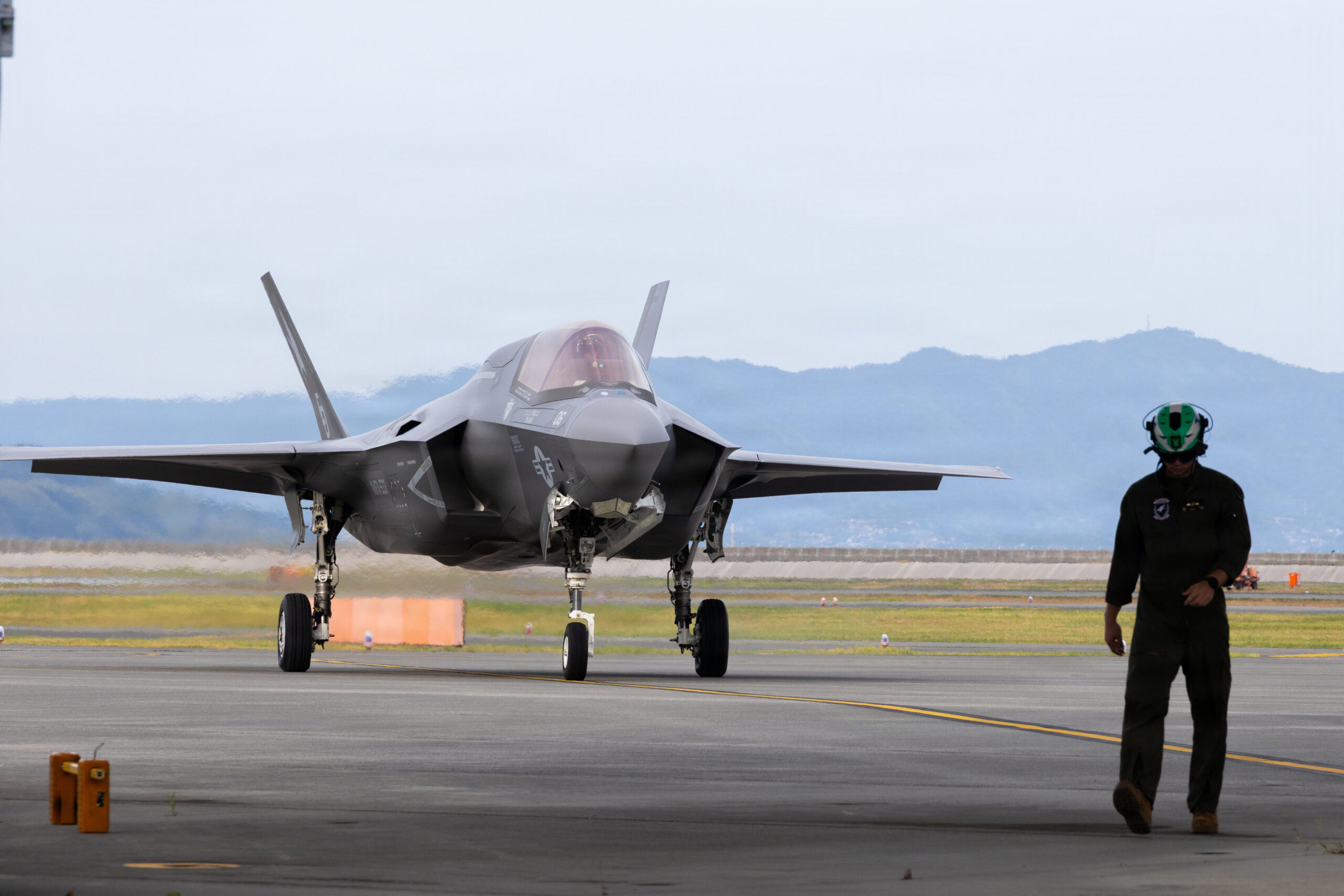
In a recent development, the US Marine Corps has deployed another squadron of F-35B fifth-generation fighter jets to Japan, bolstering the most strategically significant air power of the US military in the Western Pacific and further deterring the People’s Republic of China.
On September 8th, the US Indo-Pacific Command issued a press release stating that on September 5th, in accordance with the Unit Deployment Program (UDP), the US Marine Corps stationed at Marine Corps Air Station Beaufort in South Carolina has deployed the F-35B “Lightning II” squadron, also known as the VMFA-533 “Hawk” squadron, to the Iwakuni Marine Corps Air Station in Japan.
The press release stated that the VMFA-533 squadron will be assigned to the 12th Marine Aircraft Group, a part of the 1st Marine Aircraft Wing, to carry out aviation combat missions in the Indo-Pacific region and maintain readiness.
The F-35B squadron will replace the aging F-18C/D “Hornet” squadron, as part of the military’s regular rotation of deploying air assets to the Pacific region. This deployment reflects the US military’s increasing reliance on the F-35B to carry out operations in Japan’s vicinity to counter China’s military expansion.
The Iwakuni Marine Corps Air Station is the primary advanced operational base for the US Marine Corps to deploy F-35B stealth fighters in the Indo-Pacific region. In the event of a conflict with China, this fixed base could be vulnerable to long-range missile attacks. Therefore, the Marine Corps is expected to utilize the STOVL (Short Takeoff and Vertical Landing) capability of the F-35B to disperse its deployment to smaller, more unpredictable operational locations.
The deployment of F-35B in Japan highlights the evolving balance between survivability and conventional combat performance. As a sensor platform and stealth platform, the F-35B holds great value. Its advanced radar, electronic warfare, and data fusion capabilities extend beyond weapon delivery.
The Iwakuni Marine Corps Air Station has a runway that is shared by the US military, the Japan Maritime Self-Defense Force, and civilian aircraft. The base is also home to the Carrier Air Wing 5 of the US Navy, a key aviation combat force of the USS George Washington aircraft carrier, whose homeport is Yokosuka Naval Base south of Tokyo and is currently deployed in the Middle East.
The Indo-Pacific Command stated that the Unit Deployment Program allows forces stationed in the US to gain operational experience in the region through continuous and overlapping deployments. The “Hawk” squadron will enhance the capabilities of the 1st Marine Aircraft Wing, providing a task-organized aviation force in a state of readiness to operate on naval vessels and expeditionary environments. This enhancement increases combat readiness, promotes regional stability, and demonstrates the enduring commitment of the US to the US-Japan Mutual Cooperation and Security Treaty.
However, the F-35B is currently one of the most expensive fighter jets in production globally, with a unit cost close to 140 million US dollars, which is over 50% higher than the more widely used F-35A model.