
The National Palace Museum in Taiwan showcased the exhibition “Convergence 1950: The Splendor of New Collection” on the 11th, shedding light on the 182 artifacts known as the “Jiangxi Crates” transferred by the Jiangxi Provincial Government’s temporary office in 1950. This exhibition delves into the journey of these artifacts from Jiangxi to Taiwan, culminating in their official donation to the National Palace Museum in 2025.
The opening ceremony of the exhibition “Convergence 1950: The Splendor of New Collection” was held on the 11th, attended by distinguished guests including the Director of the National Palace Museum, Xiao Zong-huang, Chairman of the Yang Ming Culture Foundation, Qiu Zeng-yu, Vice Director of the National Palace Museum, Huang Yong-tai, and Secretary-General Wang Yao-feng, among others.
The National Palace Museum stated that the artifacts from the “Jiangxi Crates” traveled across the sea to Taiwan, temporarily housed in the Beigou warehouse in Wufeng, Taichung, before officially being added to the collection of the National Palace Museum in 2025. This exhibition, revolving around the artifacts, invites the audience to witness the era of Taiwan in the 1950s and reveals a lesser-known aspect of the formation of the National Palace Museum’s collection.
Director Xiao Zong-huang expressed in his speech that the exhibition, as its name suggests, brings together significant collections from various sources. He expressed gratitude to the Yang Ming Culture Foundation for not only donating the model of the “Hai-Lu” ship but also assisting in showcasing the N3 cargo ship involved in the maritime crossing of the Jiangxi Crates, thereby interweaving the stories of maritime history, shipping industry, and the migration of artifacts at the exhibition.
Director Xiao Zong-huang also extended thanks to the National Museum of Taiwan History and Literature for lending artifacts such as the Jiangxi Provincial silver coins, filling in the historical context of the “Jiangxi Crates” coming to Taiwan. Finally, he acknowledged the Ministry of Foreign Affairs for donating relevant artifacts related to the “Zhangzhiguo Case” in 2024 and granting authorization for the usage of diplomatic archive digital images at the exhibition venue.
He mentioned that these artifacts entering the National Palace Museum post-war, along with diplomatic records left by the transfer of ships after the war, vividly portray the historical landscapes of people, items, and vessels traversing in the 1950s.
Chairman Qiu Zeng-yu of the Yang Ming Culture Foundation stated in his address that the pre-war Shanghai vessel of the Yang Ming Shipping Company played a historical role in transporting the National Palace Museum artifacts to Taiwan in 1949. For them, the vessels carried not only goods but also precious cultural assets and the vital mission of preserving culture.
Chairman Qiu Zeng-yu mentioned that the Yang Ming Shipping Company, focusing on maritime transportation, believes that apart from creating economic value, businesses also have a responsibility to preserve social memory and heritage culture. Therefore, they highly value their collaboration with the National Palace Museum.
She expressed that by donating the model of the Hai-Lu ship to the National Palace Museum, through display and research, this history can be preserved for an extended period. She anticipates that the “Hai-Lu” ship will continue to witness history at the National Palace Museum and serve as a bridge connecting maritime transport, culture, and the memories of Taiwan.
The exhibition “Convergence 1950: The Splendor of New Collection” was curated by Assistant Researcher Chung Ya-hsun from the Department of Ceramics, unfolding the story of the Jiangxi Crates through four chapters: “Incorporation: The National Palace in Beigou, 1950,” “Unboxing: The Origin of the Jiangxi Crates,” “Collection of Pearls: Selections from the Jiangxi Crates,” and “Convergence: The Wave of the 1950s.”
Chung Ya-hsun stated that after the artifacts from the Jiangxi Crates arrived in Taiwan, they became one of the first new collection artifacts when the Beigou warehouse in Wufeng, Taichung was opened. Due to the lack of complete records of their origin, the characteristics, craftsmanship, and usage traces of the artifacts became critical in determining their age and region, with some key artifacts displaying the craft styles of the southern region.
Chung Ya-hsun explained that as the artifacts from the Jiangxi Crates have mostly lost their original context, it is challenging to comprehend them through a single narrative. The exhibition carefully selected representative artifacts, encompassing items from the Han Dynasty and various artistic themes spanning different eras, such as auspicious patterns like mythical creatures and a variety of vessels, showcasing diverse aspects.
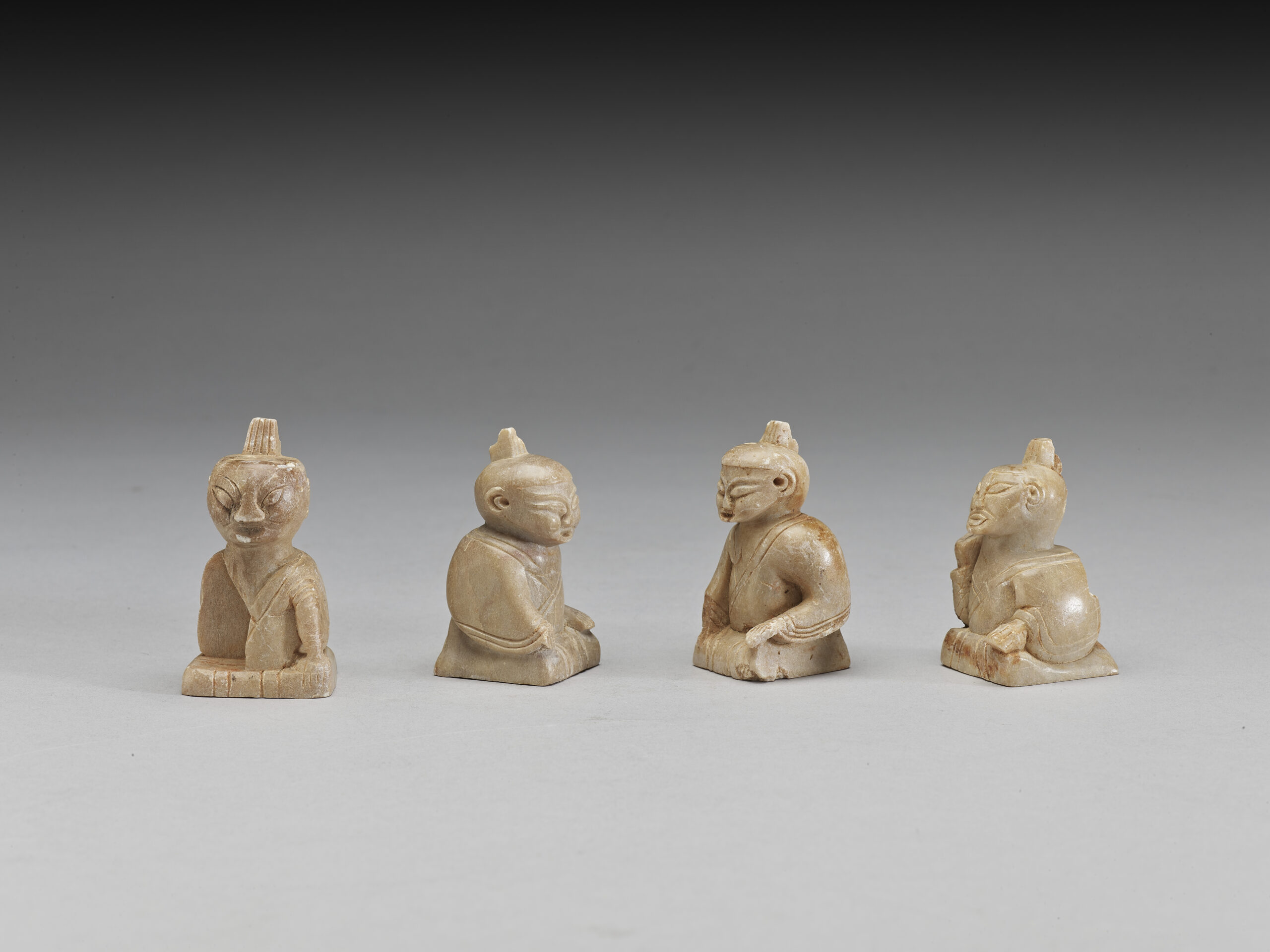
The National Palace Museum elaborated that the “Western Han Dynasty Soapstone Figures” comprised a set of objects popular between the Warring States and Han dynasties, used to secure the corners of bamboo or grass mats known as “seat anchors.” Soapstone, primarily unearthed in the southern regions of China, was preferred due to its soft and carvable texture, often used in creating funerary objects.
“These artifacts not only reflect the burial culture of the Han Dynasty but also exhibit distinct regional characteristics, offering essential clues for studying the artifacts from the Jiangxi Crates,” stated the National Palace Museum.
The National Palace Museum mentioned that the decoration pattern “Boju” on the “New Mang – Early Eastern Han Dynasty Divine Figures and Mythical Animals Mirror” is one of the most common decorative motifs on Han Dynasty bronze mirrors.
“The design of Boju may be related to the popular board game ‘Liu Bo’ at the time. Besides being used for gameplay, Liu Bo boards also served for divination purposes, hence bronze mirrors adorned with Boju patterns often carried protective connotations,” said the National Palace Museum.
Chung Ya-hsun mentioned, “This curation process is much like continuously ‘unboxing’ a series of artifacts. When museums study a collection, they first confront the artifacts themselves. The artifacts from the Jiangxi Crates have been under the care of the National Palace Museum for a long time, and the initial stage of this exhibition mainly focused on professional collection expertise, identifying and dating each item through clues like form, patterns, and craftsmanship to ascertain what they are and from which time period they belong.”
Chung Ya-hsun added that based on this foundation, the curatorial questions expanded further, akin to opening the box a little more: apart from asking “what is this,” they also began to inquire why these artifacts are here. This question led the research from the objects themselves towards their contextual transit.
Chung Ya-hsun explained that through archival research, the pathways gradually emerged on how these artifacts came about, as well as how they moved amidst the turmoil of war. As the route extended from Jiangxi to Shantou and naturally shifted from land to sea: how did they eventually cross the Taiwan Strait?
Therefore, the research traced back to the “Deng Keang” ship, which carried the artifacts from the Jiangxi Crates to Taiwan in 1949. Further investigation revealed that the ship was originally an N3 type cargo ship built during World War II, which then intertwined with the extensive shipbuilding during the war, the transfer of vessels post-war, and the historical reconstruction of maritime transportation after the war.
She highlighted that the scale of the research gradually unfurled—from an individual relic, a collection, to the paths taken and ships used, ultimately revealing how in an era, people and objects set off from different places, transcended land and sea, converged in Taiwan, and formed new connections.