
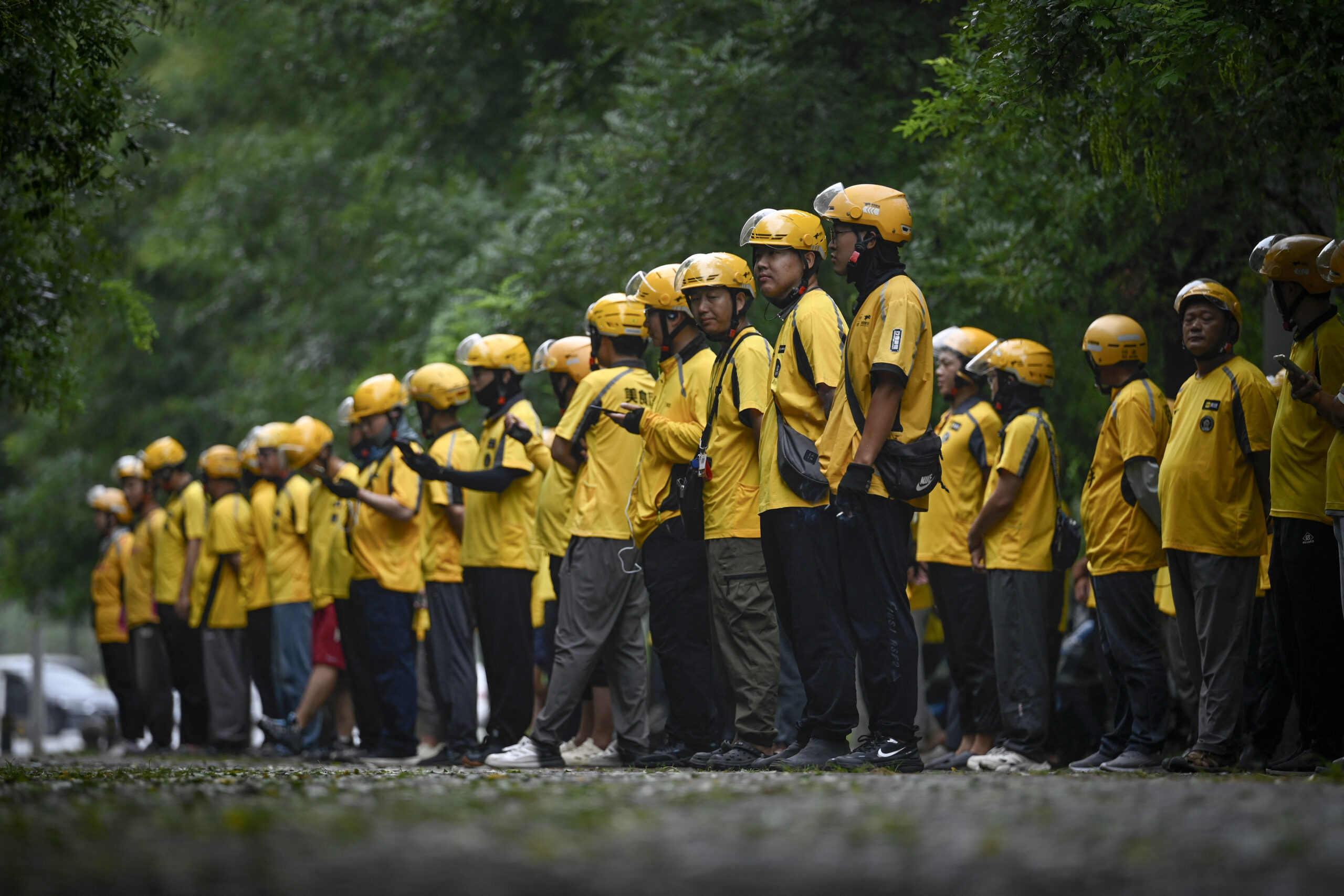
A news report dated September 9, 2026, highlighted the growing crisis of the social security fund deficit in China, prompting the communist authorities to target the flexible employment population. With approximately 300 million flexible workers in China, there has been a lack of social security coverage for them, including old-age and medical insurance. Currently, the Chinese government is adjusting the medical insurance system and aiming to mandate flexible workers to participate and contribute to the insurance fund. Some analysts suggest that instead of protecting flexible workers, this move is seen as a form of deprivation.
In a report by the Chinese state media on September 9th, the National Healthcare Security Administration and six other departments issued a notice on the 8th to launch a special action for flexible workers, migrant workers, and those in new forms of employment to join the medical insurance scheme. The notice aims to explore payment models accommodating the specific characteristics of these groups within approximately three years.
According to the notice, the years of medical insurance contributions for flexible workers and other staff can be accumulated on a monthly basis, with every 12 months equivalent to one year of contribution. It encourages platforms employing flexible workers to adopt a payment method of “individual payment + platform subsidy” for stable workers joining the employee medical insurance scheme. Local governments are also encouraged to include flexible workers in the maternity insurance coverage.
A representative from the National Healthcare Security Administration explained that many flexible workers who work outside their hometowns may inconsistently contribute to the employee medical insurance each year. Therefore, the policy allows for the accumulation of payment years on a monthly basis. Once insured individuals reach the statutory retirement age and fulfill the required payment years, they can enjoy retirement medical benefits. For those who fall short of the required payment years, they must make additional payments based on regional regulations.
In a report titled “2025 China Blue-Collar Employment Research Report” released by the China New Employment Research Center in June, it covered various blue-collar workers, including food delivery drivers, domestic service workers, truck drivers, online streamers, couriers, factory workers, construction workers, cleaners, and security guards.
The report disclosed that in 2025, there were 280 million flexible workers in China, with an estimated increase to 320 million by 2026. Cross-referencing the data from the report with official figures from the National Bureau of Statistics of China, the 320 million flexible workers account for 44.1% of the total employed population, which is 725 million, indicating a significant portion in unstable employment or facing unemployment.
Currently, the Chinese government allows flexible workers to voluntarily enroll in social security programs, including pension and medical insurance. If they opt for employee insurance, without having an employer to share the costs, they must bear the full financial burden of both the employer’s and employee’s contributions.
Political observer Xia Yan remarked that the flexibility in choosing the pension premium base allows flexible workers to select between 60% and 300% of the average wages in the locality. However, the majority tend to opt for the lower end. For instance, in Beijing for the year 2026, the upper and lower limits of the premium base are 36,348 yuan and 7,270 yuan respectively. Calculating the pension insurance rate of 20% (equivalent to 1,454 yuan) and the fixed medical insurance rate of 593.68 yuan, a flexible worker, without any employer help, needs to pay at least 2,047.68 yuan per month. This amount nearly matches the current minimum monthly wage standard of 2,420 yuan in Beijing.
Researcher Nie Riming from the Shanghai Institute of Finance and Law recently expressed concerns in an article, claiming that flexible workers are not genuinely protected by contributing to employee social insurance; instead, it can be seen as deprivation. Under the current system, compelling low-income, highly mobile flexible workers to pay employee social security primarily deducts from their current income rather than providing protection. The payments immediately feed into a system primarily funding the existing retirees’ benefits, making uncertain the returns for contributors in the future. Disparities in medical insurance across regions and retirement payment year requirements further amplify this uncertainty.
Nie Riming emphasized that the deeper issue lies in flexible workers and migrant workers bearing the obligation to pay into urban employee social insurance without enjoying equal citizenship rights over an extended period. Genuine protection should ensure access to medical care, injury compensation, retirement benefits, and basic public services. Without achieving equivalent citizenship treatment to local residents and considering how the social security system still prioritizes stable employment, imposing high employee social insurance contributions on these groups can be perceived more as leveraging their characteristics such as youth, low income, high mobility, and distant benefit collection to supplement the existing payment pool.
Chinese affairs expert Wang He stated that China currently faces a significant unemployment challenge. The government’s move to enforce social security contributions under these circumstances risks exacerbating the chronic deficit of the social security fund, which has depended heavily on substantial fiscal subsidies to sustain operations for over a decade. As the fiscal situation worsens and the budget deficit expands, the sustainability of these subsidies becomes increasingly difficult. Therefore, resorting to social security measures aims to alleviate financial pressures in the short term.