
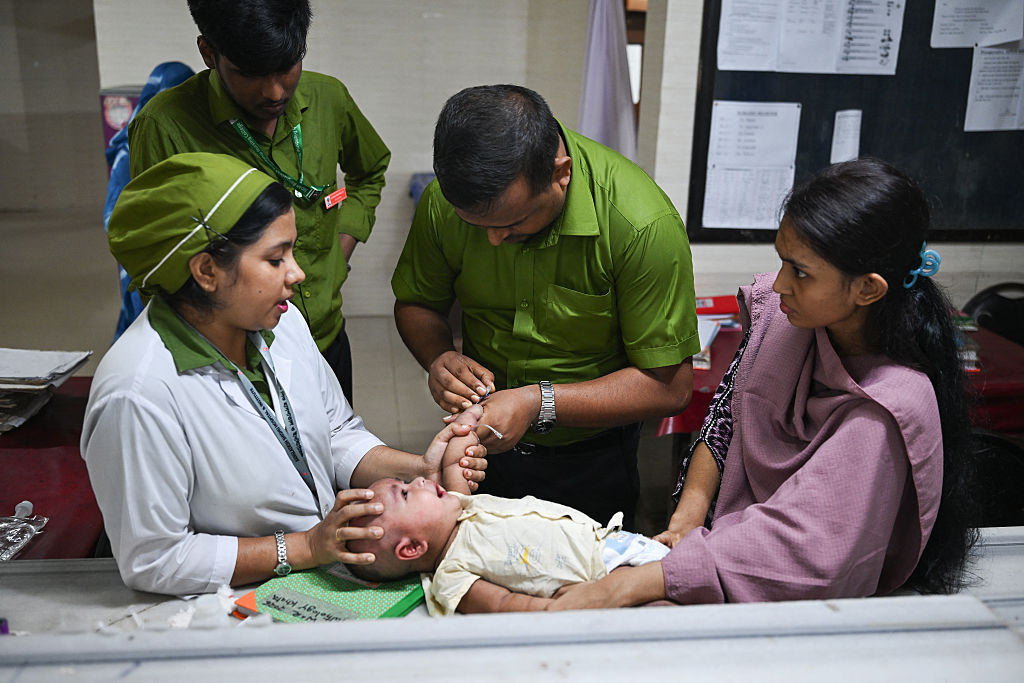
Bangladesh is currently experiencing the largest measles outbreak in the world, with cases and death tolls continuing to rise. According to the Bangladesh Directorate General of Health Services (DGHS) report on September 9, a total of 167,580 suspected cases have been reported in the country since mid-March, out of which 19,904 cases have been confirmed through laboratory tests. The total number of deaths related to suspected and confirmed measles cases has reached 1,002.
The global measles outbreak list compiled by the Centers for Disease Control and Prevention (CDC) in the United States shows that Bangladesh currently has the largest measles outbreak in the world.
Recent data from the Bangladesh Ministry of Health indicated 999 suspected and confirmed measles-related deaths earlier this week. As per a report from the country’s health ministry cited by the English daily newspaper “Daily Sun” on September 9, the death toll has risen to 1,002, out of which 902 were suspected measles-related deaths and 100 were confirmed deaths due to measles.
Over the past decade, Bangladesh has maintained measles vaccination coverage rates at or above the World Health Organization’s (WHO) recommended 95%. According to WHO and official statistics from Bangladesh, the country had been close to achieving measles elimination goals at one point. However, a gap in vaccination coverage emerged in 2024 and 2025, leading to an increase in unprotected children, which experts and health officials point to as a factor contributing to this year’s rapid spread of the outbreak.
Health officials and experts in Bangladesh attribute this current outbreak to various factors, including insufficient management and oversight of vaccination programs, changes in vaccination procurement policies, and disruption of routine immunizations during times of political turmoil, as highlighted by WHO, UNICEF, and other organizations.
Bangladesh’s Health Minister Sardar Md. Sakhawat Husain stated in parliament on Monday that changes in procurement policies had resulted in vaccine shortages. A vaccination program scheduled for 2024 was delayed, and the national measles-rubella vaccination campaign in 2025 was canceled.
This has led to a continued accumulation of unprotected children. According to health ministry data, in the early stages of the outbreak, children under five years old accounted for approximately 80% of cases; infants under nine months old, who had not yet reached the age for routine immunization, were particularly vulnerable.
Former director of the Institute of Epidemiology, Disease Control, and Research (IEDCR) Mahmudur Rahman expressed that the vaccination coverage gaps in 2024 and 2025 had caused Bangladesh to miss the opportunity to eliminate measles, saying, “To my knowledge, we have never had so many measles patients and child deaths in a single year before.”
According to Reuters, Nasima Begum, a 35-year-old domestic worker, saw her 13-month-old son contract measles about two months ago. In a bid to get him admitted, her family visited four different hospitals before finally securing a bed. The child was discharged after ten days of hospitalization but continues to have recurrent fevers and has not fully recovered to date.
The child missed his scheduled vaccination due to illness. Once he was better, Begum took him to a vaccination center again, only to be told that there were no vaccines available. Her other four older children had completed routine vaccinations as per the schedule.
Mohammad Ripon, a factory worker, had his 8-month-old daughter show symptoms suggestive of measles. The family visited several healthcare facilities before finally heading to a hospital specialized in treating measles patients.
With a surge in cases, hospitals began to be overwhelmed. The Shaheed Suhrawardy Medical College Hospital in Dhaka, designed to accommodate 1,350 patients, currently has over 2,350 patients on site. The hospital only has 60 beds allocated for measles patients, resulting in some patients receiving treatment on the floor, and shortages of pediatric saline and other intravenous supplies.
Meanwhile, Bangladesh is also grappling with a dengue fever outbreak. Over 45,000 dengue fever patients have been hospitalized this year. On September 8 alone, 1,571 new dengue fever patients were admitted, with nine fatalities, setting new daily records for the year in both categories. The overlapping epidemics are further straining the healthcare system.
Following the worsening outbreak, Bangladesh launched a nationwide emergency measles-rubella vaccination campaign in April this year, aimed at vaccinating approximately 18 million children under the age of five and six months. Health ministry data indicates that about 19.72 million individuals have been vaccinated so far, exceeding the original target.
Experts believe that the immunization gaps formed earlier still need to be addressed by increasing routine vaccine coverage and conducting catch-up vaccinations for missed children.
For Begum’s family, the outbreak is more than just a string of statistics. Her son missed one vaccination dose due to illness, and by the time he recovered and was taken back for vaccination, the vaccines were no longer available.