
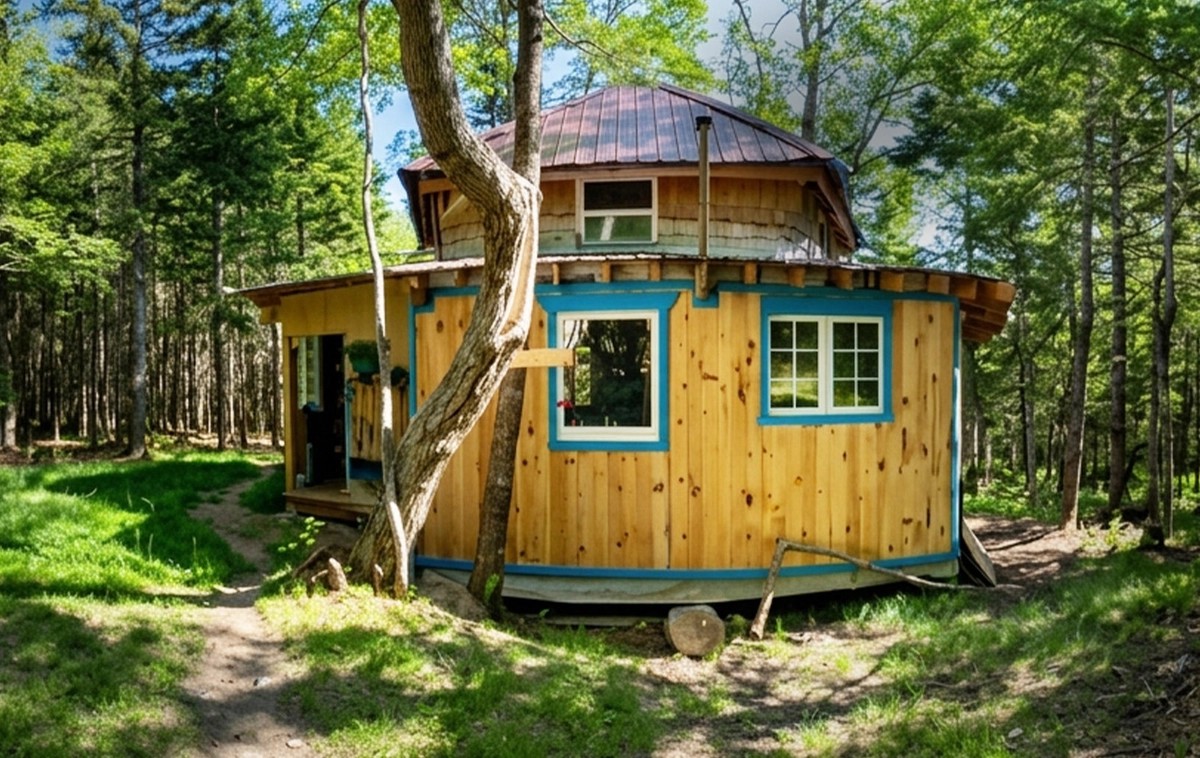
In the current economic environment, buying a dream home is starting to look like just that—a dream—for many people. Ten years ago, Cameron Ringland from Ontario, Canada found himself caught in the all-too-familiar vicious cycle. Working in overseas education in continental Europe and Southeast Asia, he witnessed how out-of-control inflation turned Canada’s real estate market into a potential lifelong trap.
Now 58 years old, Ringland sat down for an interview with The Epoch Times in a cozy apartment near Budapest, Hungary. He and his wife knew they wanted to return to Canada eventually. Ringland vividly recalls telling his wife, “We’re not going back to work five more years just to throw all our money into the traditional ‘rent pit’.”
For Ringland, a former commercial tree planter who spent 20 years planting over a million tree seedlings in Canadian soil, the solution wasn’t to find a better job within the existing system but to completely step out of the endless rat race.
On New Year’s Day 2019, sipping coffee in Da Nang, Vietnam, he found his way out online. Through owner financing, without physically inspecting the site, he purchased a 3.7-acre undeveloped forest-covered land in Cape Breton, Nova Scotia, Canada, bypassing traditional banking institutions by only paying a 10% down payment.
“I realized that as long as you live within a system that relies on public utilities, you’re living in a bubble of illusion. It’s not until the bubble bursts that you realize it was always a bubble,” Ringland from rural Ontario said.
When the COVID-19 pandemic brought the global economy to a standstill in 2020, trapping urban residents indoors, Ringland and his wife were deep in the forest implementing a unique alternative living blueprint. With the local tree planting season canceled due to carpool safety regulations, he methodically repurposed extended seasonal unemployment benefits into full-time house construction funds.
The real obstacle was not the natural environment but the entrenched local bureaucratic system. Richmond County’s municipal building authority rejected his alternative design plans twice. They were highly skeptical of Ringland’s off-grid farmhouse with exterior insulation made entirely of straw bales and framing constructed with logs harvested directly from the site.
“The local inspectors looked at me like I came from Mars,” Ringland joked.
To break the impasse, he devised a tactical compromise plan. He spent $60 to purchase digital architectural design plans from a designer in Bangladesh, hired a local structural engineer to ensure compliance with municipal safety codes, and enlisted a certified local contractor as a consultant, finally getting his third application approved.
In a four-month grueling sprint, the couple stood shoulder to shoulder and erected a 620-square-foot home. The house was supported by six heavy-duty carbonized steel helical piles driven deep below the local frost line.
To avoid the exorbitant $30,000 drilling cost, Ringland utilized the site’s 6% natural slope to direct rainwater captured in a 1,000-liter tank with a gravity-fed pipeline to the interior faucet without needing a pump.
They powered the entire homestead with a 400-watt vertical solar panel array, specially angled to self-clear snow in winter; heating was provided by a complex hybrid fuel system including a sealed wood stove, kerosene stove, and automatic diesel heater. This eliminated recurring utility bills, reducing their housing fixed expenses to only $650 Canadian dollars yearly in property tax.
For a brief period, it seemed like a resounding victory over the entire economic system—mission accomplished. But Ringland quickly realized that behind the freedom lifestyle lay a high physical and mental cost.
On Cedar Drive, the un-serviced road where they built their home, although 17 properties were sold, the Ringlands were the only residents who actually built a dwelling. As the initial romanticism faded, reality began to weigh heavily on them: managing multiple heating systems during continuous sub-zero blizzards, often lasting until the end of April.
Labor was relentless. They constantly repeated the process of moving 8-foot logs, sawing them into suitable sizes, and splitting firewood by hand to keep the stove burning. Their days were mostly consumed by exhausting manual labor.
Apart from this, they also faced severe cultural barriers. The elderly and closed-off rural residents viewed the Ringland couple with faint suspicion, labeling them “CFAs”—”Come From Aways”.
By winter 2025, loneliness crushed their dreams. To ease the physical burden and escape the tense local social atmosphere, they packed up and took temporary consultancy jobs near Budapest, Hungary. They listed their handcrafted homestead for $144,500.
Their experience reads like a bittersweet cautionary tale: the wilderness ultimately prevailed. It proved that one cannot permanently escape the shackles of the modern economic machine if they don’t want to lose human community.
Therefore, in mid-May of this year, Ringland flew back alone to Cape Breton, intending to prepare the house for eventual sale. However, as he crossed the threshold and gazed at the unscathed sanctuary he had built with his own hands under a clear spring sky, his thoughts underwent a radical transformation.
Reflecting on the deep peace brought by their mortgage-free life, Ringland shared, “Everything just exists naturally. There’s a certain tranquility that comes with the off-grid lifestyle. It really alleviates the kind of madness currently engulfing people around money, finances, and bills. For me, it’s a very valuable way of life.”
Ringland did not choose between complete repayment or returning to isolated self-sufficiency. Instead, he creatively restructured his off-grid living model. He withdrew the property from the market, began developing a new road to a lower part of the land, and divided the land into three distinct levels of shared ownership.
Drafting a legally binding contract with the help of professional cohabitation legal advisors, this pioneer is transitioning from a survivalist to a community cartel organizer. He offers shares to like-minded individuals at $50,000, one-third of the property’s total appraised value.
In this new model, new partners receive fair ownership rights to the land and a pre-cleared building site to construct their own off-grid sanctuary. During construction, they can even temporarily use the Ringlands’ existing slide-in truck camper.
This decentralized strategy ingeniously solves two practical problems. The initial down payment will provide the Ringland couple with the necessary funds to purchase a second home on the coast of Sicily for less than $85,000 due to the changing demographics and abandoned historic buildings. Meanwhile, they have established a mini commune in Canada where the physically demanding off-grid lifestyle burdens will be shared by a trusted community partner upon their return each spring.
For Ringland, comfortably staying in his Budapest adjacent apartment while his wife fulfills teaching contracts, it’s no longer just about financial considerations but personal emotional connections.
With a deep sense of peace brought by their mortgage-free living, Ringland shared, “Everything just exists naturally. There’s a certain tranquility that comes with the off-grid lifestyle. It really alleviates the kind of madness currently engulfing people around money, finances, and bills. For me, it’s a very valuable way of life.”