
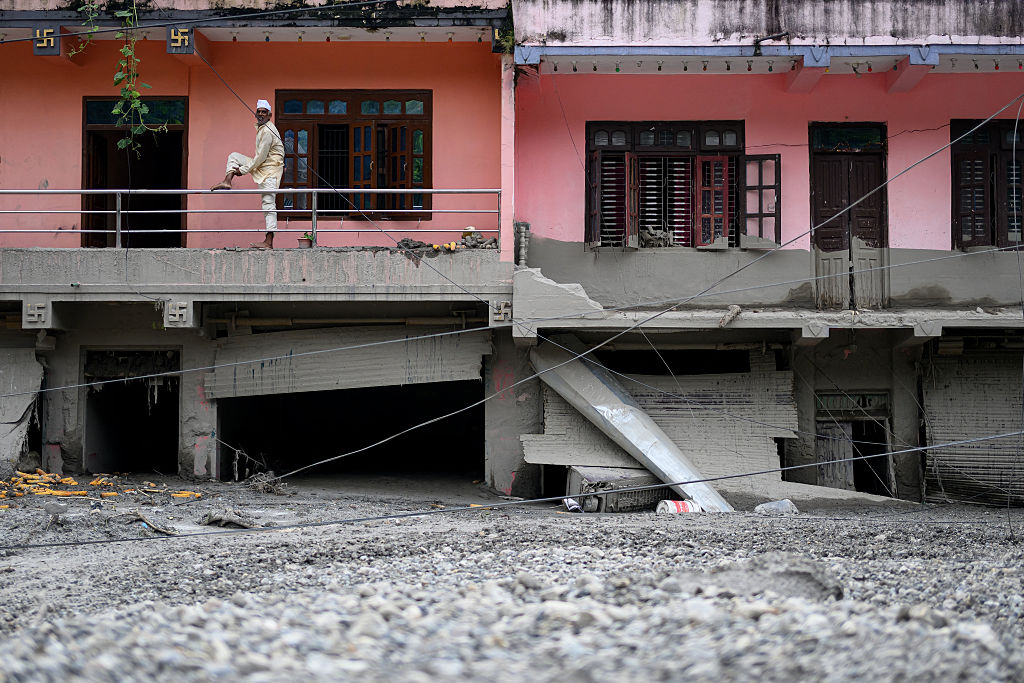
Two days after a mudslide occurred at the Gyirong Port in Tibet, mainland China’s official media only announced that the first batch of professional rescue teams had arrived at the core location of the national gate, but has not yet made public the detailed list of over 500 missing persons or the results of the search in the core area. According to political analyst Chen Pokong based in the United States, in an interview with Epoch Times, there are suspicions of propaganda and falsifications in the Chinese Communist Party’s (CCP) rescue efforts, with information about the disaster on the Tibetan side still tightly controlled.
On August 27th, mainland China’s official media announced in the afternoon that Premier Li Keqiang had arrived at the mudslide disaster area in Gyirong County, Tibet. At the time of the interview with Epoch Times, Chen Pokong pointed out that there were no photos or videos released by the official media of Li Keqiang in the disaster area.
Chen Pokong questioned whether Li Keqiang actually entered the affected area. He mentioned that in the past when Chinese premiers visited disaster areas, the official media would usually quickly release images of inspections and condolences; however, this time, there was initially only a text message, and Li Keqiang attended a CCP Politburo meeting in Beijing on the 28th.
“This time there are no photos, no videos as evidence.” Chen Pokong stated, not ruling out the possibility that Li Keqiang did not enter the most severely affected area of the disaster. The official side only released the news of his arrival to show concern for the victims.
On the afternoon of the 28th, Xinhua News Agency released two photos of Li Keqiang in Gyirong County, captioned as Li Keqiang “personally inspecting the disaster” and visiting relocation sites, both said to be taken on the 27th. At the time of the interview, Chen Pokong had not seen these photos.
The photos were all released by Xinhua News Agency, with no evidence of Li Keqiang entering the most severely affected Gyirong Port area.
Chen Pokong believed that it is still questionable whether CCP leaders truly entered the core disaster area. He said, “The CCP often does many things as a show.”
The mudslide at the China-Nepal border hit Gyirong Port on the morning of August 26th, local time. After the disaster, professional rescue teams were delayed in reaching the national gate area. Mainland China’s official media attributed the slow progress of the rescue to the destruction of roads leading to the port, narrow river valleys, steep terrain, and a higher risk of secondary disasters.
As of the morning of the 27th, mainland China’s official announced that only two villagers from Hexuo Village were rescued. The figures released at that time were 3 dead and 558 missing persons, with no public list of the deceased or missing.
On the morning of the 28th, due to the overflow of an upstream barrier lake and the possibility of new floods, all Chinese rescue personnel and vehicles were temporarily evacuated to a safe area; search and rescue operations on the Nepalese side were suspended for about 3 hours. After the risk subsided, operations resumed on both sides.
Mainland China’s official media reported on the evening of the 28th that the first professional team to arrive at the “core rescue location” at Gyirong Port did not arrive until 4:30 pm that day, more than two days after the mudslide occurred. This team consisted of 21 firefighters and a search and rescue dog.
The official media stated that after the first professional team arrived, they only conducted surface area searches with artificial methods and search dogs, but did not specify whether they found any missing persons or discovered any bodies. Xinhua News Agency later stated that around 6 pm on the 28th, all rescue personnel and reporters were urgently evacuated due to the risk of the barrier lake collapsing. As of the early morning of the 29th, there were no reports on when the rescue personnel returned to the core location or the related search results.
On the evening of the 28th, mainland China’s official media claimed that a total of 2096 people participated in the rescue effort, with 505 person-times “entering the core area of the port”; by the early morning of the 29th, the number of rescue personnel had increased to 2141 people, with 505 person-times “entering the front line.”
As of 1 am on the 29th, mainland China’s official figures raised the death toll to 7, adjusted the number of missing persons from 558 to 554, but still only publicly announced that two villagers from Hexuo Village were rescued. Up until the time of drafting this report, the list of the deceased and missing persons has not been disclosed.
Chen Pokong stated that despite the CCP’s claim that large-scale rescue forces, including the military, had been deployed to the disaster area, it is still difficult for the outside world to assess their actual operations and effectiveness from limited public images. Regarding the related rescue footage, he said, “It is possible that they are also falsifications or performances,” and “It is hard to say what really happened.”
He further criticized the CCP for diverting vast resources to maintaining stability instead of adequately preparing for floods, mudslides, and other disasters. The authorities “only prepared for stability” and failed to learn from the repeated disasters.
As of the early morning of the 29th, mainland China’s public reports still show limited testimonies from Tibetan side survivors or families of the missing persons, and the continuous visuals from the core disaster area are very few.
According to a report by The Guardian, although the mainland Chinese official media dispatched reporters to the Tibetan disaster area, the coverage mainly focused on rescue operations rather than the scale of the destruction from the disaster. The report cited an example of a report sent back from a relocation site in Tibet where the reporter did not interview any of the people seated behind.
Foreign journalists are not freely allowed into Tibet, and local residents might face penalties for unauthorized contact with foreign media, making it hard for the outside world to independently verify the casualties on the Tibetan side.
Steve Tsang, Director of the China Institute at the School of African and Oriental Studies, University of London, stated that Tibetan affairs are always placed under the framework of “national security”; even if on-site personnel witness more bodies, they cannot announce this publicly until it is officially adjusted.
Chen Pokong pointed out that after the disaster, the CCP restricted the dissemination of related imagery, stating that “video and photos cannot be distributed, and if they are distributed, they will be deleted.” He also mentioned that the propaganda department demanded that reports first cover the situation in Nepal before addressing the situation on the Tibetan side to divert attention from the casualties in Tibet.
In comparison, international media have been able to enter the Nepalese disaster area, interviewing survivors, families of the missing persons, and rescue personnel, and capturing scenes of helicopter evacuations of victims and the search for missing persons at the rescue site.
A report by the Associated Press on the 28th stated that over 3700 people have been rescued in Nepal, with 3253 people transferred by helicopter, and there are still 1924 missing persons. Another report on the same day from the AP revealed that Nepal deployed 14,829 military and security personnel for search and rescue efforts.
Reported by Reuters, a large number of family members of the missing persons went to local military camps to inquire about information, and the rescued personnel list was posted outside the barracks. The Nepalese government also disclosed information on some of the rescued individuals.
Chen Pokong stated that the rescue efforts, survivor transfers, and the searching process by family members on the Nepalese side can be seen by the outside world, and foreign journalists can interview survivors and rescue personnel. Although there are 260 foreign nationals on the list of missing persons on the Tibetan side, independent verification by foreign media is still not allowed on-site.
Chen Pokong criticized the CCP continuously claiming “people first, life first,” but the actual disaster situation and search results lack public verification. “Democratic countries achieve results rather than just slogans, while authoritarian countries are all about slogans,” he said.
In July 2025, the same river valley had experienced glacial lake outburst floods, which destroyed the China-Nepal Friendship Bridge, causing 11 people on the Chinese side and 6 Chinese construction workers on the Nepalese side to go missing. Gyirong Port was only reopened in January this year.
Remote sensing analysis released by Chengdu University of Technology last year showed that there are 55 glacial lakes in the upper reaches of the Yarlung Tsangpo River basin, with a total area of approximately 3.39 square kilometers. Researchers had previously stated that there is still a risk of glacial lake outbursts in the upper reaches.