
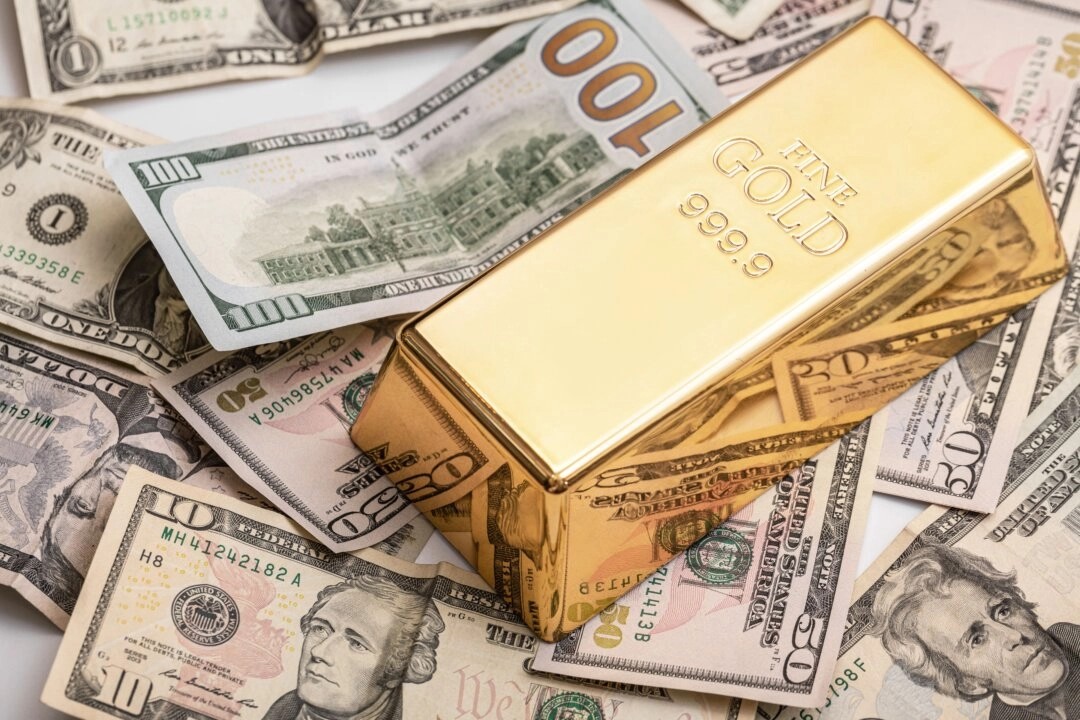
On Friday, August 21, the price of gold rose, with a forecasted nearly 5% increase for the week.
The turmoil in the bond market, a weakening US dollar, and renewed concerns about US debt issues have all boosted the demand for precious metals.
In early trading on Friday, gold futures rose by 1.67% to $4,647.70, while spot gold prices increased by 1.55% to $4,588.08. This upward trend marked a successful week for the precious metal, with a total increase of 4.7% and futures prices approaching a three-month high.
At the time of this rebound, gold prices were significantly retreating from earlier highs near $5,600 earlier this year, and had experienced their worst quarterly performance since 2013 in the three months leading up to June.
According to CNBC’s report, UBS commodity analyst Giovanni Staunovo stated that the increase in global debt levels, coupled with the ongoing weakness of the US dollar, had previously supported the surge in gold prices, and now these concerns are resurfacing.
Staunovo said in an email interview with CNBC, “We believe this will drive gold prices to $5,400 per ounce in the next 12 months.”
On Wednesday, the US Treasury announced it would double the liquidity support for its 10 to 30-year government bond repurchase program to stabilize the sell-off situation in the long-term government bond market. Following this announcement, bond yields fell, the US dollar weakened, and gold prices rose.
At the launch of this repurchase program, the total US government debt surpassed $40 trillion for the first time.
Diane Garrett, Chairman and CEO of Hycroft Mining, stated that the market seemed to interpret these measures as a signal that the cost and maturity of debt burdens would become key factors influencing policy direction.
Garrett mentioned in an email interview with CNBC, “These are the type of structural and long-term driving forces that gold investors value, and this explains why central banks continue to adjust their reserve structures by reducing government bonds holdings and increasing gold holdings.”
The World Gold Council’s annual Central Bank Gold Reserves survey released in June showed that 89% of respondents expected global central bank gold reserves to increase in the next year. A record 45% of respondents anticipated an increase in their institution’s gold holdings, with only 1% expecting a decrease.
Garrett added, “While this may indeed bring about a certain level of volatility, we believe it provides support for the underlying potential demand for precious metals.”
Theo Botoulas, Chief Executive Officer of Neo Energy Metals, a gold and uranium mining developer focusing on the South African market, said, “Current annual gold consumption is at record levels, nearly 5,000 tons per year. Meanwhile, the growth rate of supplies is slightly above 1.5% per year, providing favorable prospects for the gold market.”
Analysts, however, acknowledge that the market still faces adverse factors. Staunovo pointed out that ongoing conflicts in the Middle East leading to rising oil prices could create a pressure point.
“Rising energy prices might exacerbate inflationary pressures, prompting central banks to be cautious with rate cuts; this may lead to an increase in bond yields, putting pressure on interest-free gold,” Staunovo said.
Rhona O’Connell, StoneX’s head of analysis for the Europe, Middle East, Africa (EMEA) and Asia markets, stated that given the strong performance of the US economy, the expected upward pressure on yields would reappear.
“In conclusion, gold faces both the unfavorable factor of rising (and potentially further rising) bond yields and benefits from the favorable factor of a weak US dollar, along with the need to consider the situation in the Gulf region. The market has largely absorbed these factors, and gold prices may currently need a breather,” O’Connell said.
David Morrison, Senior Market Analyst at Trade Nation, stated that the recent rebound in gold prices may expose it to the risk of short-term retracement.
Morrison said, “Although the recent trend in gold prices is impressive, especially considering that gold has rebounded by 10% from multi-month lows since the end of last month, this may indicate a case of too rapid and too large an increase. Gold may need to retrace and consolidate before further gains.”
He added, “However, even if gold falls back to $4,400, as long as it finds stable support at that level, it will be a positive signal for potential gains; and if the US dollar continues to weaken, the significance of this signal will be even more pronounced.”