
After the listing of the mainland robot enterprise Yushu Technology, the stock price frenzy lasted only one day. On August 20, the stock plummeted by 18.7%; and on the 21st, it fell again. Compared to the closing price on the first day of listing, the market value has evaporated nearly 70 billion yuan (RMB). The intraday low price dropped by about 42% from the initial listing price of 1,100 yuan.
Yushu Technology issued at 150.80 yuan per share on August 19, opening at 1,100 yuan and reaching a total market value of 444.9 billion yuan at one point. However, it closed at 845 yuan that day, reducing the market value to approximately 341.8 billion yuan.
According to “First Financial Daily”, on August 20, the stock continued to fall after opening low, closing at 687 yuan, a decrease of 18.7% in a single day, bringing the market value down to about 277.9 billion yuan. Compared to the closing price on the first day, the market value evaporated by about 63.9 billion yuan in a day.
On August 21, the lowest price of Yushu Technology plummeted to 636 yuan during trading, a drop of about 42% from the opening price on the day of listing. It closed at 672.41 yuan that day, further declining by 2.12%. Compared to the closing price on the first day of listing, the company’s market value has now lost nearly 70 billion yuan.
Data from the financial service platform Pai Pai Net shows that the total unrealized profits of public and private institutions participating in the new stock totaled 10.146 billion yuan on the first day, but with the price decline on the 20th, the unrealized profits dropped to 7.837 billion yuan, a decrease of about 2.3 billion yuan from the first day.
Yushu Technology’s price-earnings ratio at issuance reached 219.23 times. Guoxin Securities stated in a research report released before the listing that this valuation implies the company must maintain growth well above the industry average for the next few years to justify the current valuation.
On the first day of listing, based on the annualized profit for the first half of 2026, Yushu Technology’s dynamic price-earnings ratio once exceeded 800 times; even at the closing price of 845 yuan, it still reached about 585 times.
Yushu is not the only high-flying new stock to experience a sharp fall. Pingzhun Laser, which went public on August 18, opened at 1,100 yuan, soared to a high of 1,300 yuan during trading, and closed at 1,152 yuan on the first day. The next day, it closed at 942.03 yuan, a decrease of 18.23%. On the 21st, the lowest price dropped to 885 yuan during trading, retracting by about 32% from the peak on the first day. Both new stocks had less than 20% of tradable shares in their initial public offerings.
Jiao Bing, a researcher at Geshang Fund, stated that Yushu’s first-day surge was the result of scarcity in the floating shares combined with speculative premiums. The subsequent decline reflects a shift in valuation from “future dreams” to fundamentals, influenced by institutions cashing in on profits and the slowing growth rate.
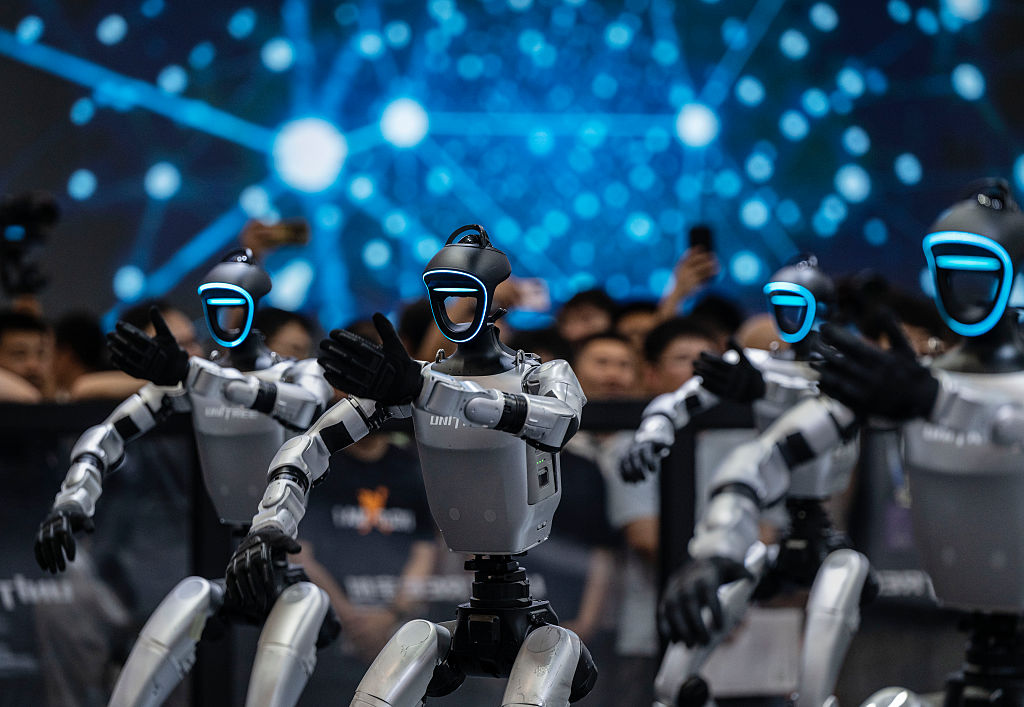
The CCP has long identified robotics as a key industry for support. Yushu Technology’s humanoid robot revenue mainly comes from the research and education sectors, with significant distance still remaining from large-scale commercial scenes such as factories and homes.
Yushu Technology’s founder, Wang Xingxing, admitted on August 20 that even though robots can perform some simple tasks, their efficiency is still lower than that of human labor. While success rates can reach nearly 100% after thorough training in fixed scenarios, success rates drop significantly when objects are changed or environments are slightly altered.
Wang Xingxing stated that due to insufficient overall efficiency and generalization capabilities, Yushu has not yet undergone large-scale deployment. He predicts that achieving embodied intelligence (allowing artificial intelligence to perceive the environment through robots and execute actions) similar to ChatGPT’s industrial tipping point may still require two to three years on the fast track or possibly five to ten years on the slow track.
According to Yushu Technology’s response to inquiries from the Shanghai Stock Exchange, in the first nine months of 2025, 73.60% of its humanoid robot revenue comes from the research and education sector, while commercial consumption accounts for 17.39%, and industry applications only 9.01%. The industry application is mainly focused on enterprise guidance, with intelligent manufacturing and smart inspection accounting for only 29.29% of industry applications, which is approximately 2.6% of humanoid robot revenue.
Yushu Technology also acknowledged in its prospectus that large-scale commercial deployment of humanoid robots faces uncertainties and risks such as technological progress falling short of expectations and inadequate market demand.