
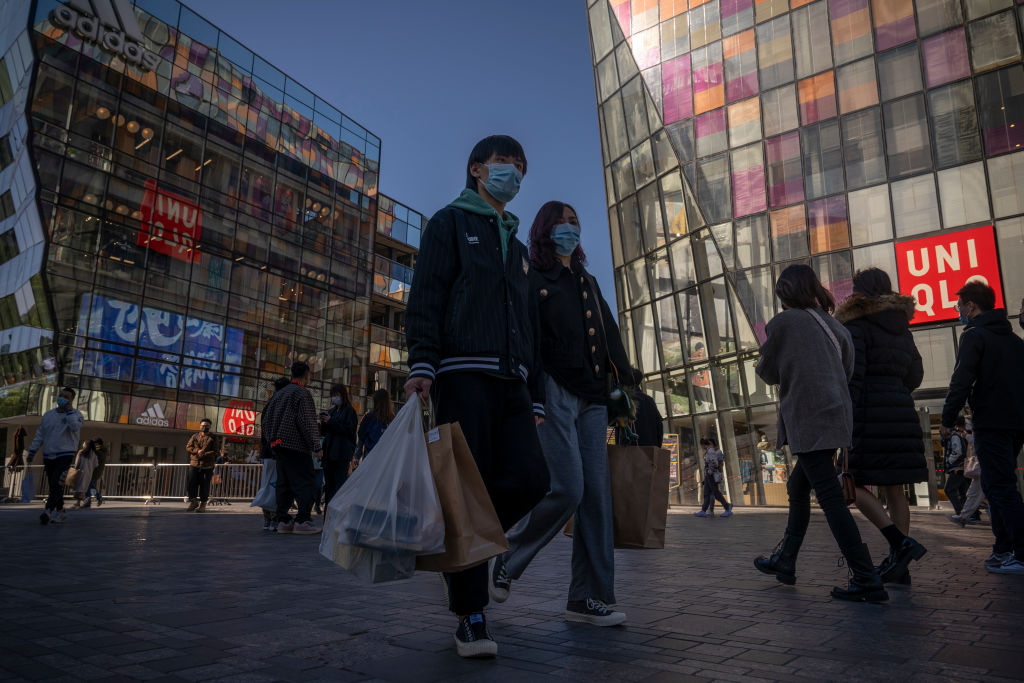
Amid ongoing stimulus measures by the Chinese Communist Party to boost consumption, young people in mainland China are increasingly turning to “renting instead of buying,” with a growing demand for short-term rentals of products such as cameras, drones, designer bags, and outdoor gear, while the total retail sales of consumer goods in July this year increased by only 0.6% year-on-year.
According to a report by The Wall Street Journal on August 20, this spring, a college student named Wang traveled to Taiyuan for three days. Instead of spending over 3000 yuan to purchase a DJI Pocket 3 handheld camera, she rented it for 65 yuan.
Similar practices have expanded from cameras, drones, and computers to skiing equipment, camping gear, designer handbags, wedding dresses, and toys.
A photographer from Qingdao stated that renting a drone costs around 40 yuan per day, a DSLR camera about 50 yuan, and an entire set of equipment less than 100 yuan per day, while purchasing similar equipment would require tens of thousands of yuan.
Previously reported by the Beijing Daily, 28-year-old Xiao Mai once rented a DJI sports camera for around 200 yuan for ten days. After trying it out, she found that she didn’t use it much in reality, so she no longer rushed to spend thousands of yuan on buying it.
A white paper released by the State Administration for Market Regulation of the Chinese Communist Party and Ant Group in August 2025 estimated that the transaction volume of the leasing economy in mainland China exceeded 42 trillion yuan in 2024, a 32% year-on-year increase, serving over 750 million people cumulatively.
Data from Chinese lifestyle service platform Meituan shows that in 2026, the search volume for camera rentals increased by 67% year-on-year, drone rental searches increased over tenfold, with nearly 70% of searches coming from people aged 20 to 35.
A survey conducted by the China Youth Daily in February this year on 1,334 young people showed that 77.3% of respondents had experienced “renting instead of buying,” with the post-2000 generation accounting for 82.2%. Digital devices were the most common rental category, followed by outdoor gear.
The survey indicated that 54.1% of the young respondents believed that some goods were used infrequently, leading to the mentality of “renting is better than buying.”
Zhu Di, a researcher at the Institute of Sociology of the Chinese Academy of Social Sciences, stated that young people’s consumption patterns are shifting from “being unable to afford and giving up” or buying on credit to meeting their needs based on their purchasing power through bargaining, sharing, and renting.
The Chinese Communist Party continues to stimulate expenditures through programs such as trading in old items for new ones and subsidized personal consumption loans. Reuters reported in December 2025 that as part of the “Trading Old for New” program for consumer goods in 2026, the Chinese government allocated an initial 62.5 billion yuan, covering automobiles, household appliances, and some digital products; Reuters also reported in January this year that the subsidy policy for personal consumption loans was extended until the end of this year.
Official data from the National Bureau of Statistics of the Chinese Communist Party shows that in July, the total retail sales of consumer goods in mainland China increased by only 0.6% year-on-year, lower than the 1% growth in June; for the first seven months of this year, the growth was 1.2%.
Another set of official data from the Chinese Communist Party indicated that retail sales of goods grew by 1.1% in the first seven months, while service retail sales increased by 5.0%.
The Wall Street Journal analysis suggests that some consumers see renting as a way to try before buying, while others abandon purchases after trying. More young people are choosing to rent rather than buy, potentially reducing sales of related products and posing new challenges to stimulating domestic demand for the Chinese Communist Party.
In its July briefing on the Chinese economy, the World Bank pointed out that soft housing demand, the negative wealth effect from declining house prices, and a soft labor market have led mainland Chinese residents to maintain cautious spending; consumption is expected to remain subdued, and the sluggish transition of the economy towards consumption-driven growth continues at a slow pace.