
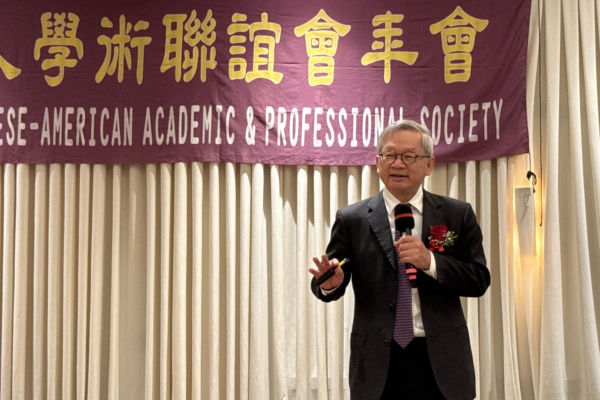
On August 16th, Wu Chengwen, Director-General of the National Science and Technology Commission of the Republic of China, stated in New York that Taiwan Semiconductor Manufacturing Company (TSMC) has established unique manufacturing capabilities through long-term cooperation with top technology companies in the United States. This collaboration has led to the entry of global equipment and material suppliers into Taiwan, driven by customer demand. With most advanced processes research and manufacturing taking place in Taiwan, international suppliers have found it necessary to come to Taiwan in order to meet the demands of TSMC, making it a “must-visit” destination.
At the 51st Annual Meeting of the Chinese Scholars Association in the Eastern United States held in New York, Wu Chengwen delivered a keynote speech on the topic of “AI Technology Development Policy Layout under Geopolitical Challenges.” Over several decades of accumulation, Taiwan has developed a complete semiconductor ecosystem centered around TSMC, integrating local and international manufacturers from the United States, Japan, the Netherlands, Germany, and others. He emphasized that bringing this ecosystem to the United States is “a very, very difficult task.”
Taiwan currently leads the global semiconductor industry in areas such as wafer fabrication, IC packaging, and AI servers. To maintain its competitive advantage, Taiwan must continue to progress in processes, components, materials, equipment, packaging, and testing fields.
As TSMC has become a leading manufacturer in advanced process technology globally, equipment and material suppliers must closely collaborate with TSMC. Wu Chengwen explained that all companies producing the most cutting-edge semiconductor process equipment must learn from TSMC in order to meet its equipment requirements. Therefore, collaboration is essential for progress in this industry.
Driven by the demands of global customers, including tech giants like Apple and NVIDIA, TSMC continues to grow. These American technology companies submit numerous customized requests to TSMC based on advanced products and market needs. By accommodating various customers, TSMC has gradually developed a process model capable of adapting quickly to different requirements, extending this capability to advanced packaging as well.
According to Wu Chengwen, Taiwan absorbs new demands and technologies from customers and further drives the growth of its supply chain. International suppliers situated in Taiwan focus on research and development and manufacturing activities. If these suppliers remain in their home countries, they may not be able to meet TSMC’s requirements in a timely manner, hence the need to enter Taiwan. As these large international equipment manufacturers enter Taiwan, their downstream supply chains also gradually localize, increasing the participation of Taiwanese companies. This ultimately shapes a complete semiconductor ecosystem centered around TSMC, while also involving international firms. Companies from Japan, Germany, the Netherlands, and the United States have already invested in Taiwan.
Taiwan also aims to extend its existing semiconductor advantage to the next generation of technologies, with one crucial direction being efficient quantum computing. Although Taiwan started in the quantum computing field relatively late, Wu Chengwen compared this with Taiwan’s entry into the semiconductor industry decades ago. While semiconductors initially stemmed from U.S. innovation, Taiwan caught up and gained a leading position globally through its development model in the manufacturing sector.
Taiwan does not seek to replace countries leading in quantum computing but rather aims to leverage its semiconductor advantages to facilitate faster commercialization and practical applications of high-performance quantum computers. Taiwan has openly recruited international partners, with European, Japanese, and American startup teams currently in discussions for collaboration.
Another field that Taiwan hopes to break into using its semiconductor advantages is Silicon Photonics. Wu Chengwen pointed out that AI data centers heavily rely on GPUs, consuming a considerable amount of energy. Apart from chips themselves, significant power loss and heat are generated within server racks due to the large volume of copper wires from packaging, circuit boards to backplanes, necessitating additional power consumption for cooling.
One of the next crucial technological directions is gradually transitioning data transmission from copper wires to optical transmission. Wu Chengwen highlighted that the government’s overarching strategy involves utilizing Taiwan’s existing semiconductor advantages to uphold its leadership while extending to the international supply chain and next-generation technologies such as quantum computing and Silicon Photonics.