
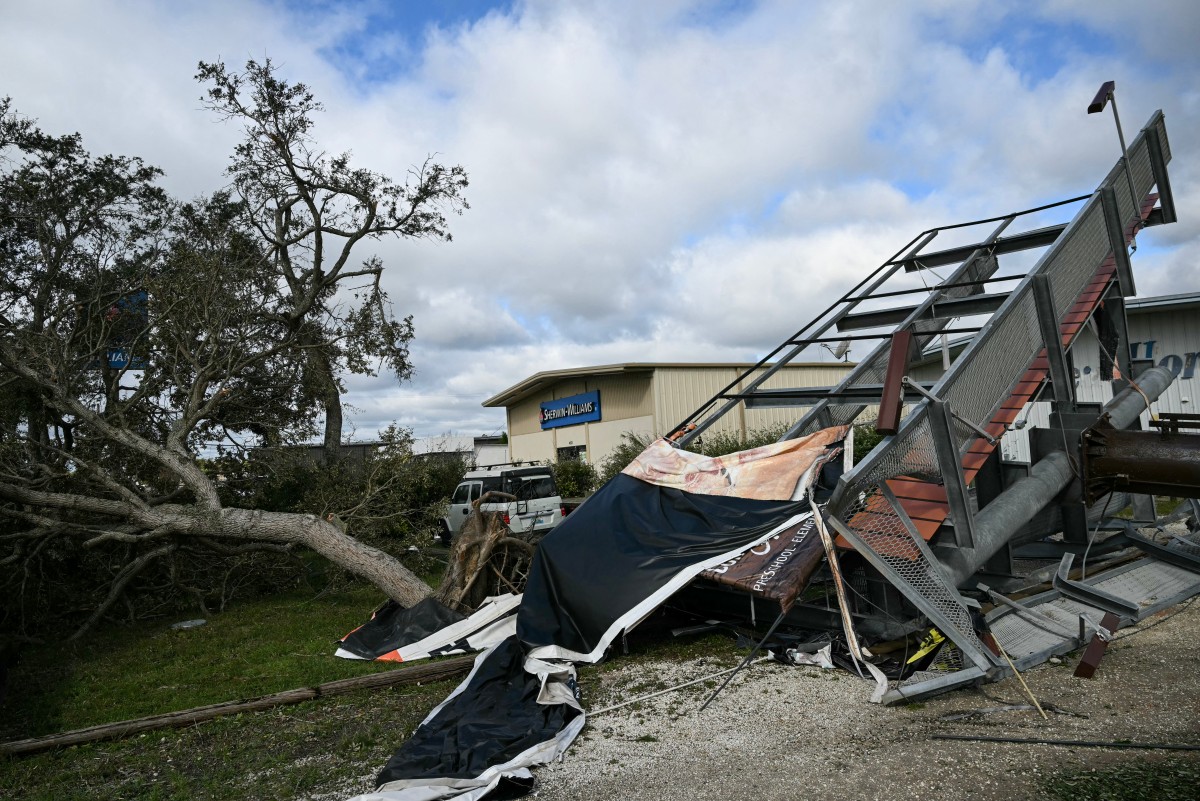
Despite the deadly Hurricane “Isaias” weakening into a post-tropical cyclone in the early hours of Saturday (October 10), significant threats of flooding and tornadoes persist as the storm moves inland across the United States. Up to now, “Isaias” has caused at least 2 deaths and left over 840,000 households without power.
According to the National Hurricane Center (NHC), earlier on Saturday, “Isaias” was located about 25 miles south-southwest of Montgomery, Alabama, and approximately 105 miles south of Birmingham, with maximum sustained winds of 35 mph. The storm is expected to move into the Tennessee Valley region later on Saturday and Sunday.
The Jefferson County Emergency Management Agency reported that as “Isaias” passed through Alabama earlier on Saturday, an incident occurred in Birmingham where a tree fell on a residence, resulting in one fatality.
Officials mentioned that several homes in the Birmingham area were damaged due to fallen trees, but no other casualties have been reported so far.
Escambia County in Florida also confirmed a death related to the storm. On Friday (October 9), “Isaias” made landfall near Destin, Florida as a Category 2 hurricane, bringing storm surges up to 5 feet and sustained winds of 105 mph. This marks the first hurricane landfall in the U.S. since Hurricane “Milton” landed as a Category 3 storm south of Tampa two years ago. Hurricane “Isaias” weakened into a post-tropical cyclone early on Saturday.
Sheriff Chip Simmons of Escambia County mentioned on social media that during the storm, a tree falling on a residence resulted in the death of a woman.
This deadly storm has left a large number of users without power. As of the latest information from PowerOutage.com, there are still 840,000 households without power, with Florida having the most outages (nearly 440,000), followed by Alabama (around 260,000), and then Georgia (89,000). North Carolina, Tennessee, and South Carolina each have thousands of households experiencing power outages.
The Alabama Emergency Management Agency stated that in southeast and southwest parts of Alabama, several Emergency Operations Centers (EOCs) are currently relying on generators for power, with some experiencing varying degrees of communication disruptions.
Florida Governor Ron DeSantis mentioned in a press conference on Saturday that the current focus is on restoring power supply to the affected areas. Thousands of power restoration workers have already been dispatched to the scene.
DeSantis also cautioned that while the eye of “Isaias” has left Florida, the threats from the storm are far from over. Residents in the Florida Panhandle and the Big Bend region may still face rainfall and flood threats throughout the weekend.
“The flood risk remains high,” DeSantis said. “Sometimes floods can occur one or two days after the storm passes, so the issue of flooding is not over yet.”
As the remnants of “Isaias” move northward, sporadic tornadoes and strong winds remain threats in the southeastern U.S. from Saturday into early Sunday. Moreover, there is a risk of flash flooding from northern Georgia to western North Carolina.
Robbie Berg, a warning coordination meteorologist at the National Hurricane Center in Miami, told the Associated Press that despite the storm surge warnings being lifted, strong winds still pose a threat in the southeastern U.S.
“Even though ‘Isaias’ has transitioned into a post-tropical cyclone, the threats of strong winds and heavy rain persist. In the coming days, severe flooding may occur in some areas,” Berg said.