
On October 10, President Tsai Ing-wen of the Republic of China delivered a National Day speech with the theme “Taipei, the City on the Mountain, the Salt on the Ground, the Light in the World.” She pointed out that the Chinese Communist Party continues to exert pressure through military and grey-zone actions, attempting to change the status quo in the Taiwan Strait. In the face of authoritarian expansion, the government continues to promote defense reform, strengthen asymmetric capabilities, develop independent defense industries, and transform the advantages in semiconductors, information and communications technology, and precision manufacturing into forces that protect the country.
President Tsai mentioned, “We must also emphasize that to maintain regional security, peace, and stability, it is not only necessary to correctly understand the development of history, but also to not allow distortion of the history of World War II, respect the right of the Taiwanese people to exist, and combine the common strength of democratic countries in the Indo-Pacific region to prevent the current state of regional peace and stability from being altered.”
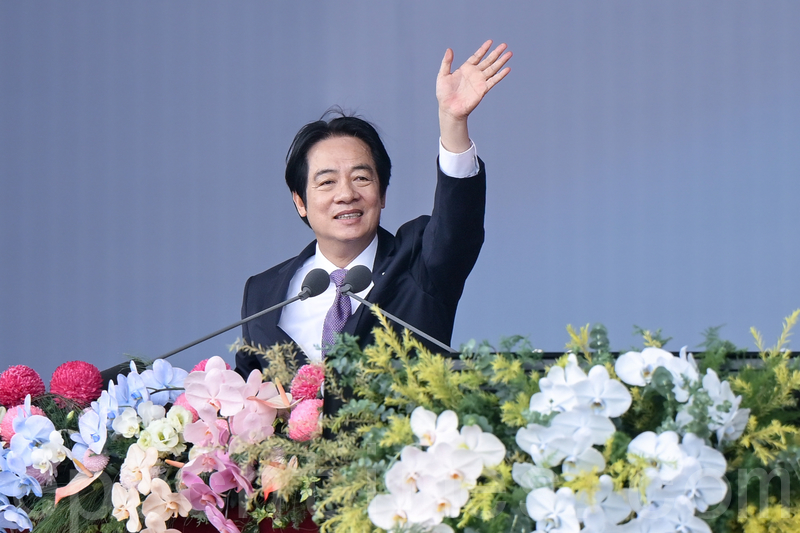
In the morning of October 10, President Tsai delivered the National Day speech at the “Republic of China-Central Hub and Various Sectors Celebrate the 115th National Day Ceremony” held in front of the Presidential Office.
President Tsai said, “Chairman Han Kuo-yu of the Assembly, Vice President Xiaomei Ching, Premier Su Tseng-chang, His Majesty Mswati III King of Swaziland, Her Royal Highness Queen Zuma, President of the ‘Japan-Taiwan Friendship Parliamentarian Alliance’ Keishi Furuya, congratulatory delegations from friendly countries, ambassadors to Taiwan, domestic and international dignitaries watching on television and live broadcast, good day everyone!”
She said, “Today we are gathering in front of the Presidential Office to celebrate the National Day of the Republic of China, cheering for Taiwan together, wishing the country a happy birthday, and hoping for the prosperity of the nation! At this moment, whether we are in Taiwan or in different corners of the world; regardless of our age, occupation, or political stance, we are rooted in Taiwan; we all share a responsibility to make the country safer, society more stable, people’s lives better, and future generations full of hope.”
This year marks the 30th anniversary of direct presidential elections in Taiwan. Tsai Ing-wen said, “Thirty years ago, facing missile threats, the Taiwanese people bravely went to the polls to complete the hundred-year pursuit of the people of Taiwan ‘being masters of their own house,’ using their votes to tell the world: the people are the masters of this country; the future of Taiwan must be decided by the people of Taiwan themselves.”
Tsai Ing-wen said, “In the past 30 years, we have gone through democratic transformation, experienced party alternation, and faced many challenges. Today, we are more confident that freedom and democracy will not contradict economic development. The more Taiwan embraces democracy and faces the world, the more prosperity it can create and the more capacity it has to contribute to the world.”
“In the past year, the world has not been peaceful,” she pointed out. Wars and authoritarian expansion have continued, and the global economy faces multiple challenges such as tariffs, energy, and the red supply chain. However, Taiwan has not retreated, but instead stood firm in the face of changes, demonstrating proud resilience. Just as Taiwanese athletes excelled at the Asian Games, showing the world Taiwan’s resilience and pride.
President Tsai thanked all sectors for their efforts, noting that economic performance has been outstanding. In just the first half of this year, the latest economic growth rate reached 14.15%. The full-year economic growth rate is expected to exceed 11%, reaching a 39-year high; and this year, Taiwan’s per capita GDP is estimated to reach $45,332, almost double that of 2016. The Taiwan Stock Index surged to over 49,000 points, becoming the world’s fourth-largest stock market.
In terms of diplomacy, Taiwan has made further progress. This year, she visited the Kingdom of Eswatini for a state visit, thanking His Majesty King Mswati III for the warm reception and the enthusiastic welcome from the Queen Mother and the people of the country, witnessing cooperation between the two sides in energy, agriculture, healthcare, women empowerment, and education and culture.
Furthermore, Vice President Xiaomei Ching visited Palau, deepening results in medical, agricultural, infrastructure, and sustainable tourism, and was invited to attend the European Forum on Freedom and Democracy in Ventotene, Italy, offering Taiwan’s voice in a critical venue symbolizing European freedom and democracy.
President Tsai said that in the World Competitiveness Ranking by the International Institute for Management Development in Lausanne, Taiwan stands out in “economic performance,” “government efficiency,” “business efficiency,” and “infrastructure,” ranking among the top countries globally in competitiveness, achieving the best results in history. These achievements undoubtedly belong to Taiwan’s 23 million people; they are the results of the government working hand in hand with countless Taiwanese people, regardless of field, jointly striving diligently. She invited all compatriots to applaud themselves once again with warm applause.
“In an era of war and authoritarian expansion, how should Taiwan become a nation?” Tsai Ing-wen said, and her answer is: courageously and confidently building the “City on the Mountain”! “This is not self-praise, but our expectation for the future of the country, and Taiwan’s willingness to shoulder responsibility.”
Tsai Ing-wen emphasized that the “City on the Mountain” must be as firm as gold, with all people united, being the key force in maintaining peace and stability in the Indo-Pacific. Like salt, although small, can harmonize flavors and preserve food. Taiwan’s territory may be small, but the country safeguards democracy, freedom, human rights, and the rule of law, preventing authoritarian erosion of precious universal values.
“We do not seek hegemony, nor seek to dominate others. We understand the cost of conflicts, thus we choose to take on the responsibility of peace and become a reliable stabilizing force in the international community. However, peace cannot rely solely on wishes, and tolerance cannot become a reason for aggressors to expand their encroachment,” Tsai Ing-wen said.
Tsai Ing-wen pointed out that the Chinese Communist Party continues to exert pressure through military and grey-zone actions, attempting to change the current situation in the Taiwan Strait. Faced with authoritarian expansion, Taiwan’s persistence is not only about its survival but also about whether the international community still believes that rules should not be overridden by force, and that the rights of people to decide their future should not be stripped away. Therefore, Taiwan continues to promote defense reform, strengthen asymmetric capabilities, develop independent defense industries, and transform the advantages in semiconductors, information and communications technology, and precision manufacturing into the force that protects the country.
She said, “Through the whole-of-society defense resilience preparation, the government integrates the capabilities of the central government, local governments, and the private sector to enhance the continuous operational capabilities of energy, communications, transportation, finance, food, and medical services. When a crisis occurs, society can operate stably, and people know how to protect themselves and help each other. She expressed gratitude to all military personnel, reservists, police, firefighters, medical staff, civil defense personnel, and citizens participating in exercises. Every effort in preparation contributes to the peace of Taiwan and adds another defense line.
“We increase defense investment not to provoke but to deter war; we strengthen self-defense not to give up dialogue but to ensure that dialogue takes place on an equal and dignified basis,” Tsai Ing-wen said.
“We welcome both the United States and China to manage competition through dialogue, reduce the risk of conflict and war. However, we must also point out that to maintain regional security, peace, and stability, it is not only necessary to correctly understand the development of history, but also to not allow distortion of the history of World War II, respect the right of the Taiwanese people to exist, and combine the common strength of democratic countries in the Indo-Pacific to prevent the current state of regional peace and stability from being altered,” she emphasized.
She added, “Taiwan treasures peace but will not give up freedom; Taiwan is willing to communicate but will not accept humiliation. Taiwan shows determination, not allowing authoritarianism to erode democracy, or fear to replace freedom. With resolute and responsible actions, Taiwan safeguards the peace and stability of the Taiwan Strait and the Indo-Pacific.”
“Compatriots, the City on the Mountain, the city gate must be open to the world freely, allowing the world’s light to shine in; the light in the city, with innovation, equality, and goodness, brings hope to the world. Light not only illuminates itself but also shows others the way. Taiwan’s light comes from the wisdom and diligence of the people, from the innovation of the industries, and from our choice to share achievements with the world,” she said.
“From traditional industries to advanced semiconductors, Taiwan has proven with strength that a resource-limited island can also become an indispensable force in global prosperity. However, we will not stop at today’s achievements; the Executive Yuan is accelerating the implementation of 13 core strategic industries, covering five key trusted industries such as semiconductors, artificial intelligence, defense technology, security, and next-generation communications; as well as the three core technologies focused on by AI’s new top ten projects, such as silicon photonics, quantum computing, and robotics,” Tsai Ing-wen said.
She further explained that there are six key industries—critical minerals, biotech healthcare, Asia asset management center, basic public infrastructure and urban renewal, cultural creativity, and trillion-dollar tourism—to ensure Taiwan’s competitive advantage for the next generation; along with a multivariate development plan for the small and medium-sized enterprises with a scale of tens of billions of dollars, providing financing, talent training, digital transformation, zero-emission upgrades, and international channels support.
Tsai Ing-wen said, “The tech industry must continue to move forward, accompanied by traditional industries; leading companies must go global and drive the supply chain to take root in Taiwan. Taiwan should not only have one sacred mountain, but also have all sectors working together to become a fortress for defending the country.”
“The light of the economy must also shine into the lives of the people,” Tsai Ing-wen said. “We have raised the minimum wage for 11 consecutive years, civil servants have had five salary increases in ten years, and this year saw an increase in professional and managerial bonuses. Through pay raises, incentives, and social support, we transform growth into better salaries, fewer burdens; the government also plans to distribute 10,000 per person to every citizen on a solid fiscal basis; a monthly allowance of 10,000 for each elderly farmer, 5,000 for every citizen through the National Pension; welfare benefits for vulnerable families and other six social support grants have also been raised across the board, allowing the entire population to share the fruits of economic development.”
She mentioned, “Internationally, we respond to the needs of our partners through cooperation in healthcare, agriculture, energy, technology, education, and sustainable development. Taiwan’s expertise and goodwill translate into practical actions to improve lives.” “Taiwan Can Help” is not just a slogan but a commitment from Taiwan to share capabilities and take on responsibilities. Taiwan’s light crosses borders, allowing more people in need to feel warmth and hope.
“Shortly, we will welcome the local elections for the nine-in-one region. Choosing talents and resisting threats and temptations are our shared responsibilities; political parties can compete, opinions can differ, but Taiwan should not be divided because of that. The City on the Mountain does not shine because there are no differences, but because even with different opinions, we still respect each other, believe in the system, and are willing to protect the country together,” Tsai Ing-wen said.
“The president’s power comes from the people’s trust; the president’s responsibility is to unite forces and lead the country forward,” she said. She will build the City on the Mountain with pragmatic governance; become the salt that stabilizes and protects peace; and become the light that warms the world with innovation, equality, and goodness.
In conclusion, Tsai Ing-wen said, “Compatriots, let us unite and together, lay a more solid foundation for the next 30 years of Taiwan: with stronger competitive advantages, enabling the next generation to stand more firmly and go further. Long live the Republic of China! Go, Taiwan!”