
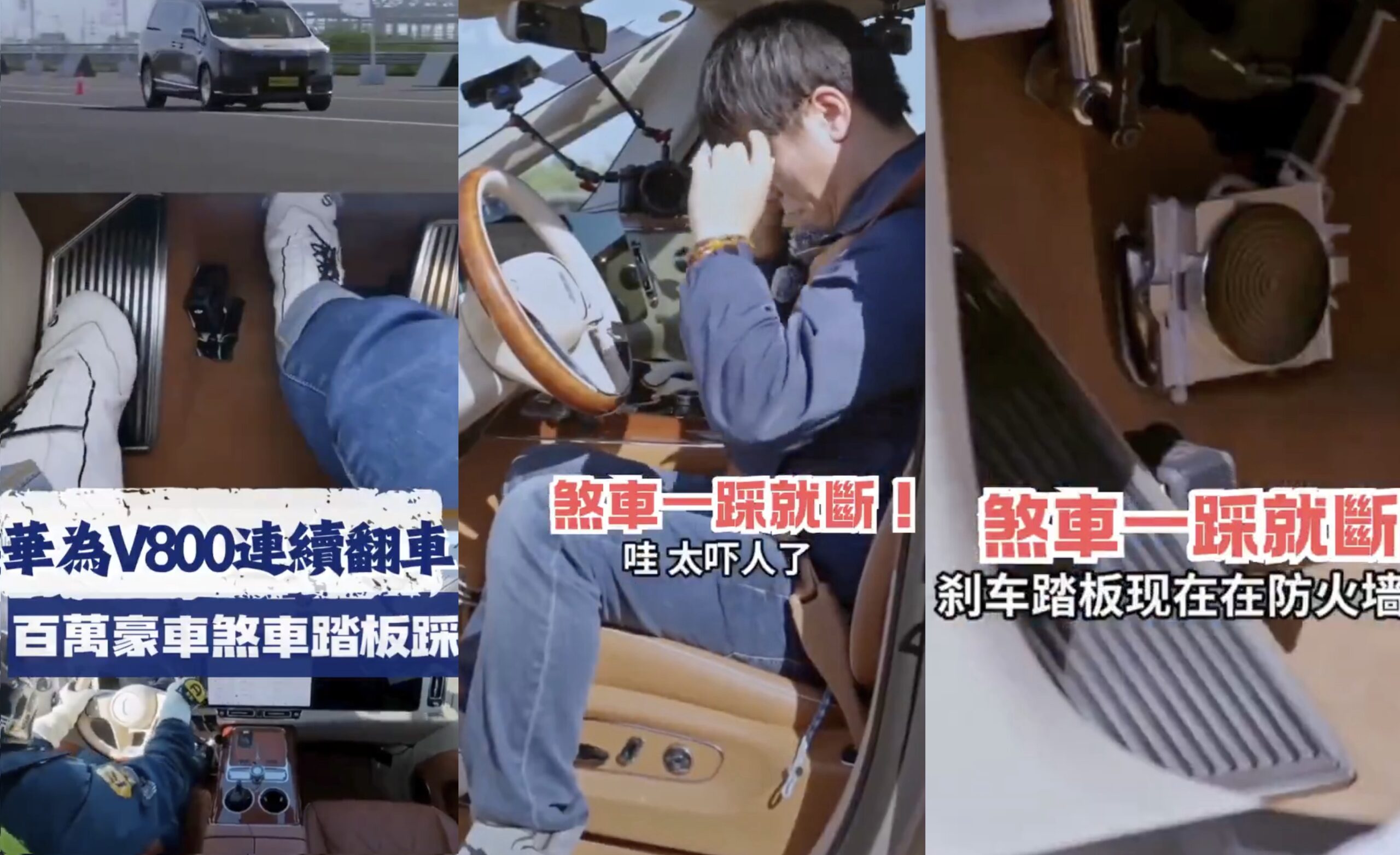
Huawei’s high-end new energy vehicle brand, Junjie, created in collaboration with Jianghuai Automobile, has recently been embroiled in a controversy over brake safety. The automotive platform “Car Emperor” conducted emergency braking tests on three Junjie V800 vehicles at a speed of 100 kilometers per hour, and all three vehicles experienced brake pedal bracket failures. The incident has continued to escalate, with Car Emperor’s related testing videos reportedly being taken down from multiple platforms, and the person in charge of the tests claiming to have received bombardment of text messages, while Junjie’s statement relayed by Xinhua News Agency was also deleted.
According to reports from Fast Technology and The Paper on October 9, Dongmen Jiannan, the person in charge of automotive safety content at Car Emperor, led a team to conduct emergency braking tests from 100 kilometers per hour to zero on three brand-new Junjie V800 vehicles. The results showed that the brake pedal bracket of all three cars broke, and the position and morphology of the fractures were highly similar, with one test vehicle having a total mileage of only 3 kilometers.
After the related test videos were made public on October 8, they quickly sparked heated discussions online. Some netizens believed that the consecutive similar fractures of the same component in three vehicles deserve attention, while others questioned whether the pedal force during the test was excessive, exceeding normal driving conditions.
Regarding the circulating “4589N” (approximately 468 kilograms of force) pedal force data online, Car Emperor responded on the evening of October 8, stating that this was a digital residue caused by the difference in refresh rates between the high-speed camera and the detection equipment screen, and not the actual peak value. The data published by the platform showed that the real peak pedal force when the three vehicles broke was 1612N.
Car Emperor also stated that emergency braking at 100 kilometers per hour is a basic item in automotive testing, and similar situations may also occur during high-speed driving, thus cannot be simply attributed to extreme conditions. The platform mentioned that the occurrence of similar fractures in three vehicles in close proximity was a situation discovered for the first time during testing, indicating a safety hazard.
On the same night, Junjie released a statement explaining the situation, stating that the braking system had been developed and verified according to requirements higher than national and industry standards, and since the first batch of vehicles was delivered, there had been no incidents of brake pedal bracket base fractures during actual user consumption. Junjie also expressed that they would further optimize the design of related components, provide free upgrade options for delivered vehicle owners, review component design verification, test boundaries, and production quality management.
However, in the statement, Junjie did not specifically explain why the three test vehicles consecutively experienced similar fractures, or disclose further investigation results. Questions about whether the test conditions were reasonable, why the components broke, and whether there are safety issues requiring recall measures still need further verification.
Following the escalation of the incident, the spread on the internet has once again attracted attention.
Screenshots released by mainland Chinese media and netizens show that the official Xinhua News Agency, the Chinese Communist Party’s official media outlet, had previously reposted Junjie’s statement on Weibo and official accounts, but the related content was later deleted. Some netizens claimed that shortly after the reposted content was published, it became inaccessible.
Currently, there is insufficient information to confirm the specific reasons for Xinhua News Agency deleting the related content, and it cannot be concluded that external pressure was the cause. However, the fact that the official media reposted and then deleted the car manufacturer’s statement has still sparked skepticism online.
In addition to the removal of the videos, there have been speculations about whether Huawei’s HarmonyOS smartphones had influenced the playback of related content, becoming a point of controversy.
According to reports from Fast Technology and Phoenix Technology, an automotive blogger named “Niu Ge Shuo Che” previously posted screenshots claiming that when using a Huawei smartphone, some search results related to “brake pedal fractures” on the Car Emperor app could not be opened, leading to suspicions by netizens.
On October 9, related screen recordings circulated online showing that after users searched for keywords on the Car Emperor app, they could see the search results for Junjie V800 test videos, but clicking on them resulted in a message saying, “Functions are being gradually opened, please stay tuned.”
However, the available information does not confirm whether this was actively blocked by the HarmonyOS system, nor does it exclude technical factors such as app compatibility or redirection to other platforms.
Simultaneously, it was reported that Car Emperor’s test videos were successively unable to be played on platforms like Douyin, Bilibili, Weibo, and some netizens even mentioned that related videos within the Car Emperor app could not be opened.
At the time of the dissemination of this related information, the specific reasons for why the videos were taken down remain unclear, making it difficult to determine whether they were deleted by the publishers themselves, by the platforms, or due to other factors.
Recently, American economist Huang Dawei, in an interview with Dajiyuan, stated that Chinese car companies usually handle vehicle quality issues as reported by consumers by deleting posts, banning accounts, and applying legal pressures, thereby limiting consumers’ spaces for expression and rights protection, which does not solve the product and accessory problems. Official industrial protection should not be used as a reason to suppress consumers.
As the situation continues to escalate, the person in charge of Car Emperor’s tests, Dongmen Jiannan, reportedly faced online harassment.
According to reports from Fast Technology on October 9, an automotive blogger disclosed that Dongmen Jiannan had allegedly faced a bombardment of text messages. Subsequently circulated screenshots showed that his phone received a large number of verification code messages from various websites in a short period.
An online article in mainland China claimed that Dongmen Jiannan was subjected to derogatory comments in the comments section of the related test videos. Since his surname is relatively uncommon, some netizens escalated the incident to a height of patriotism, questioning his nationality and even labeling him as Japanese or a Japanese spy, thus questioning the motives of the tests.
Another point of focus is the claim that Car Emperor had reportedly purchased six brand-new Junjie V800 vehicles for this test, with three used for testing, and the remaining three sealed to address potential legal disputes.
This claim was mentioned in online articles and revelations by netizens, but there is currently a lack of independent evidence to confirm the purchase, sealing, and notarization situation of the other three vehicles.
The Junjie incident has also drawn attention from other automotive brands, leading to situations of leveraging publicity.
Images and videos circulating online show that brands such as Dongfeng Peugeot and Dongfeng Citroen released promotional content emphasizing that some models use integrated stamped metal brake pedals, highlighting product features with slogans like “Reliable to step on in emergencies.”
Furthermore, a Douyin user posted a video of them using their foot to press a metal flush valve in a restroom, associating it with brake pedal fractures. Subsequently, netizens mentioned abnormalities in the profile picture and username of that account.
These promotions and online videos reflect that the material, structure, and load-bearing capacity of brake pedals have become a focal point of public discussion.
Meanwhile, the capital market has reacted to the incident.
According to reports from the Beijing News, Jianghuai Automobile saw a halt in trading on October 8, with another halt at the opening on October 9. The market value evaporated by approximately 11.767 billion yuan over the two trading days compared to 619.22 billion yuan at the close on September 30.
The Junjie V800 was launched in August this year with official prices ranging from 766,000 yuan to 1.016 million yuan, created in collaboration between Huawei and Jianghuai Automobile. This incident not only involves the braking safety of a single model but also poses pressure on Jianghuai Automobile’s brand reputation and partnership risks.
It’s worth noting that Huawei is often referred to as a party-enterprise or military-enterprise of the Chinese Communist Party and that, empowered by a large legal team, the company frequently takes critics questioning their marketing or product quality to local courts, seeking high compensation ranging from hundreds of thousands to millions of Chinese yuan.
Apart from civil claims, Huawei has also intervened in public opinion crises through criminal complaints. The police would launch investigations on charges like “damaging business reputation,” even arresting critics and bloggers located in remote areas across provinces to create a strong deterrent effect online.
Some netizens have connected this incident with other controversies Huawei has been involved in this year, such as the “bamboo cicada,” “toilet signposts,” and the current “Junjie brake pedal” incidents, raising concerns about the product quality, advertising methods, and handling of criticism by the company.
In recent years, the rapid expansion of Chinese new energy vehicles and independent brands has seen a proliferation of marketing concepts, yet the core quality and safety performance frequently face doubts.
ByteDance’s automotive content platform, Car Emperor, has been revealing quality loopholes in the rapidly iterating Chinese automotive industry through a series of extreme and daily practical tests in recent years.
During the winter testing period in 2023, about 20 hybrid and extended-range vehicle models generally achieved low battery life rates. The Do-Jie M7 extended-range version, with a 31.6% achievement rate, garnered criticism and rebuttals from multiple automotive executives.
(The contribution of reporter Luo Ya to this article)