
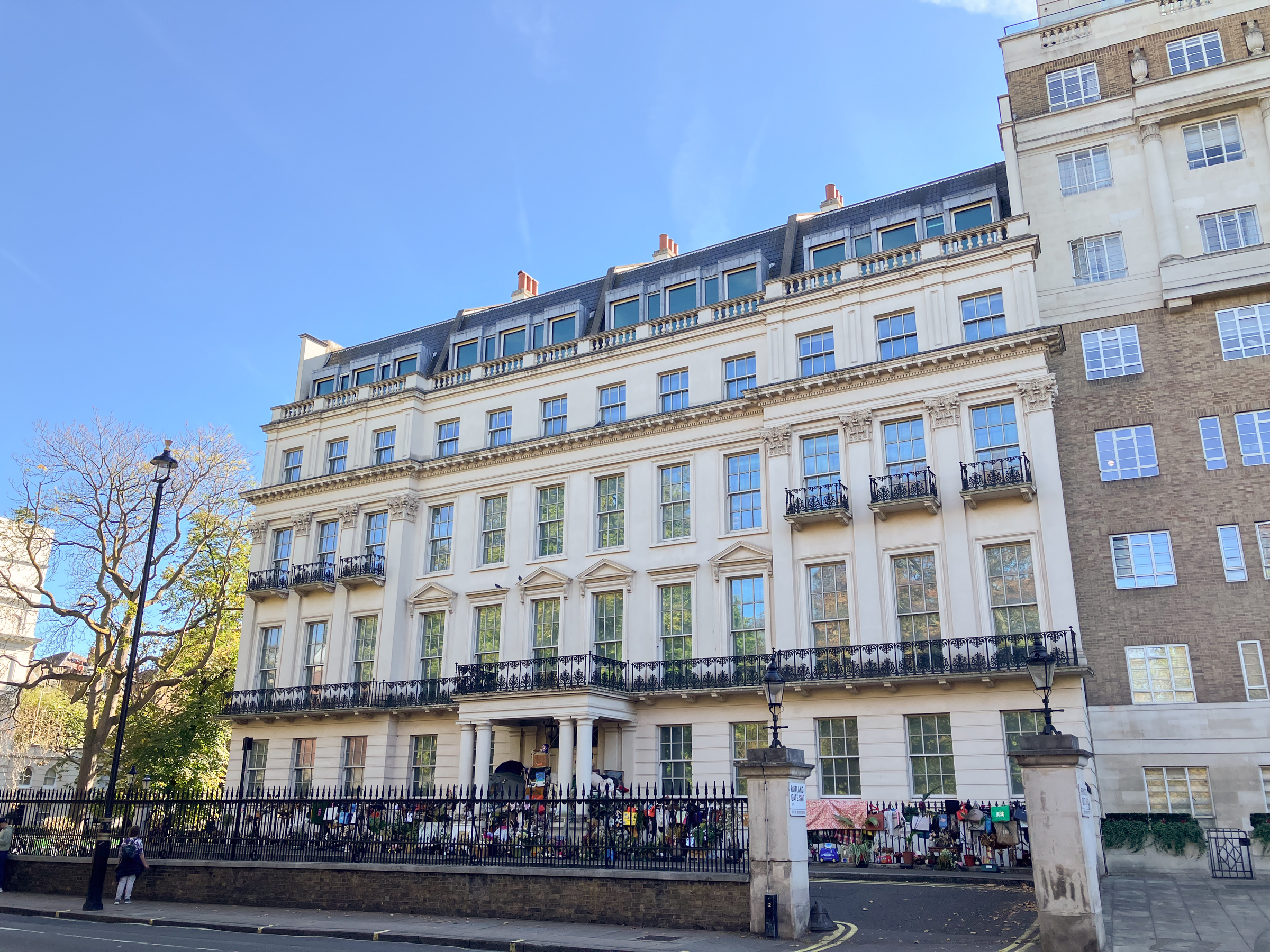
The founder and former chairman of China’s Evergrande Group, Xu Jiayin, is facing a situation where his £21 million luxury mansion in London is in a state of abandonment. Situated in one of the most expensive residential markets in London and globally, the mansion was already vacant before Xu Jiayin purchased it. With Xu Jiayin’s plans to rebuild the mansion halted due to investigations and Evergrande facing a collapse, the mansion continues to deteriorate.
Upon a recent visit to the mansion by Epoch Times reporters, it was observed that the seven-story building located across from Hyde Park in the affluent Knightsbridge area appeared grand from a distance. However, upon closer inspection, the windowsills were covered in dust, leaves littered the walls, black mold was visible at the base of the iron fence, and the gates and fences facing Hyde Park were cluttered with belongings of homeless individuals, with flocks of pigeons scavenging for food in front of the entrance.
The mansion, located at 2-8a Rutland Gate, previously housed prominent figures including a former Prime Minister of Lebanon and the Crown Prince of Saudi Arabia. Once a magnificent palace-like residence, it has been left unrepaired since the passing of its last owner. Xu Jiayin’s purchase in 2020 through Hong Kong real estate tycoon Zhang Songqiao did not lead to the planned reconstruction, and subsequent attempts to resell were unsuccessful, resulting in the mansion being abandoned for years.
Three years ago, homeless individual Anders Fernstedt sought shelter from the rain by setting up a tent in the mansion’s porch facing Hyde Park. Despite the mansion being ignored, Fernstedt’s “home” outside the porch underwent changes as he amassed plants and objects, gradually expanding to both sides of the porch. Today, Fernstedt, along with the mansion, has become a familiar presence.
Fernstedt, a Swedish national, shared that he previously worked as a journalist for the Financial Times in the UK and had experience in technical research and gardening to help his mother. However, facing financial difficulties, he resorted to living on the streets.
In the past three years, Fernstedt mentioned encountering only one Chinese man visiting the mansion, who requested him to clear the pathway but did not gaze inside. Additionally, he recalled instances where individuals drove into the underground garage without conversing with him, indicating minimal human interaction around the property.
As the news of the mansion unfolded, various groups of Chinese and international visitors came to photograph it. Notably, a resident of Lebanese descent expressed concerns regarding the mansion’s deteriorating internal structure and advocated for its possible sale or transformation into a high-end hotel to prevent prolonged abandonment.
The long-time resident noted being unaware of the mansion’s acquisition by a Chinese buyer. Fernstedt’s stay by the mansion’s entrance has remained uninterrupted, with his tent gradually expanding and filling the exterior with belongings, visible changes evident when compared to a photograph from 2015.
Despite this, Fernstedt reiterated his commitment not to enter the property or cause damages but expressed gratitude for peacefully residing at the mansion’s doorstep. The legality of sleeping rough in the UK and lack of complaints or legal actions have allowed Fernstedt to establish his makeshift “paradise” under the mansion’s shadow.
Reflecting on his three-year tenure, Fernstedt pondered the uncertainty of his prolonged stay and expressed readiness for the next chapter, despite the unknown destination, emphasizing a sense of appreciation for the time spent at the mansion.
The mansion’s history dates back to the 1750s, with significant modifications carried out by billionaire Rafic Hariri in the 1980s-1990s, transforming it into a lavish palace featuring gold leaf decoration, an indoor swimming pool, multiple elevators, a ballroom, and marble baths. After Hariri’s assassination in 2005, the property was gifted to Saudi Crown Prince Sultan bin Abdul Aziz, who resided there until his passing in 2011.
Following a failed sale attempt for £300 million in 2015, the mansion underwent internal dismantling and auctions of luxury furnishings, with plans to convert it into luxury apartments. However, the conversion project into 13 units remained unimplemented by the time of its acquisition in 2020.
Xu Jiayin’s aspirations for the mansion’s reconstruction were overshadowed by Evergrande’s debt crisis, leading to discussions of overseas debt restructuring and asset sales in 2022. The mansion was quietly listed for sale in autumn 2022, attracting interest from potential buyers, including Middle Eastern royalty and affluent American investors.
However, Xu Jiayin’s legal troubles in China and the freezing of Ding Yumei’s assets halted the sale plans, leaving the mansion abandoned, depicting a stark contrast to its once opulent past. Currently, there have been no new records regarding 2-8A Rutland Gate following its 2020 acquisition.