
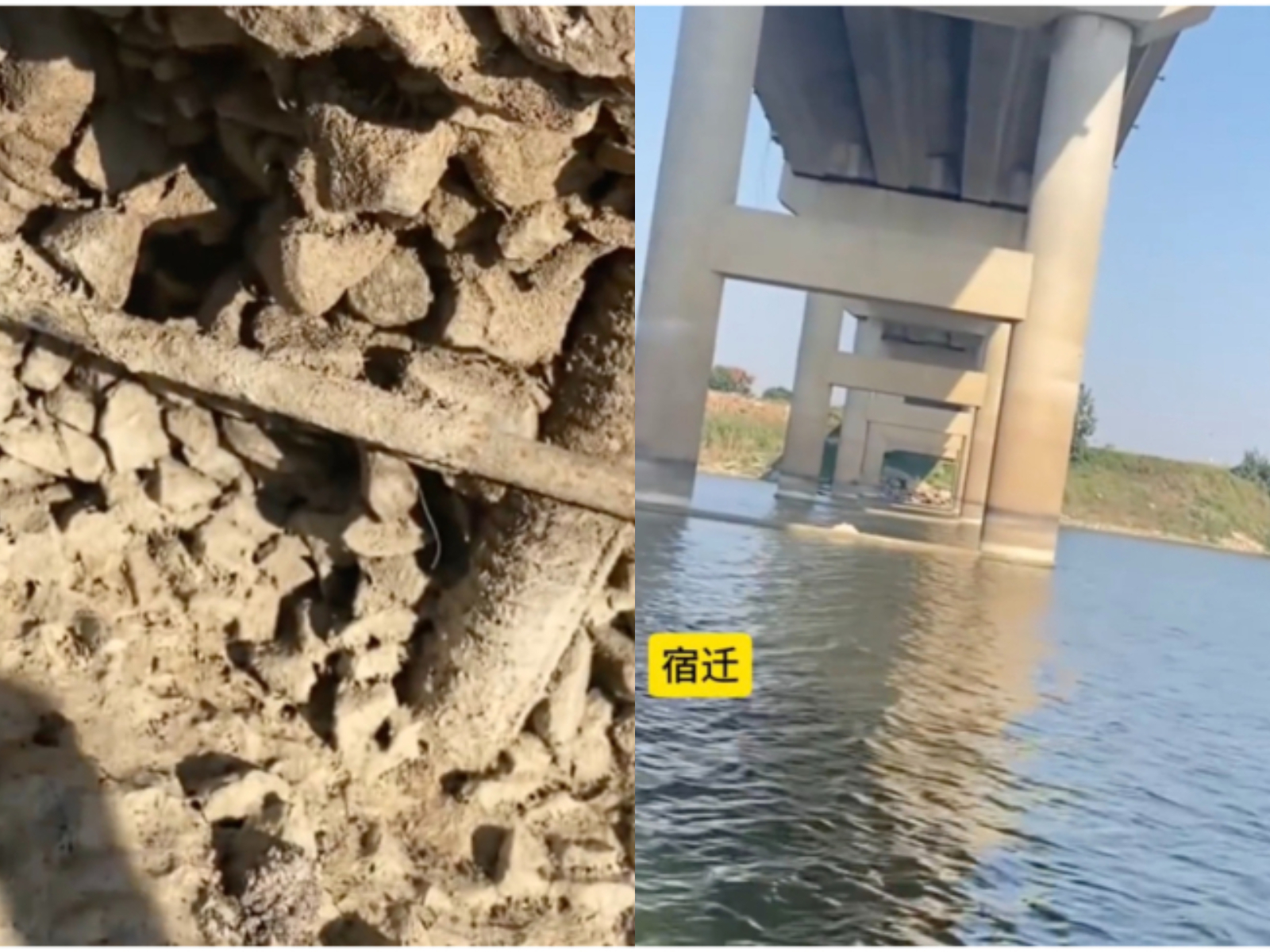
On October 8th, the “Tongyue Line Xinyi River Grand Bridge” in Shuyang, Suqian City, Jiangsu Province was reported to have safety hazards such as concrete falling off the bridge piers and exposed steel bars. The local transportation department responded that as the bridge was built over a decade ago, they were unable to locate the responsible person at that time, leading to public doubts about the quality of the construction and file management.
Video footage captured by netizens showed the surface concrete and gravel of the “Tongyue Line Xinyi River Grand Bridge” peeling off, exposing a large area of inner steel bars, some of which have started to rust.
County transportation department officials told the New Beijing News that they had received complaints from local residents about the issue before, but as the bridge was constructed over a decade ago, they could not find the person in charge at that time. The construction team is now preparing to address the situation.
Many netizens questioned this explanation, stating that information regarding such a large bridge should typically be permanently preserved, and it is unacceptable to claim that the responsible person cannot be found. They believe that the exposed steel bars are a result of construction quality issues, for which both supervision and inspection departments should be held accountable.
Others pointed out that if the quality of the reinforced concrete was normal, it should not deteriorate in such a manner even after a hundred years. They called for relevant authorities to intervene and investigate the situation. According to them, the quality of the bridge piers shown in the video clearly indicates a construction quality issue, where the concrete grade did not meet standards, resulting in low strength and significant safety hazards that must be addressed.
In fact, inferior construction projects in mainland China are not uncommon, with collapses occurring at an alarming rate. On February 20, 1998, the Jiaojiawan Bridge in Badong County, Hubei Province collapsed during construction, leading to the immediate death of 11 individuals.
In May 1998, the Kunlu Highway in Yunnan Province, which was constructed with an investment of 380 million yuan, experienced severe quality problems such as road subsidence and surface cracking just 18 days after its official opening, requiring an additional investment of 100 million yuan for repairs. Over the next decade, the Kunlu Highway remained trapped in a vicious cycle of repeated repairs.
On January 4, 1999, the Rainbow Bridge in Qijiang, Chongqing, which had only been in operation for three years, suffered a catastrophic collapse, claiming the lives of 40 people.
On March 9, 2003, the Shigangzui Bridge in Xinyi City, Guangdong Province suddenly collapsed while its main construction had just been completed and not yet renovated. A reporter from the Guangzhou Daily found that cement blocks at the site would crumble under slight pressure.
On September 28, 2010, the Baishazhou Yangtze River Bridge in Wuhan began a 40-day period of closed maintenance. The total investment in the bridge was 1.1 billion yuan, and over the course of its first ten years of operation, it had undergone 24 maintenance projects, averaging less than one year between each repair.