
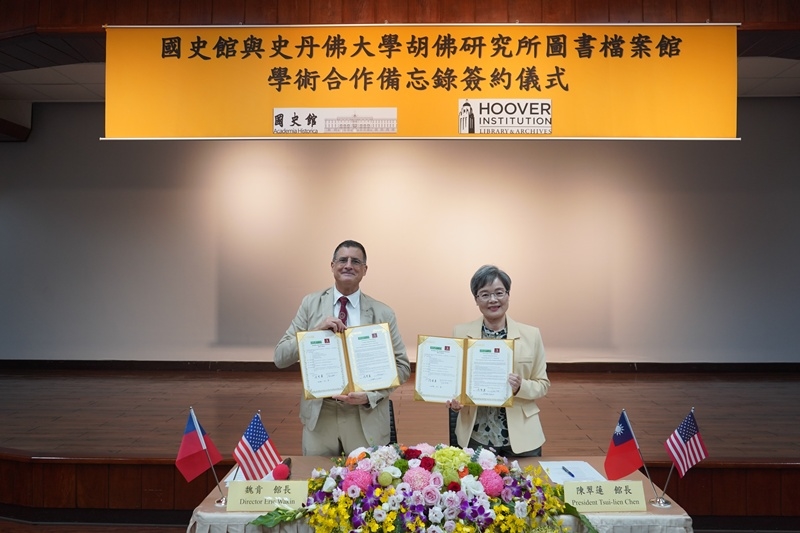
The National Museum of Taiwan History (NMT) signed a memorandum of academic cooperation with the Hoover Institution Library & Archives at Stanford University on the 8th of October. NMT Director Chen Tsui-lian stated that they will continue to deepen the research and promotion of Taiwan’s democratization history, creating a platform that “unites our common history” through the mutual verification of diverse historical materials.
According to the press release issued by the NMT, the signing ceremony of the memorandum took place at the NMT Taipei Branch, with Chen Tsui-lian and Eric T. Wakin, Deputy Director of the Hoover Institution and Director of the Library & Archives, signing on behalf of their respective institutions. Former NMT Director Chen Yi-shen and Lin Hsiao-ting, Research Fellow at the Hoover Institution and Director of the East Asia Collection at the Library & Archives, were also in attendance as witnesses.
In her speech, Chen Tsui-lian emphasized the significant achievements accumulated by the NMT under the efforts of past directors. Building upon this foundation, she expressed the commitment to further deepen the research and promotion of Taiwan’s democratization history. It is not only about reminding society of the arduous journey towards democracy and freedom but also about cherishing the hard-won democratic system.
Chen Tsui-lian highlighted that the NMT and the Hoover Archives respectively house representative archives and personal documents related to Taiwan and modern China. Through establishing a long-term close cooperation mechanism, researchers can transcend geographic and collection limits, allowing for the mutual verification of diverse historical materials to create a platform that “unites our common history.”
The collaboration between the two institutions began with the Chiang Kai-shek Presidential Database project in 2020. During the pandemic in 2021, they first signed the academic cooperation memorandum via video conferencing. The renewal took place in 2024, and this year marked the first joint attendance at the signing ceremony by both parties.
Past collaborations between the NMT and the Hoover Archives have resulted in the publication of a six-volume series titled “Post-war Taiwan Historical Materials and Research: Diary During Huang Chieh’s Tenure as Police Chief”, which presents the workings of post-war Taiwanese politics and authoritarian systems. The NMT also plans to integrate the archives of Wang Sheng and President Chiang Ching-kuo, with the publication of a two-volume series titled “Wang Sheng and Military Aid to Vietnam Work Archives” scheduled for July next year.
The collaboration also involves the opening of the diaries of the two Chiangs. After about 10 years of transnational litigation, around 59 crates of original Chiangs’ diaries and related documents were returned to the NMT in September 2023. Since March 2024, the NMT has quarterly released catalogs and image files, with 34 volumes of Chiang Kai-shek’s diary and 29 volumes of Chiang Ching-kuo’s diary already published.
Following the signing ceremony, Eric T. Wakin delivered a keynote speech emphasizing that archives should not remain dormant in storage but be brought to life through publications, exhibitions, and digitization. He cited the example of Mao Zedong’s former private secretary Li Rui’s diary, illustrating how the institution invested $6 million in transnational litigation to protect precious historical materials and honor the wishes of donors.
Wakin underscored that one of the crucial missions of the Hoover Archives is to become a “safe haven for endangered historical materials.” With the development of digitization and artificial intelligence translation technology, he believes that language barriers will be reduced, enabling more researchers to utilize historical archives from around the world.