
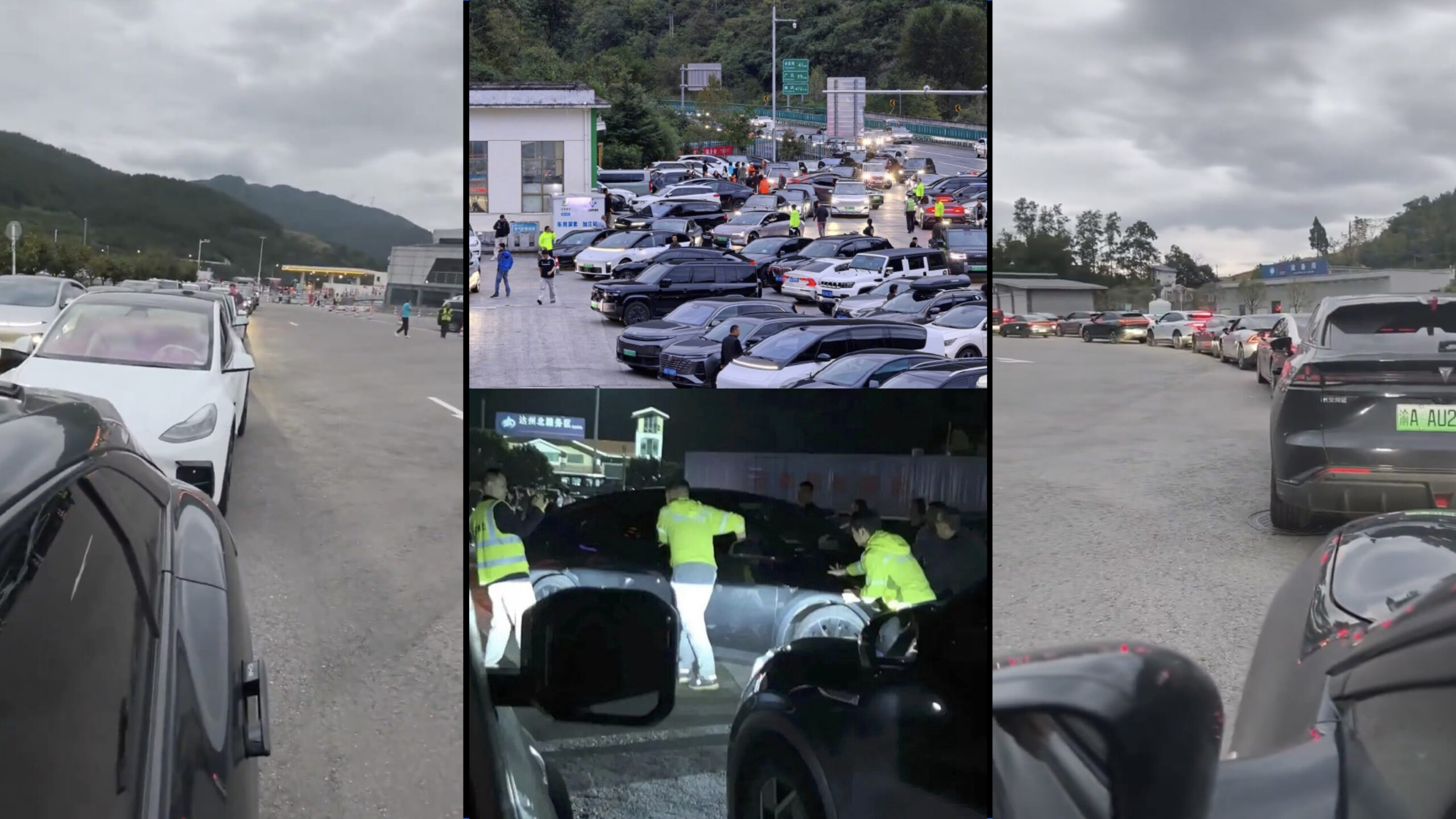
During the “Golden Week” holiday, the flow of new energy vehicles on highways in mainland China surged, highlighting once again the challenge of charging at service areas in various locations. Scholars interviewed pointed out that the authorities are vigorously supporting the electric vehicle industry in order to compete for global dominance in the automotive market, while the public facilities, quality, and risk costs are borne by consumers.
During the “Golden Week” holiday, the flow of new energy vehicles on Chinese highways increased significantly (reaching a peak of about 17.8 million trips on the first day). Although there are approximately 89,000 charging facilities built in service areas nationwide, the supply-demand contradiction remains prominent. Serious congestions occurred at service areas in many places, with some car owners waiting in queues up to number 169, with waiting times ranging from 5 to 7 hours on average, and even waiting overnight.
Even if car owners manage to get in line, they may not necessarily be able to recharge quickly: some high-power “flash charging” stations suffered from insufficient energy storage due to continuous usage by multiple vehicles, resulting in a slowdown to “slow charging”; similarly, swapping stations also experienced congestion with dozens of people waiting, taking more than 5 hours.
On October 4, Xinhua News Agency published an article titled “Holiday Electric Car Travels Face Charging Challenges, How to Overcome Charging Anxiety,” focusing on the phenomenon of new energy vehicles queuing for charging in highway service areas during holidays. However, the widespread “charging anxiety” felt by society was portrayed in a positive light in official media, presenting it as another symbol of the thriving development of China’s new energy vehicle industry.
In this regard, American economist David Huang, when interviewed by the Epoch Times, provided analysis from the perspectives of industrial policies, energy structures, and public infrastructure.
Huang believes that with the rapid increase in the number of new energy vehicles, the problem of insufficient charging resources becomes more apparent during holidays. One significant reason for this phenomenon is the discrepancy between the speed at which the CCP promotes vehicle purchases and production expansion and the lack of synchronized development in public supporting infrastructure.
“Manufacturing and selling cars can directly generate income, investment, and achievements, whereas building charging stations, expanding power grids, and upgrading service areas require continuous investment and coordination among different departments.”
In his view, the challenge of high-speed charging difficulty cannot simply be understood as a lack of charging poles. “Having poles doesn’t necessarily mean adequate power supply; when multiple vehicles charge simultaneously, the power needs to be shared; limited service area space can block entry when there are queues.”
He believes that after the rapid increase in the number of new energy vehicles, what truly needs synchronously expanded is not only the charging poles themselves but also the electric grid capacity, transformers, service area space, and related traffic organization.
According to Huang, the predicament of high-speed charging reveals not just a service capacity issue on a specific holiday but also a balance issue between manufacturing and public services in the rapid expansion of the new energy vehicle industry.
Huang said, “Output, sales, exports, and factory scale can easily become achievements, while the waiting time, supporting costs, quality risks, and environmental costs borne by consumers can easily be overlooked.”
He mentioned that if evaluating the success of an industry is only based on production volume, sales volume, and export scale, it is easy to overlook the implicit costs borne by society and consumers during the industry’s expansion. “Therefore, evaluating the success of an industry cannot simply look at how much is produced, exported, but also needs to consider what society has sacrificed for it.”
Huang pointed out that the rapid expansion of the new energy vehicle industry will ultimately need to be scrutinized based on the actual costs borne by consumers. “Expanding domestic production capacity, companies reaping profits, while consumers enduring inconvenience and risks in the long term; this cost allocation is the core issue that industrial policies need to address.”
“Compared to traditional fuel vehicles, electric vehicles eliminate the complexity of engines and transmissions, reducing the manufacturing thresholds of certain power systems and allowing China to bypass some shortcomings in traditional automotive technology, rapidly expanding production based on its mature manufacturing industry, battery, and component supply chains.”
He mentioned that the Chinese authorities have been expanding the domestic market through subsidies, tax benefits, and license advantages, initially promoting domestic enterprises to scale and then further entering the competition in overseas markets. “This set of industrial policies prioritizes national strategy, domestic industry expansion, and export competition over consumer experience, quality, and safety.”
Huang stated that during the rapid expansion of the industry, consumer rights have not formed a strong enough constraint force. “The inadequacy of supporting facilities, product quality, and the costs of usage risks are borne by the consumers, becoming the cost of supporting industry growth.”
He also mentioned that the phenomena of deception and subsidies surrounding new energy vehicles have exposed rent-seeking space in fiscal subsidies. Additionally, the tariffs and market access barriers faced by imported vehicles and parts will also increase the costs of competitive products, providing a certain degree of industrial protection for domestic vehicles.
He believes that national industrial strategies, corporate profit-seeking, and power rent-seeking may intertwine, “Prioritizing the benefits of industrial expansion while consumers bear the costs without receiving equal consideration.”
Regarding whether the long queues for charging on highways during holidays will impact consumer confidence in purely electric vehicles, Huang’s answer is affirmative.
“This particularly affects those who frequently travel long distances and cannot charge at home. Consumers buy a means of transportation, with the most basic requirement being convenience and reliability.”
In his view, consumers calculate the total operating cost when purchasing electric vehicles. If the saved fuel costs are exchanged for a substantial amount of waiting time and travel inconvenience, consumer judgment on what constitutes low-cost travel may change.
“Saving on fuel expenses in exchange for hours of waiting, restricted travel, or even hesitance to continue the journey will alter their perception of the cost of using vehicles.” He believes that some consumers may reconsider traditional fuel vehicles or opt for hybrid vehicles.
On the afternoon of October 6, 2026, in Baoding, Hebei Province, a domestically-produced new energy training vehicle belonging to Chi Yu Driving School lost control and collided with multiple vehicles, causing damage.
Talking about the reasons behind China’s vigorous promotion of the electric vehicle industry, Huang pointed out that this is primarily an industrial policy choice. He described electric vehicles being labeled as “new energy vehicles” as a form of “greenwashing,” where the electrification of vehicles is promoted as energy innovation, leveraging green and low-carbon labels to gain policy benefits, carbon emission-related advantages, and negotiating chips in climate talks.
“I believe this is a form of ‘false new energy’: promoting vehicle electrification as energy innovation, leveraging green and low-carbon labels to seek policy incentives, carbon emission-related benefits, and climate negotiation chips.”
He stated that electric vehicles are not a completely new technological concept, “Electric vehicles have existed for over a hundred years; electrification itself does not imply that the energy is new or clean.”
Huang particularly mentioned China’s energy structure. He cited relevant data indicating that about 78 million kilowatts of new coal-fired power capacity was commissioned in China in 2025, accounting for approximately 80% of global new capacity during the same period. He believes that if the electricity used by electric vehicles mainly comes from coal-fired power generation, then energy consumption and emissions simply shift from the tailpipes of vehicles to the power generation end.
In addition to the energy-related controversies, Huang pointed out that the advancement of the electric vehicle industry also aims at another significant target: competing for the global automotive market.
Regarding the incidents of vehicle fires, spontaneous combustions, accidents, and charging issues reported by consumers, Huang believes that there needs to be open investigations and responses.
“Handling criticism with content deletion, account suspensions, and legal pressures will restrict consumer expression and rights, but will not resolve product and infrastructure issues. Industrial protection cannot become a reason to suppress consumers,” he said.
China’s electric vehicles frequently face quality issues.
China’s Chery driving【Regents Park】middle【kiwi】axis beam and two wheels fall off.
A video circulating online shows the vehicle’s rear axle and two wheels still connected, falling behind the vehicle.
The video has gone viral on overseas social media platforms, sparking discussions:
“Incredible.” “If you see a car like this, don’t get too close.” “With low-end torsion beam models, the wheels fall out like this, if it’s independent suspension, a half wheel should fly out.”
— The Epoch Times News Network (@dajiyuan)
October 7, 2026
China AI Smart Electric Vehicle, Super Cool 7X!
Highest safety factor in China, and very thoughtful, if you are in a bad mood, it will automatically set off fireworks for you to see! Superb Chinese AI! https://t.co/whotmAp4YB
【Car Guru Reveals the Cause of the Breakage in the Regent’s Brake System: The Bracket is Too Weak】
— The Epoch Times Whistleblower Platform (@china_epoch)
October 8, 2026