
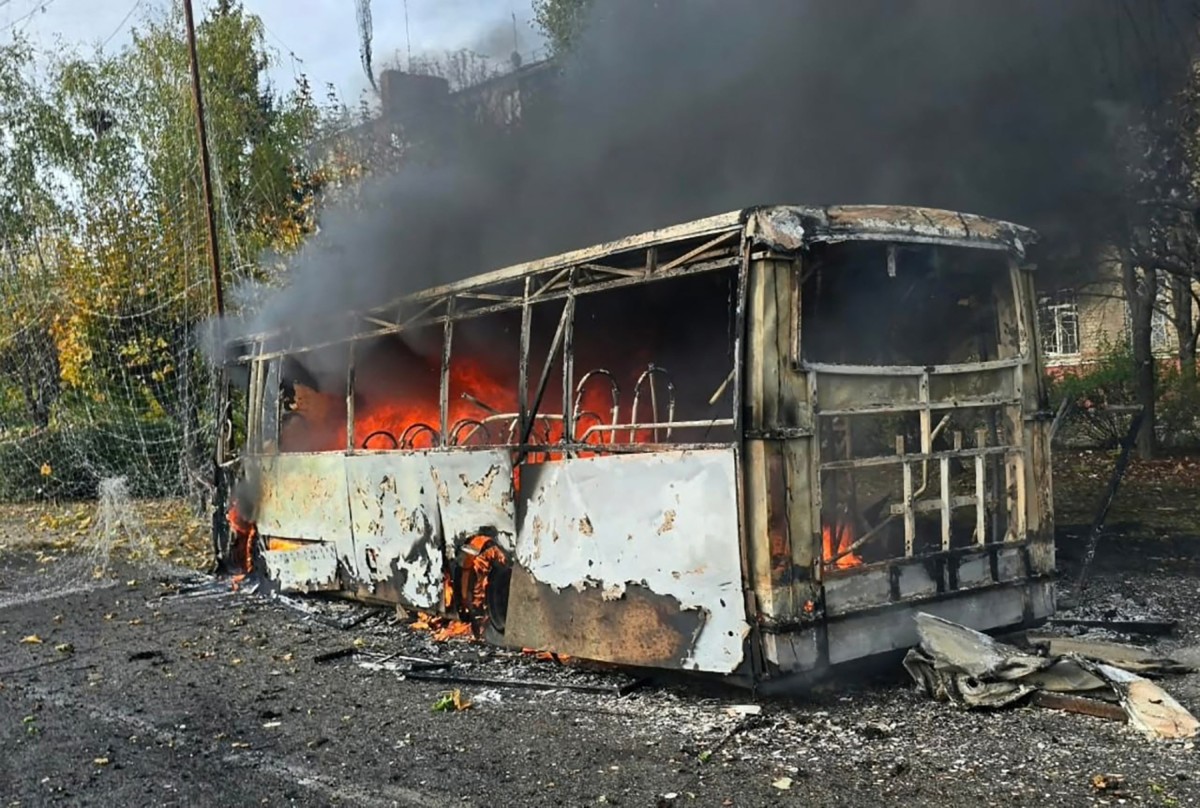
Ukrainian officials stated on Thursday (October 8th) that the Russian military launched a gliding bomb attack on the frontline city of Kramatorsk in eastern Ukraine, hitting two civilian buses driving on the streets and parked at a bus stop, resulting in at least 33 deaths and 18 injuries.
This incident was described by Ukrainian authorities as the deadliest single attack by Russia leading to civilian casualties so far this year.
Images released by Ukraine’s State Emergency Service (SES) and local police showed the engulfed public bus, leaving behind only a charred metal shell, with scattered debris and bodies on the street.
Ukrainian President Volodymyr Zelensky identified the attack location as a public bus station, with details provided by the police indicating that two city buses were traveling on the street at the time.
Vadym Filashkin, the military and civil administration chief of Donetsk Oblast, condemned the attack on Telegram social media, accusing the Russian military of deliberately targeting civilians.
Filashkin expressed concern that a bus filled with passengers is an attractive target for the Russian military, as it can cause mass casualties with a single strike. He ordered the immediate suspension of all public transportation in Kramatorsk and the nearby city of Slovyansk due to the deteriorating security situation, urging the remaining residents to evacuate to safer areas in Ukraine.
The Kramatorsk City Council denounced the attack as a “terrorist act by the Russian military against civilians,” emphasizing that the targeted location had “no military objectives.” Zelensky also expressed condolences to the families of the victims on Telegram, urging Ukraine’s international allies to take “concrete actions” to enhance the protection of Ukrainian civilians through new defense assistance programs.
Kramatorsk and Slovyansk are core cities of the remaining “fortress belt” in Donetsk Oblast, serving as logistical and supply hubs for the Ukrainian military on the eastern front. However, with the advancement of the Russian military towards the eastern suburbs, these cities have been frequently targeted by glide bombs and long-range fire. Glide bombs, equipped with wings for guidance, can be deployed from tens of kilometers away to strike targets, posing a significant threat to local security.
CNN cited a spokesperson from the Ukrainian 93rd Mechanized Brigade, stating that due to frequent shelling by the Russian military, Kramatorsk can no longer serve as a rear base for troops to retreat and regroup. The report also mentioned that over the past four years of conflict, the fortress belt has been slowly eroding, with the supporting point at Kostiantynivka, located at its southern end, effectively falling.
Moscow has not officially commented on the attack on Kramatorsk. Reuters reported that Russia had previously demanded Ukraine cede the remaining 20% of Donetsk Oblast still under Ukrainian control as a ceasefire condition, which was rejected by Ukraine. Despite Russia consistently denying intentional targeting of civilians, the recent attacks on Ukraine have escalated. According to the United Nations, as of August 2026, the number of civilian deaths in Ukraine due to airstrikes this year has surpassed the total for the whole of 2025.
The day before this incident, a five-story residential building in Pryluky, Ukraine was attacked by the Russian military, resulting in 22 deaths, including 5 children. On Thursday, the capital city Kyiv also faced another attack with explosive-laden drones by the Russian military, causing 3 deaths, 14 injuries, and triggering widespread power outages and water supply difficulties.
As reported by the BBC, British Foreign Secretary Yvette Cooper strongly condemned the Russian attacks during her meeting with Zelensky in Kyiv on Thursday, denouncing it as part of Russian President Vladimir Putin’s “evil strategy.” She announced further sanctions against Russia’s shadow fleet, oil companies, cryptocurrency, and military financing, reaffirming strong support for Ukraine.