
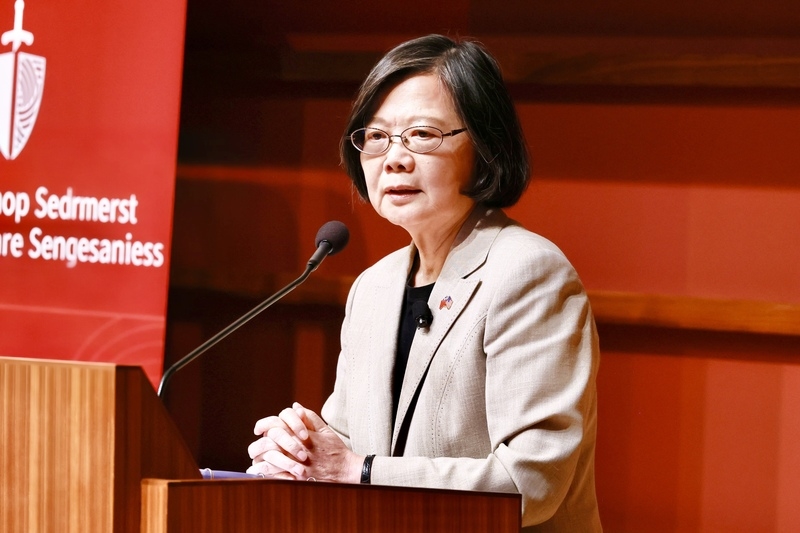
Former President of the Republic of China, Tsai Ing-wen, visited the United States and delivered a speech at Stanford University, where she emphasized that Taiwan faces complex threats from the Chinese Communist Party on a daily basis. Taiwan possesses a strong and independent industry chain in semiconductor, drones, and other crucial sectors, making it an indispensable partner in global security and supply chains. She expressed her hope for democratic partners to leverage their respective strengths to build a more resilient supply chain with Taiwan.
During the Stanford DEFCON “2026 Technology and National Security Seminar” on October 7th, Tsai Ing-wen delivered the opening speech titled “Building Security Together: Taiwan’s Role in Global Stability.” She highlighted the intertwined nature of technology and national security, emphasizing the importance of economic resilience, supply chains, industrial capabilities, and access to critical technologies in maintaining peace in the Indo-Pacific region.
Tsai Ing-wen underscored the rapidly evolving security environment, where challenges cannot be neatly categorized anymore. She pointed out that technology advancements such as AI, autonomous systems, drones, and communications technologies are transforming the nature of security competition, necessitating a comprehensive approach involving industry, researchers, investors, and civil society. She emphasized the critical need for both determination and resources to translate commitments into tangible capabilities swiftly.
The former president highlighted Taiwan’s daily encounters with cyber attacks, cognitive warfare, information manipulation, economic coercion, and actions seeking to compromise critical infrastructure. She noted the frequent activities of Chinese military aircraft and vessels surrounding Taiwan, along with increasing maritime presence of coast guards and other operations in the vicinity.
Tsai Ing-wen stressed the importance of Taiwan’s responsiveness to these pressures while maintaining confidence, freedom of action, and enhancing self-defense capabilities to deter potential aggressions. She emphasized the significance of continuous adaptation to gray zone activities, which aim to escalate costs, test responses, and gradually alter Taiwan’s security environment without risking overt confrontation.
In addition, she discussed the broader regional implications, highlighting Taiwan Strait’s critical role as a major trade and energy transportation route worldwide and Taiwan’s deep integration into global technology and manufacturing networks. Any significant disruptions in this area would have widespread repercussions across the Indo-Pacific region and possibly beyond.
Tsai Ing-wen addressed the imperative for Taiwan to prepare for various scenarios, emphasizing the importance of balancing traditional military capabilities with smaller, more agile, and decentralized systems. She noted the ongoing evolution in Taiwan’s defense strategy influenced by discussions on these concepts that have gained broader acceptance and shaped the nation’s defense posture today.
Furthermore, she emphasized the need for Taiwan to enhance societal resilience beyond hardware and military capabilities to ensure normal operations in essential sectors like communication, energy, healthcare, public services, and access to reliable information. During her presidency, Taiwan began integrating cybersecurity into national security and investing more resources to boost societal crisis response capabilities in combating misinformation and information manipulation.
She emphasized the critical role of public trust in institutions as a fundamental component of national resilience, emphasizing the importance of establishing trust before crises occur. Tsai Ing-wen highlighted the vulnerabilities authoritarian forces exploit in democratic societies to sow division and erode trust, underscoring that a robust system and functioning essential services, along with mutual trust among citizens and the government, are vital elements of overall national defense capabilities.
Tsai Ing-wen positioned Taiwan as a key player in global manufacturing capacity and supply chain solutions, going beyond being seen solely as a security-risk region in need of assistance. She highlighted Taiwan’s ability to significantly contribute to manufacturing production capacity and addressing supply chain challenges, reinforcing the narrative of Taiwan as a democratic country capable of offering crucial support rather than solely being dependent on security assistance.
She discussed the pivotal role of Taiwan in semiconductor production and its broader impacts, emphasizing Taiwan’s role in producing critical components for advanced AI systems, servers, and satellite technologies that underpin global technological advancements. The importance of Taiwan’s industrial capabilities and contributions across various sectors highlighted how Taiwan’s strength is integral in ensuring a secure and reliable global supply chain.
Tsai Ing-wen underscored the need for democratic nations to collaboratively build a network to reduce overdependence on a single source, ensuring joint responses during supply chain disruptions or security crises. She pointed out Taiwan’s indispensable role in technological sectors such as drone technology, where over 200 Taiwanese companies are involved, showcasing Taiwan’s expertise in producing essential components for drones and countering UAV systems.
The former president emphasized Taiwan’s unique position as a central player in manufacturing and technology industries along the first island chain, highlighting Taiwan’s geographical location, democratic system, technological capabilities, and industrial strength as irreplaceable assets contributing to regional stability in the Indo-Pacific region. She stressed Taiwan’s ability and responsibility to make significant contributions to the international system based on its accumulated capabilities.
Tsai Ing-wen noted the global trend of nations re-establishing manufacturing capacities and the necessity for collective efforts in this endeavor. She reiterated Taiwan’s crucial role in this process, given its advanced manufacturing capabilities, accumulated processing experience, engineering talent, and a comprehensive electronics industry supply chain, all of which have been developed over decades.
Looking forward, she advocated for deepening cooperation with Taiwan, not only to enhance Taiwan’s security but also to bolster regional stability and increase the resilience of democratic countries collectively. Tsai Ing-wen concluded that Taiwan’s collaboration is imperative in building the necessary industrial and technological capabilities to ensure resilience in technology, industry, and security, highlighting Taiwan as an essential and indispensable partner in this shared endeavor.