
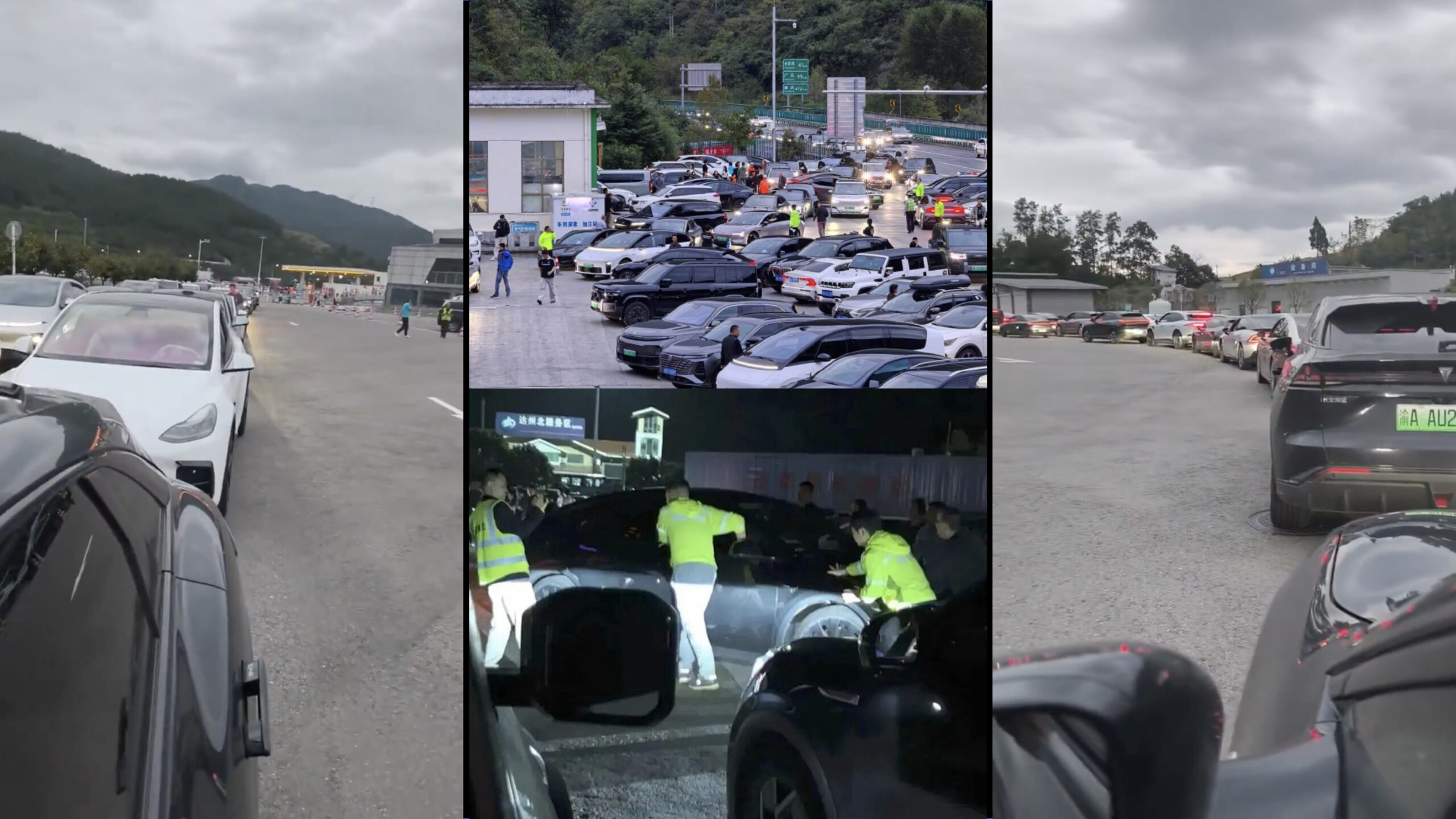
During the “National Day” holiday season, the amount of electric vehicle charging in China’s highway service areas surged, causing car owners to once again be caught in a “charge post battle.” Some owners waited for several hours or even until daybreak before their turn to charge. Experts interviewed pointed out that the difficulty in high-speed charging is not just due to insufficient charging posts, but also factors like the sudden surge in holiday demand and the challenge of balancing investment with actual needs.
The “National Day” holiday period saw a significant increase in the number of electric vehicles (commonly referred to as “new energy vehicles”) on China’s highways, leading to difficulties in charging in multiple service areas.
Recently, a netizen shared a video of their experience during the “National Day” holiday self-driving trip. They mentioned spending almost three days either charging or searching for charging posts, or stuck in traffic.
The netizen described their holiday trip with friends from Nanjing to Henan’s Nanyang and Laojieling Scenic Area, covering over 1000 kilometers. While the friend drove an electric car to save on fuel costs, the netizen drove a Toyota sedan, incurring a gas expense of 500 yuan. The friend’s electric car had to be charged seven times, costing over 500 yuan, with the longest wait exceeding four hours. To await their friend, the netizen had to stay in a hotel temporarily, waking up at 3 am to see their friend still queuing for charging.
On social media, many car owners shared their experiences of long lines for charging and the struggle to find available posts. Some posted pictures showing their queue numbers, with some even waiting until daybreak to charge.
Furthermore, a car owner revealed that their new energy vehicle’s battery was at 1% and couldn’t proceed, eventually being pushed to a charging post by service area staff and other car owners.
Reports from media outlets like The Paper and “Xiaoxiang Morning News” indicated that the “charge post battle” phenomenon was widespread across the country.
According to reports, Mr. Li from Chengdu had to queue for four and a half hours while driving 1000 kilometers. Another car owner at the Lingjiang service area on the Beijing-Kunming Expressway got number 99 and waited over five hours to charge. Another car owner with the surname Liu from Gansu queued for about 7 hours at the Luotang service area on the Lanhai Expressway, finally charging at 5 am the next day. At the Zaoyangbei service area in Hubei, a queuing system with around 200 vehicles was implemented.
The Chinese transportation authorities estimated that during the first day of the “National Day” holiday, the peak flow of new energy vehicles on highways reached about 17.8 million trips, 1.8 times the usual volume. Currently, there are approximately 89,000 charging facilities in service areas nationwide.
Chinese problem expert Wang He, in an interview with Epoch Times, pointed out that the difficulty in electric vehicle charging is not simply due to “insufficient charging posts” but the “tidal” supply-demand conflict caused by concentrated electric vehicle travel.
“The normal charging utilization rate is less than 30%, and in remote areas, it’s even below 5%; so during holidays, the charging system becomes overwhelmed, up to 4 to 5 times the usual volume,” Wang explained.
It was reported that various types of electric vehicles, including pure electric ones, extended-range hybrids, and plug-in hybrids, queued for charging at highway service stations. Owners have differing opinions on the use of high-speed charging resources.
Some pure electric vehicle owners believe that extended-range and plug-in hybrids occupy the already limited high-speed charging resources. Certain owners noted that in some service areas, “8 out of 10 posts are used by hybrids,” while others observed that “more than half of the vehicles in line are extended-range cars.”
Owners of extended-range hybrids mentioned that since their vehicles have relatively smaller battery capacities, the actual charging time might not be long; if high-speed charging queues are substantial, they would switch to using the fuel mode to continue driving.
Meanwhile, some owners complained that even high-power “fast charging” stations couldn’t achieve the advertised charging speeds when there were many vehicles in line. Some expressed frustration that despite promises of charging in 5 minutes or reaching full charge in 9 minutes, the actual process was significantly slower due to insufficient energy cabinet capacity, turning “fast charging” into slow charging.
Brand customer service representatives explained to Sina Finance’s “BUG” column that the current situation can’t be artificially intervened, thus owners can only try switching to other fast charging stations.
Even at battery swapping stations, congestion was observed. According to the “BUG” report, information from a car owner indicated that 28 people were already waiting at a swapping station, with the system estimating a wait time of 5 hours and 16 minutes.
To address the surge in electric vehicle charging at highway service areas and the challenge of charging difficulties, some service areas implemented temporary measures requiring vehicles to leave once they reached an 80% charge.
However, some car owners are concerned that stopping charging at 80% may lead to range anxiety in situations like highway congestion, cold weather, or inadequate service areas in subsequent routes.
The “charge post battle” is not unique to this year’s “National Day” holiday but a recurring issue during long holidays in recent years. Both official entities and enterprises are attempting to cope with temporary interventions, including mobile equipment, temporary traffic control, and information guidance, such as restrictions allowing only up to 80% charge.
According to Wang He, the temporary measures taken by authorities do not address the root problem. The real challenge faced by the charging post industry is how to maintain balance between investment, facility updates, and actual demand in a scenario of rapid technological advancements, high demand fluctuations, and concentrated resources.
He elaborated that China is continuously increasing the number of charging posts. As per official plans, future charging infrastructure will expand further, raising questions about where these additional facilities will be located and who will enter these markets, posing new challenges.
“In the five-kilometer radius around high-speed highways and city core and boundary stations, due to relatively higher profits, these areas are firmly controlled by central enterprises,” Wang stated. He emphasized that high-speed highway charging facilities have a different issue compared to regular urban charging stations when it comes to core scenarios like highways, where monopolized resources like land, power grids, and transformers become critical limitations.
He further noted the evident over-competition in the charging post industry at present, attributing it to excessive investment.