
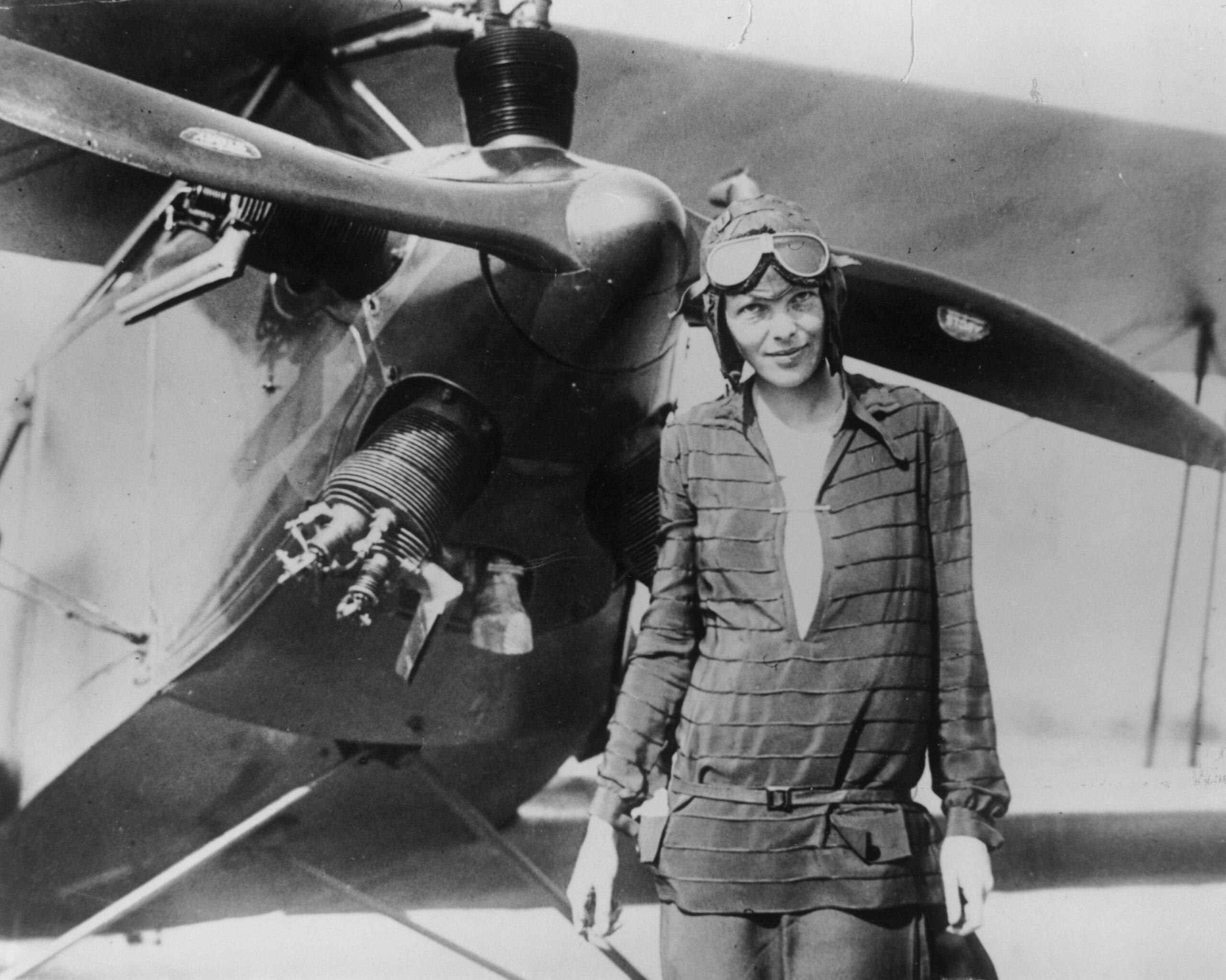
For nearly 90 years, a century-old mystery hidden deep beneath the Pacific Ocean may be on the verge of being solved. In October 2026, a team of top explorers from Purdue University in the United States and the Oregon State Archaeological Heritage Research Institute secretly set out on a mission to the remote island of Nikumaroro in Kiribati, equipped with underwater mud suction and magnetic survey equipment.
Their sole objective: to recover and unveil the mysterious structure submerged in the lagoon known as the “Taraia Object.” This object, hidden in the sediment, is believed to be the final puzzle piece in unraveling the disappearance of the legendary American aviator, Amelia Earhart.
Amelia Earhart, one of the most renowned aviation pioneers of the 20th century, set numerous records throughout her career. From flying solo to reaching record altitudes as a female pilot in the 1920s to becoming the first woman to fly solo across the Atlantic in 1932, she left a lasting legacy in aviation history.
In 1937, Amelia Earhart and navigator Fred Noonan embarked on a challenge to become the first woman to complete a circumnavigational flight around the globe in a Lockheed Electra 10E aircraft. However, during the 31st leg of their journey from Lae, New Guinea to Howland Island in the Pacific, they lost contact with the ground on July 2.
Despite a 17-day search and rescue operation by the U.S. government, no traces of the aircraft or its occupants were ever found. Over the past century, two main theories about Earhart’s fate have emerged: the mainstream belief of a “crash at sea” scenario versus the “Castaway Hypothesis,” suggesting they landed on an uninhabited island, possibly Nikumaroro, and perished while attempting to survive.
The focus of the expedition team on the “Taraia Object” dates back to 1938, a year after Earhart’s disappearance. Satellite images captured the object in the underwater “anomaly zone” of Nikumaroro in 2020. Experts noted that sediment movements over the years have intermittently exposed and buried the object, making it challenging to study.
According to Purdue University’s Senior Vice Provost and General Counsel Steve Schultz, radio signals received in North America days after the disappearance, along with the discovery of female skeletal remains and 1930s artifacts on the island in 1940, lend support to the idea of Earhart and Noonan survived for a period on the island. The ongoing underwater excavation of the object aims to provide definitive answers to the enduring mystery surrounding Earhart’s fate.
The expedition team, comprised of 17 archaeologists specializing in land and marine exploration, departed from the United States to Kiribati’s capital, Tarawa, before heading to the target area. Due to the steep terrain of the atoll’s edge, anchoring was impossible, requiring the team to utilize powered anchoring near the coast for five days. Using hydraulic pumps to remove sediment from the object’s surface and combining magnetic surveying with sonar scanning will be essential for identification and excavation. The entire process will be documented on the Archaeology Channel’s streaming platform.
Despite the efforts of the team, some experts remain skeptical. Ric Gillespie, executive director of The International Group for Historic Aircraft Recovery (TIGHAR), highlighted that past explorations in the specific location did not yield any remnants linked to Earhart.
Furthermore, a deep-sea team in 2024 captured sonar images resembling an aircraft, later confirmed to be natural rock formations, emphasizing the challenges and uncertainties of maritime searches.
Before her final flight, Amelia Earhart served as a career advisor to female students and aviation department consultant at Purdue University. Schultz emphasized that based on her legacy at the university, the team’s responsibility is to “follow the evidence in search of the truth,” regardless of the outcome regarding the object’s connection to Earhart.
This investigation has garnered full support from the Kiribati government. As the expedition team delves deeper into the Pacific lagoon, one of the biggest mysteries in aviation history that has intrigued humanity for almost a century may soon be on the brink of revealing its crucial truth.