
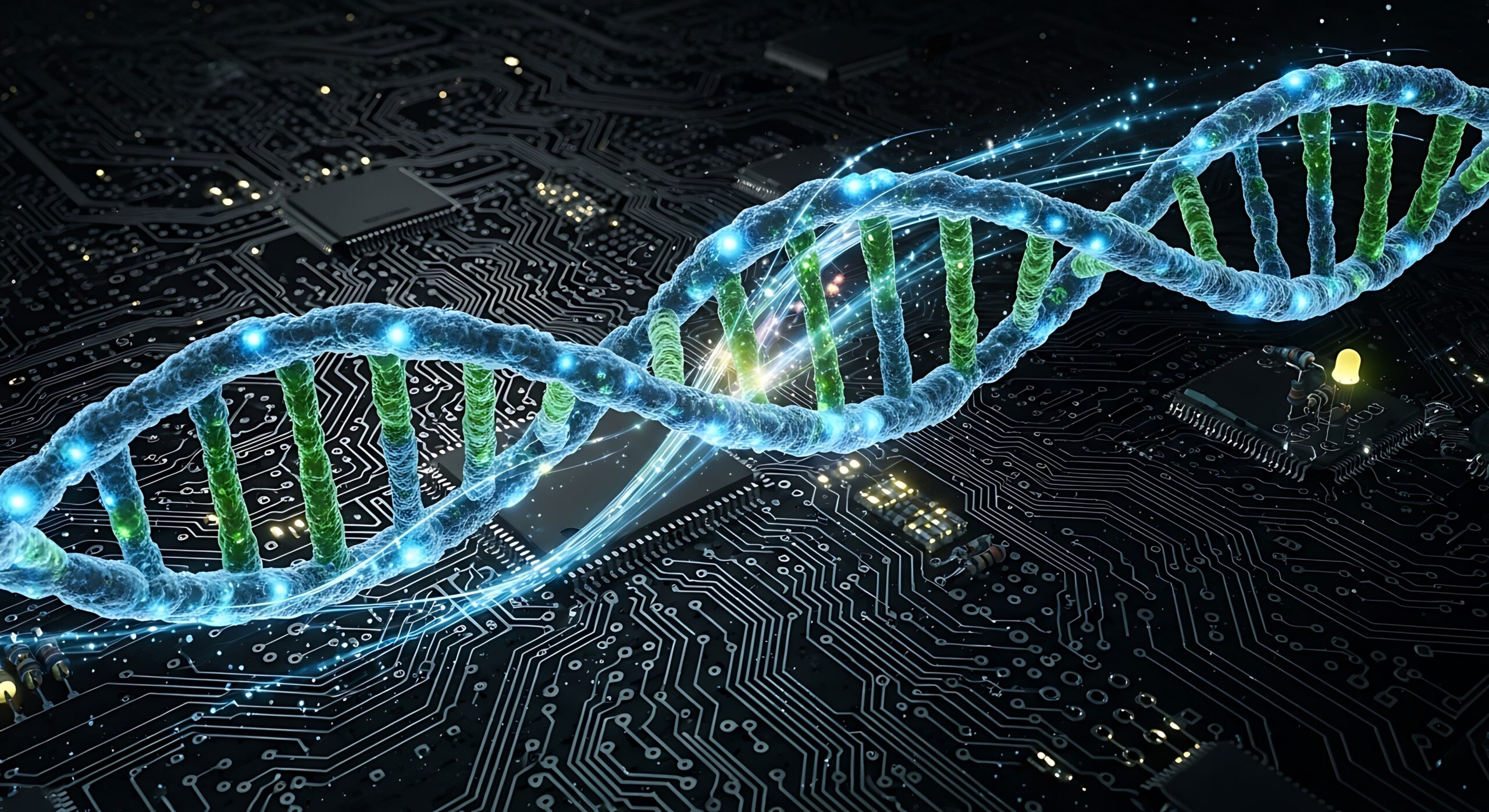
Scientists have successfully developed a new “programmable DNA computer,” which is different from traditional computers or conventional biological computing systems as it does not require continuous input of energy to accurately perform arithmetic operations. This research was published in the international authoritative journal Nature and demonstrates the enormous potential of molecular computing by utilizing the laws of thermodynamics from physics.
Named as “Scaffolded DNA Computer (SDC),” this system was co-developed by Professor Damien Woods and Assistant Professor Abeer Eshra from the Computer Science Department at Maynooth University in Ireland. They conducted 10 program tests with SDC, including arithmetic operations with 100 bits. Some calculations, such as 10+3, were completed by SDC in approximately 30 seconds.
Traditional electronic computers rely on microprocessors to continuously consume electrical energy, forcing signals through a series of logic processing steps. Meanwhile, many existing biological computers require the addition of “molecular fuel” (such as ATP or enzymes) to drive chemical reactions.
The innovation of SDC lies in its direct utilization of the principle of “thermodynamic equilibrium” from physics – physical systems naturally tend to evolve towards states of “lowest energy and most stable structure.”
Professor Woods, one of the co-authors of the study, explained, “The brilliance of this system lies in the competitive assembly process. Countless DNA molecules in solution push and compete with each other, and the molecules with the strongest bonding and most stable structure will prevail and bind to the long scaffold. This microscopic competitive process is essentially processing information. Ultimately, the system will stabilize in the thermodynamically preferred state, which encodes the correct answer to the calculation.”
This means that SDC does not require additional energy to derive results, but instead, through precise molecular sequence design, the “correct answer” coincides with the “lowest energy stable state”. In other words, compared to other biological computers that require living cells or traditional hardware for calculations, this computer requires less energy in its design to yield the answer.
The architecture of SDC consists of several short DNA strands (as “molecular tiles”) and a long DNA strand (as the “scaffold”).
1. Programming phase: Researchers write calculation rules by designing the base sequences of short DNA strands. Different DNA sequence combinations represent different input data or computational programs. The research team jokingly said, “To switch to different calculation programs or input values, we just need to take out different DNA solutions from the fridge and mix them.”
2. Computing phase: The DNA mixture is added to a small amount of saline solution and undergoes a simple heating process followed by slow cooling. During the cooling process, DNA strands competitively assemble based on the base pairing rules.
3. Outputting results: When the system reaches thermodynamic equilibrium, the final DNA structure formed represents the calculation result.
Though the reaction vessel is just a tiny droplet of liquid, it contains billions to trillions of DNA strands that self-assemble simultaneously. Professor Eshra pointed out, “This ultra-high-density molecular parallel computing is an advantage that traditional silicon crystal computers find difficult to replicate.”
The research team successfully demonstrated over 700 operations in the experiment using SDC, including basic addition, multiplication (by 3), division (by 2), and the computer domain common “8-bit parity check” for error detection.
In terms of performance:
Small computations: Basic calculations like 10+3 are completed by SDC in about 30 seconds to 1 minute. Considering the computation must undergo chemical reactions, which themselves take a similar or longer amount of time, such speed is quite remarkable.
Complex computations: Large-scale additions with numbers ranging from 11 million to 34 million take up to 14 hours for the longest computation.
Co-author Constantine Evans admitted that these simple calculations are much faster when done manually or with silicon chips. However, the value of SDC lies in how it “obtains the correct results solely through thermodynamics without fixed procedures and irreversible reactions, using only a few molecules.”
Even more groundbreaking is its “reusability.” Most molecular computers in the past were disposable, becoming ineffective after one use. SDC only requires re-temperature control to perform calculations again. The team even left SDC in the laboratory for a year and a half; despite partial drying of the samples, researchers only needed to reintroduce pure water, and SDC could immediately “revive” and perform calculations again, with three programs successfully running up to 24 times.
Eshra said, “Until now, many molecular computers have relied on specially prepared components, molecular fuels to drive the system, or precise time-controlled reactions. Our DNA computer just throws all the molecules together and operates by self-relaxing to an equilibrium state.”
Though thermodynamic DNA computers currently cannot compete with traditional electronic computers in speed, their ultra-low energy consumption and molecular-scale enable countless possibilities for future application:
– DNA archiving and data storage: Professor Eshra emphasized that SDC opens up a new direction for DNA data storage. Because systems based on thermodynamic equilibrium have an “in-built error correction” feature – DNA chain structures with mismatches are unstable and automatically replaced with correct DNA chains during the equilibrium process.
– Intelligent diagnosis inside organisms: The characteristics of not requiring external power sources or toxic reagents make SDC highly suitable for embedding in live cells or biocompatible materials, potentially used for medical sensing or precise drug delivery.
“This research successfully demonstrates that thermodynamics can be used for reliable and complex computations,” concluded Eshra, “In the future, we will continue to optimize DNA scaffold designs, improve result reading speeds, and further explore its potential applications in the field of molecular storage.”