
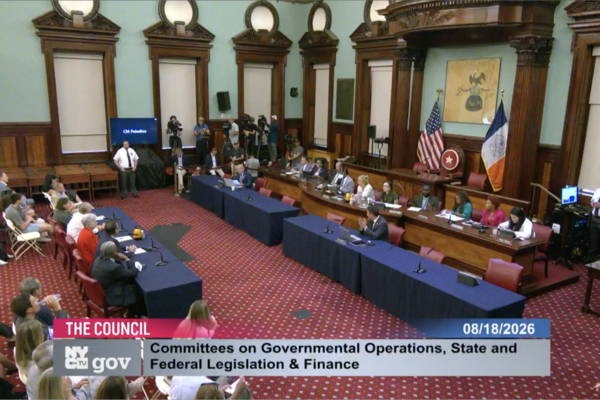
On August 18, the New York City Council held a hearing on the implementation of the “Pied-à-Terre Tax”. The focus of the hearing was on questioning the execution mechanism of the New York City Department of Finance (DOF), concerns over the disclosure of personal information, the reversal of burden of proof, and the financial risks posed to cooperative apartments (Co-ops) and ordinary citizens.
Several homeowners have filed lawsuits against the city government, including officials from the administrative departments who were absent from the hearing that day, with Finance Commissioner Richard Lee providing only written testimony.
Regarding the absence of the administrative department and the execution confusion, Brooklyn district councilor Wenyi Zhuang stated at the hearing that her concern is not about advocating for the super-rich, but rather to prevent hard-working ordinary citizens from being unfairly affected. She had recently received calls from constituents facing additional burdens due to family members living or serving, questioning the standards for determining the list by the city government and criticizing the lack of positive response from the administrative department.
Queens district councilor Youxing Huang raised concerns about financial stability, pointing out that the tax includes a five-year “sunset clause” (ending in the 2031 fiscal year). A representative from the Citizens Budget Commission (CBC) noted that temporary taxes with sunset clauses as part of non-recurring revenue pose fiscal risks as a long-term budget basis, and how future property tax reforms will interact with this tax remains unknown.
The fiercest confrontation at the hearing was regarding the scale of the list released by the DOF. The Department of Finance (DOF) released a supplemental assessment roster in July containing approximately 960,000 properties. Councilor Gale Brewer pointed out that even her house, which has been her primary residence since 1994, was included.
However, the DOF only sent out “preliminary determination notices” to about 17,000 property owners. According to the city comptroller’s estimate, the actual properties that might be affected are less than 14,000. By the time of the hearing, about 4,290 property owners had filed exemption applications with 1,906 approved.
The council and experts questioned the DOF for knowing that the list was inaccurate but still publicly disclosing the names, addresses, and valuations of over 900,000 New Yorkers, aggregating scattered and cumbersome public data into a “one-click download” list, breaking the privacy protection of “actual ambiguity” and potentially creating fraud risks such as doxxing and identity theft. Additionally, this also led to a “reversal of burden of proof” – requiring citizens who were not previously required to pay taxes to upload documents proving “this is my primary residence”.
The DOF clarified in written testimony that the 960,000 properties are not a “taxable list” but a mid-year supplemental assessment list issued legally; the preliminary notice is also not a tax bill but part of an administrative process of “notice first, verify later, and decide finally”.
The new regulation requires cooperative apartment boards to collect the additional tax from shareholders and then transfer it to the DOF, raising concerns in the industry about financial cascading effects: if individual shareholders refuse or are unable to pay tens of thousands of dollars in taxes, the cooperative apartment may be forced to use reserve funds or distribute costs to other residents, subsequently affecting the financial ratings, insurance renewals, and mortgage loans of the entire building.
Councilor David Carr raised another potentially overlooked issue: whether the property valuations used by the DOF to determine who falls within the tax range are accurate? Witnesses generally expressed long-standing doubts about DOF valuations, especially in the case of cooperative apartments, condominiums, and one-to-three-family residences, where government overvaluations could result in numerous ordinary properties being wrongly taxed. Long-standing residents of SoHo artist “live-work” spaces and retirees who moved out of New York found themselves in identification dilemmas.
Additionally, many citizens in early years, for estate planning or family arrangements such as caring for children, transferred their properties to trusts (e.g., holding an apartment in trust for children’s long-term residency). However, under the new 2026 law, the separation between “legal owners/trustees” and “actual residents” led to properties that were originally deemed “primary residences” being systemically classified as non-primary residences, receiving hefty additional tax notices. More challenging is that if a trust has more than two beneficiaries, there will be significant procedural obstacles in appealing for exemptions, resulting in huge tax burdens on past legitimate family asset planning.
The hearing also highlighted the disparity between policy philosophy and execution. On one hand, public finance scholars, unions, and education advocates support the taxation principle, believing that the high value of real estate comes from city public investments such as parks, subways, and taxing second homes can provide funds for public schools and free childcare, consistent with social equity; on the other hand, the City Council, homeowners, and cooperative apartment associations strongly question the execution mechanism, criticizing the hasty legislation and lack of communication, advocating for the government to make better use of existing data for verification instead of shifting the audit costs, burden of proof, and risks onto ordinary citizens, trust holders, and cooperative apartments.
Currently, the deadline for exemption applications for the additional tax has been extended to September 18 this year. The New York City Council stated that it will submit written requests to the administrative department to respond to the administrative loopholes, legal basis for list publication, error rates, and other issues raised during the hearing.