
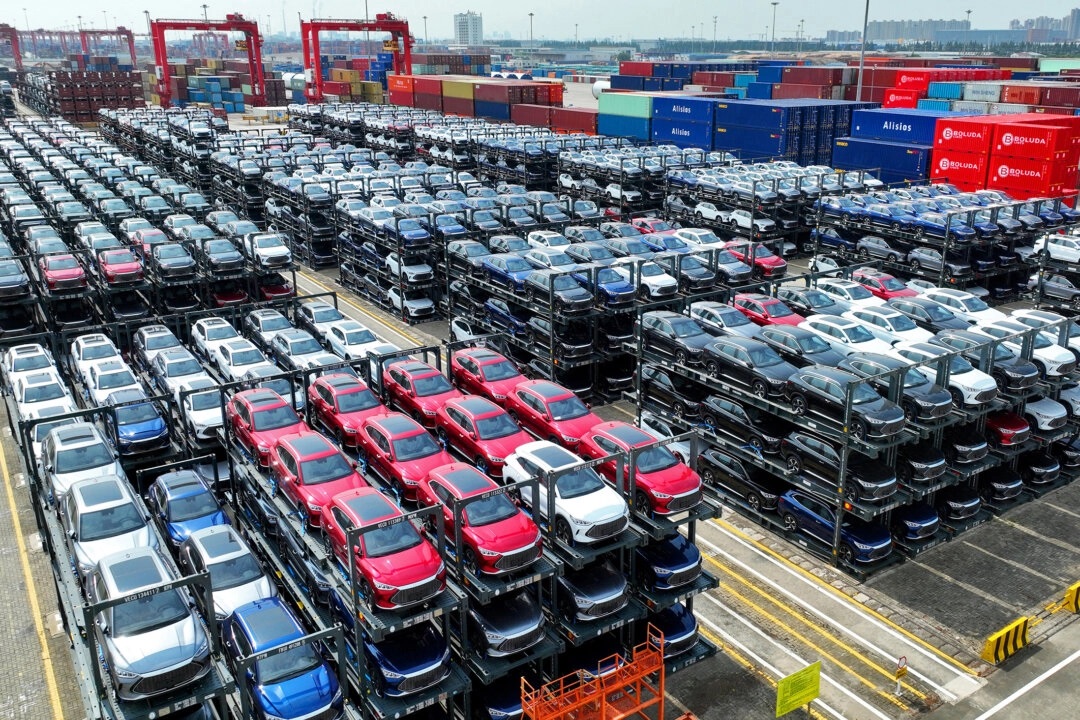
Experts warn that as internet-connected Chinese-made electric vehicles are poised to flood the Canadian market, Canada’s national security is facing increasingly serious challenges.
China’s low-cost electric vehicles (EVs) are gaining larger market share in some Western markets, providing more affordable transportation options for budget-conscious consumers. However, a seminar held by the Macdonald-Laurier Institute this week highlighted the significant national security risks that may accompany these low prices.
The Ottawa-based think tank hosted a 90-minute seminar titled “Cheap cars, high costs: The security reality of China’s EVs,” inviting industry and policy experts to discuss the potential impacts of Canada’s agreement with the Chinese government on electric vehicles.
With China reducing import tariffs on Canadian canola seeds, Canada has drastically reduced tariffs on Chinese-made electric vehicles from 100% to 6.1%. Under this agreement, initially up to 49,000 Chinese EVs per year can enter Canada with lower tariffs until March 2027, with the quota expected to increase in the coming years.
Margaret McCuaig-Johnston, a senior fellow at the University of Ottawa and a well-known expert on China issues, expressed at the seminar that Chinese-made electric vehicles raise security concerns due to integrated Chinese software in the vehicles that can collect data through cameras, microphones, and GPS systems, sending the data back to China, allowing Beijing to have control over “the details of our streets.”
McCuaig-Johnston further referenced the Vehicles-to-Grid Integration Assessment Report released by the US Department of Energy in January 2025, warning that the Vehicles-to-Grid Integration (VGI) system is vulnerable to cybersecurity threats.
She believes that China (the Chinese Communist Party) may exploit software vulnerabilities in the EV operating systems to cause a large number of vehicles charging simultaneously to initiate malicious power demands, creating grid instability and potentially leading to widespread “brownouts” in North America.
McCuaig-Johnston and Brenda Shaffer, a research professor at the US Naval War College and an energy security expert, also discussed concerns regarding the “kill switch” function.
Both experts cautioned that the embedded “kill switch” in vehicle software could be remotely activated, causing vehicles to suddenly stop running. During geopolitical or diplomatic crises, this could paralyze transportation systems and even lead to major traffic congestion in major cities.
“These threats are not theoretical or exaggerated. In fact, there are labs today that are looking at these different kill switches and remote control capabilities,” Shaffer said.
McCuaig-Johnston emphasized that Canadians should be aware that anyone opting for Chinese EVs due to lower prices may face such potential risks.
She said, “One might ask if this poses a threat to the average Canadian considering purchasing a Chinese electric car?”
She pointed out that consumers may think their privacy is “not as important as the price of the car.” However, sensitive information shared in everyday conversations, such as discussions about bank accounts between spouses, could also be collected. She stated that believing China would not leverage such data is a naive thought.
Shaffer also expressed similar concerns, noting that the UK Ministry of Defense had previously decided to place warning labels inside electric vehicles related to Chinese manufacturers or supply chains, citing concerns about espionage and data transmission issues.
She said, “But Canada, despite being aware of all this, has still decided to start importing electric vehicles this year. That’s a little surprising. Canada could have learned from the mistakes of other countries.”
Brian Kingston, President and CEO of the Canadian Vehicle Manufacturers’ Association, also participated in the seminar.
He has publicly opposed Ottawa’s decision to reduce tariffs on Chinese electric vehicles. Kingston believes that in terms of trade and regulatory policies on Chinese electric vehicles, Canada cannot diverge from the US.
The US currently maintains a 100% tariff under Section 301 on Chinese electric vehicles and has additional national security restrictions on connected vehicle technology.
Washington had previously criticized Ottawa for canceling tariffs on Chinese electric vehicles, fearing it could jeopardize the entire North American market.
Although there are still trade tensions between Ottawa and Washington, Kingston stated that the agreement between the two countries aligns with their interests, as the US exports more cars to Canada than to any other market in the world.
He said if the US takes measures to exclude Chinese-made vehicles from the market, “we must do the same, otherwise our market access will be at risk.”
Kingston pointed out that the automotive industries of Canada and the US have relied on highly integrated cross-border supply chains for over 60 years.
He also believed that China (the Chinese Communist Party) is not an ideal trade partner, as Beijing does not follow the rule-based trade and investment principles that the Canadian economy depends on.
He stated that Canadian domestic auto factories cannot compete fairly with Chinese manufacturing companies that receive substantial government subsidies, an integral part of the Chinese industrial strategy.
“This is how they drive economic growth, but we should not submit to this model and allow an industry to be destroyed because of it,” he said.
Using Europe as an example, Kingston highlighted potential scenarios some countries may face when dealing with China-related issues.
He mentioned that Chinese electric vehicles have already gained a significant market share in Europe, currently accounting for about 10% of the European market and expected to double by 2030.
This growth led to over 100,000 job cuts in the European automotive industry during 2024 and 2025.
“The EU is importing 1 million Chinese cars, while exporting only about 160,000 cars to the Chinese market. Their industry is actually being devoured by the Chinese,” he said.
Kingston also stated that China has a market advantage over Canada in terms of automotive manufacturing costs, as China’s labor and environmental regulations are not as strict as Canada’s.
“In many cases, labor rights simply don’t exist,” he said. Chinese workers do not have to receive fair wages like Canadian workers; the hourly wage for the unionized members of Unifor is around $44.50 Canadian dollars (about 210 Chinese yuan). Furthermore, China heavily relies on lower-cost coal-fired power generation, while Canada has a cleaner energy supply network.
Lower production costs enable China to produce far more electric vehicles than its domestic demand. In contrast, Kingston pointed out that there is an annual supply gap of about 4 million vehicles in North America.
“China produces twice the amount of electric vehicles it consumes,” Kingston said, “So where do these surplus cars go? They are dumped all over the world… that’s the predicament we’re facing, which poses a huge risk to the Canadian economy and, of course, to our automotive industry.”