
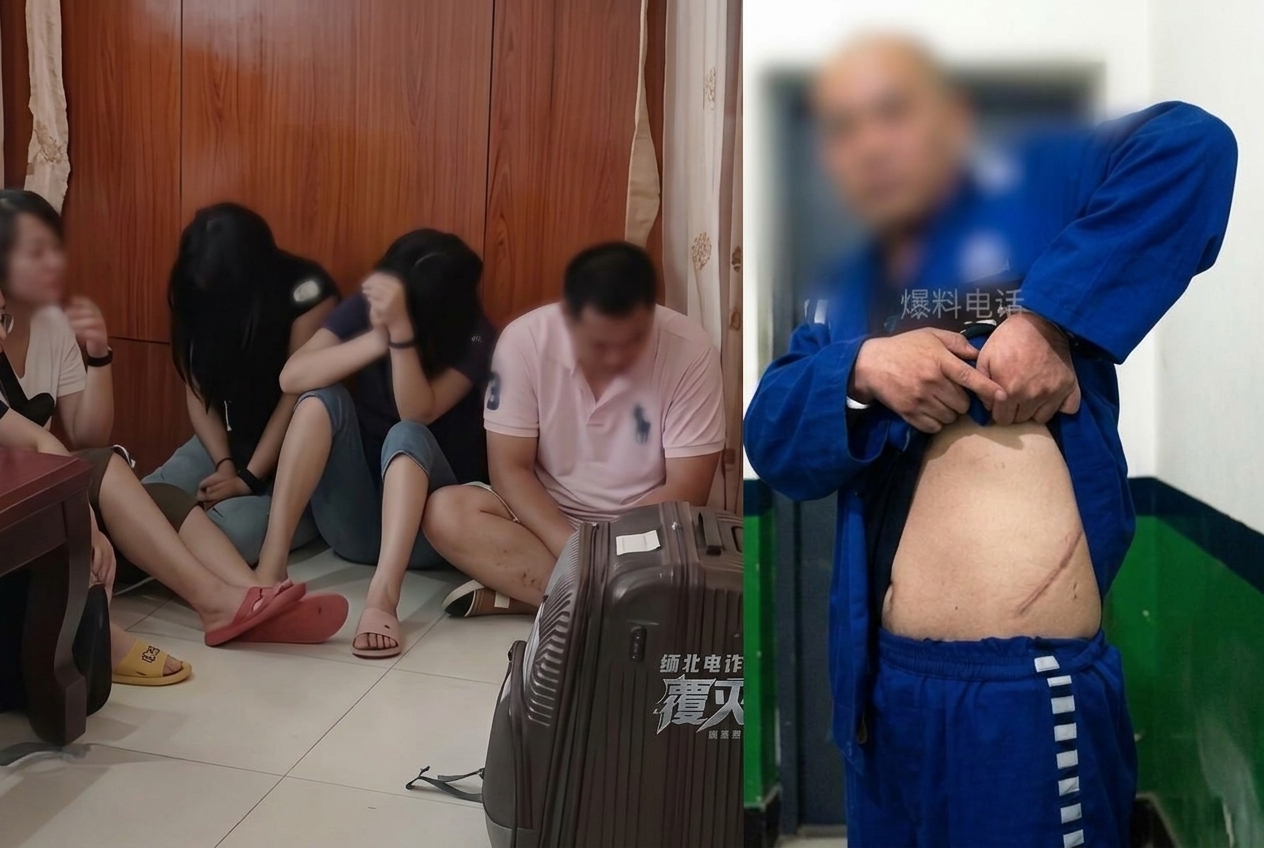
Recently, CCTV of the Chinese Communist Party (CCP) aired a documentary about telephone fraud in Northern Myanmar, where a man known as “Piglet” recounted experiencing hell and ultimately resorting to “kidney selling” to escape. However, overseas investigations and U.S. judicial documents indicate complex connections between some Southeast Asian fraud groups and CCP security departments, casting doubt on the CCP’s official narrative of cracking down on telecommunications fraud.
From October 5th to 7th, CCTV of the CCP broadcast the documentary “The Destruction of Telephone Fraud in Northern Myanmar,” jointly produced with the Ministry of Public Security, exposing the situation in some telephone fraud gardens in Northern Myanmar.
In the documentary, a man named Tang, who was abducted to a fraud garden in Northern Myanmar and commonly known as “Piglet,” narrated his story. He confessed that after sneaking into Northern Myanmar in 2021, he participated in telephone fraud. Due to poor performance, he was forced to sign a loan agreement of 70,000 yuan and was later resold among multiple gardens and subjected to physical abuse.
Tang recounted that he was eventually beaten to the point of being unable to walk, with his wounds festering, and the fraud group forced him to “sell his kidney to pay off the debt.” In his despair, he accepted, saying, “I am willing to give up a kidney, even a leg or a hand, as long as I can leave.” He recounted.
Tang disclosed that he was eventually informed of a “successful match” and was subsequently taken to a small farmyard to undergo kidney removal surgery.
CCP state media claims that the documentary demonstrates the collaboration of public security agencies in combating crimes involving China in Northern Myanmar and asserts that they have “completely eradicated” the criminal gangs known as the “Four Families” in Northern Myanmar.
However, recent overseas investigations, testimonies from involved individuals, and judicial documents reveal connections between some Southeast Asian telecommunications and gambling groups and CCP security agencies, including the Ministry of Public Security and the Ministry of State Security.
After being arrested in Thailand in 2022, She Zhijiang, the founder of Myanmar’s “Asia-Pacific New City,” confessed during an interview with foreign media while in prison that he was recruited by CCP state security personnel at the end of 2016 in the Philippines and became an intelligence agent. He also mentioned that he faced political persecution due to his knowledge of secrets related to the CCP’s state security system and the “Belt and Road Initiative.”
Furthermore, a report by the Congressional-Executive Commission on China in 2025 revealed that She Zhijiang’s “Asia-Pacific New City” project had received support from official Chinese sources and Chinese-funded enterprises in the past but later became one of the major fraudulent areas in Southeast Asia.
Public records indicate that the “Asia-Pacific New City” is a fraudulent area located in the Irrawaddy Valley in eastern Myanmar, being the largest fraudulent area globally with a scale of 30,000 people.
Another notable case is the founder of the Cambodian Prince Group, Chen Zhi. From 2021 to 2022, the Prince Group received the “Social Responsibility Model Award” at the China Financial Summit for two consecutive years, and CCP media had reported on it.
Former CCP spy Eric, in an interview with the Epoch Times, stated that Chen Zhi’s Prince Group is a key agent for CCP’s secret activities in Cambodia and Southeast Asia, serving as a financial reservoir and logistical base for the CCP’s intelligence system overseas.
Eric revealed that he witnessed CCP public security officials from Beijing and Chongqing holding meetings at Chen Zhi’s private club “Yunxuan Pavilion” in Cambodia, planning to lure the exiled cartoonist “Bian Tai La Jiao” (Wang Liming), with the entire process being handled by the Prince Group.
Meanwhile, documents from the U.S. Department of Justice reveal connections between the Prince Group and personnel from the CCP’s Public Security Bureau and Ministry of State Security.
According to a document from the U.S. Department of Justice, Chen Zhi and senior members of the Prince Group utilized their political influence to protect fraudulent activities and maintained connections with officials from the CCP’s Public Security Bureau and Ministry of State Security. The document stated that senior members of the Prince Group provided benefits to officials in exchange for obtaining advance information on law enforcement raids. It also noted that Chen Zhi had disclosed cooperating with members of the CCP’s Ministry of State Security to obtain information on law enforcement actions.