
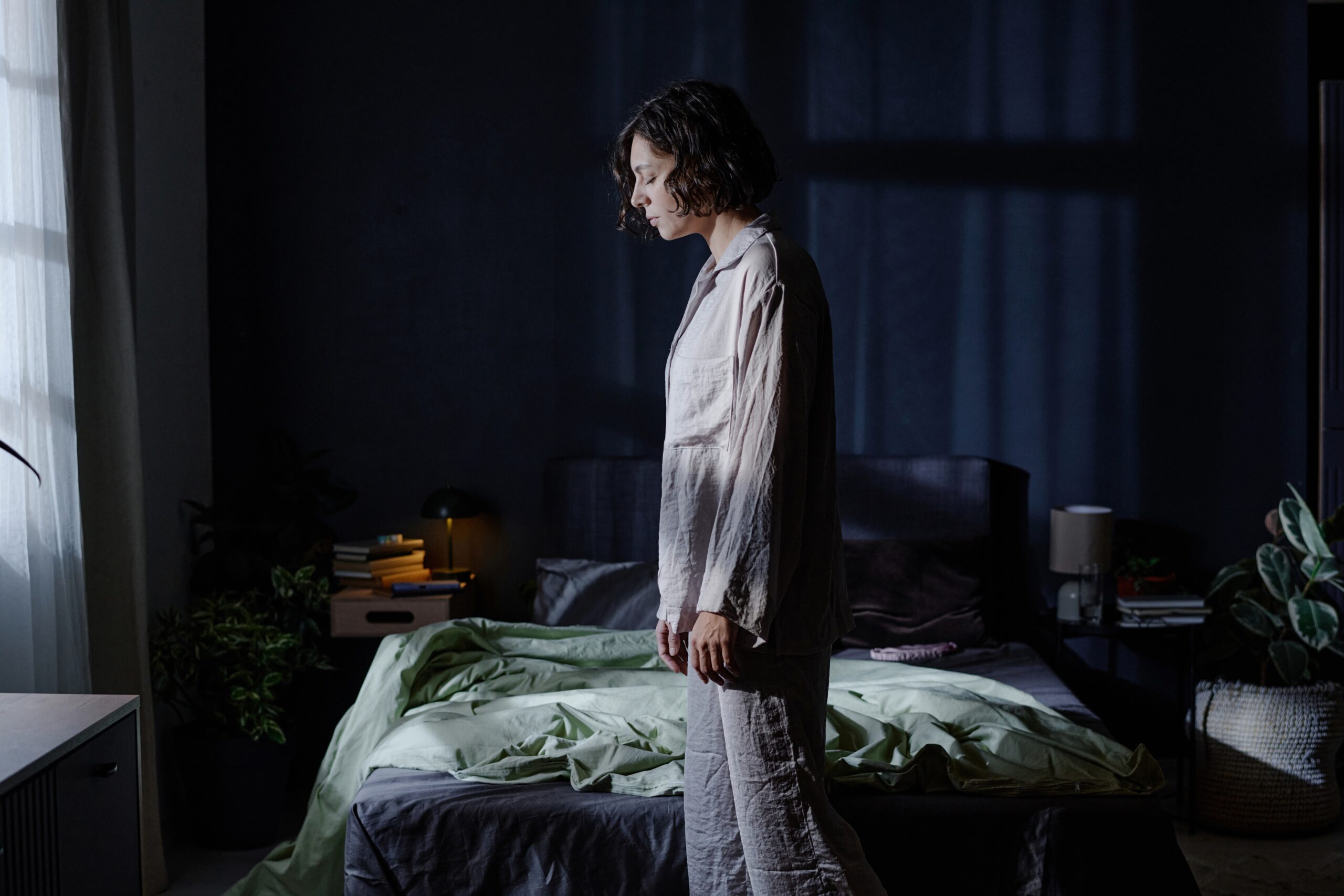
In Prague, the capital of the Czech Republic, a woman has been suffering from somnambulism for many years. Apart from walking around during a sleepwalking state, this woman sometimes even takes photos with her smartphone. She has submitted a total of 77 photos to sleep experts for research, and her case has recently been published in an international journal.
According to a report from Medical Daily website, the 50-year-old woman mentioned that she has been sleepwalking since she was young, but the condition worsened significantly when she turned 29, due to starting shift work and experiencing high work pressure. Since then, the frequency of her sleepwalking episodes increased from about twice a week to almost every night.
During her sleepwalking episodes, she talks in her sleep, moves around her apartment, and even tries to communicate with sleeping family members. She has even been known to jump out of bed at times. There was one incident where she left her apartment and only regained consciousness in the elevator.
She does not have a particular interest in photography in her waking time and does not take any regular medication. Occasionally, she recalls dream fragments related to her sleepwalking, such as chaotic work scenes.
She informed sleep experts in Prague that sometimes she takes photos while sleepwalking. She submitted 77 photos taken between August 2018 and February 2026 as evidence.
Among these photos, 27 are completely dark. The remaining 50 captured images of glowing power switches, aquarium lights, clear shadows cast by plants, and model cars behind glass cabinets, among other scenes. In several photos, her own hand can be seen pointing towards certain objects in the room.
Neurologists in the Czech Republic published her case in the journal “Nature and Science of Sleep”. They described it as a previously unreported, goal-directed behavior occurring during sleepwalking.
Researchers noted that the timestamps embedded in these photos were concentrated between 2:00 am and 3:30 am. As she usually goes to bed at midnight, this time frame aligns with the typical pattern of parasomnia during non-REM sleep. Some photos were taken consecutively within a few minutes, while others were taken during daytime sleep after night shifts.
For most of the photos, she could recall dream fragments associated with them, even if they were sporadic images. She often mentioned dreams about the ceiling collapsing, and one of the photos happened to be a poorly composed, blurry close-up of a ceiling.
Researchers observed that many recognizable scenes in her photos contained light sources or exhibited strong contrasts between light and darkness. One possible explanation is that these ambiguous visual cues integrated into her dreams and caught her attention while she was in a semi-awake state.
One intriguing question arises: how does one take photos while sleepwalking? Although snapping a photo involves actions like picking up the phone, unlocking it, opening the camera app, framing the shot, and pressing the shutter button – seemingly complex tasks, researchers believe that for many people, these steps have become highly proficient through daily use and can be performed even in a semi-awake state.
Researchers acknowledged the limitations of this study, including the lack of real-time recording of the woman’s photography during sleepwalking, absence of witnesses, post-review of related photos, and dream recall solely based on her personal account.
Despite these limitations, researchers still believe that the timing during nighttime, the patient’s clinical history, and sleep monitoring results strongly support her claim of taking photos while sleepwalking.
It is worth noting that if you encounter someone sleepwalking, it is best to guide them back to bed for the safety of both the sleepwalker and yourself, rather than waking them up. (Related reading: Why you shouldn’t wake up a sleepwalker?)