
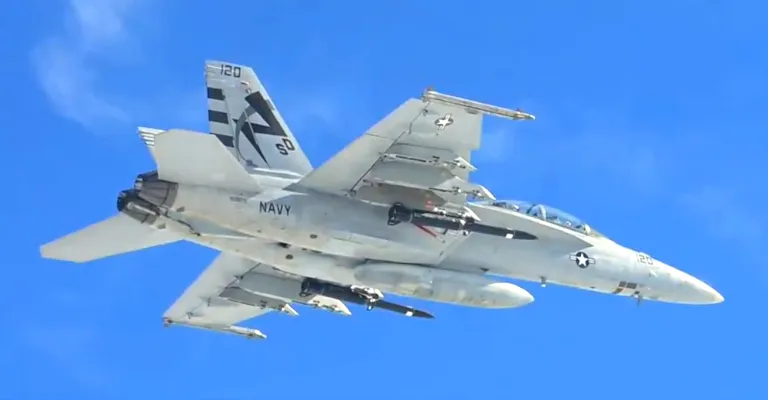
Castelion’s Blackbeard supersonic missile mounting test could potentially make the US Navy the world’s first combat force with air-launched hypersonic missiles. This new modular and cost-effective weapon will provide the US Navy’s carrier-based aircraft with unprecedented strike capabilities.
In late September 2026, the US Navy’s Program Executive Office for Aircraft (PAEA) publicly shared a video of the flight test of the Blackbeard air-launched hypersonic missiles. The video showed an F/A-18E/F Super Hornet fighter jet carrying two Blackbeard test missiles under its wings for the flight test.
Subsequently, the US Navy confirmed that the test took place on September 18 at the Patuxent River Naval Air Station (NAS) in Maryland. It was a developmental flight test phase, and neither of the test missiles was released from the fighter jet’s launchers, with both the aircraft and the test missiles safely returning to the base.
One of the most notable features of Blackbeard in the US hypersonic weapons arsenal is its significant cost-effectiveness. Public data shows that the target unit cost of this air-launched hypersonic missile will not exceed $400,000, much lower than the costs of other hypersonic weapons in the US military.
In comparison, the US Navy’s Conventional Prompt Strike (CPS) hypersonic weapons planned for deployment on Zumwalt-class destroyers and Virginia-class submarines have a unit cost of approximately $51 million, with even higher costs for the complete weapon system.
If Blackbeard can ultimately achieve mass production at the targeted cost of less than $400,000, its unit cost would only be about one-seventieth of CPS. This low-cost expendability is a significant advantage unique to Blackbeard.
In February 2026, the US Navy awarded Castelion a contract worth approximately $50 million to advance Blackbeard for Early Operational Capability (EOC). In April, the Navy signed a $105 million contract to integrate the weapon onto the F/A-18E/F Super Hornet fighter jets, including software and hardware integration, system safety, airworthiness certification, and flight tests.
In June, the Navy further procured 50 pre-production Blackbeard missiles and corresponding transport and storage equipment. In August, Castelion received another contract worth approximately $90 million to continue the production and delivery of 50 missiles.
In September, the Navy added a $200 million production order for the manufacturing, assembly, testing, and delivery of the initial batch of Blackbeard missiles.
Based on the US Navy’s investment and project progress, Blackbeard is one of the fastest-developing new low-cost hypersonic weapons in the US in recent years. The Navy is pushing the project forward to achieve Early Operational Capability around 2027-2028.
On May 13, 2026, the Pentagon signed an agreement with Castelion, indicating that after Blackbeard’s testing and validation, they would procure a minimum of 500 missiles annually. They also sought authorization to acquire over 12,000 of these missiles in the next five years.
The concept of hypersonic weapons, defined as cruise missiles or boost-glide weapons with speeds exceeding Mach 5 (approximately 6,125 kilometers per hour), is not unfamiliar. The key to determining a weapon’s true hypersonic strike capability is its ability to maneuver within the atmosphere.
During the Cold War, traditional ballistic missiles could reach speeds exceeding 20 Mach upon re-entry into the atmosphere, yet they were still classified as ballistic missiles rather than hypersonic missiles. This was because these missiles could only fly along fixed trajectories making them relatively easy to detect, track, and intercept by long-range early warning radars and defense systems.
With technological advancements, traditional ballistic missile boost technologies have gradually combined with Hypersonic Glide Vehicles (HGV), forming boost-glide weapons. These weapons not only fly at hypersonic speeds but also possess a certain degree of maneuverability. Although these weapons are still commonly referred to as ballistic missiles, they are no longer equivalent to traditional ballistic missiles due to their complex flight paths and maneuvering capabilities, hence termed hypersonic missiles. In light of their faster speeds, intricate flight paths, and maneuvering methods, the difficulty of intercepting these weapons by defense systems has increased.
As for hypersonic cruise missiles, they are typically launched from mobile platforms, relying on scramjet engines to sustain high-speed flight within the atmosphere. With no fixed trajectory to follow, intercepting these weapons becomes even more challenging.
Analysis of public data suggests that Blackbeard might employ a design similar to a ballistic missile booster combined with a Hypersonic Glide Vehicle (HGV). The booster accelerates and raises the HGV to the desired speed and altitude before releasing it toward the target. This design concept indicates that Blackbeard falls within the category of hypersonic missiles.
This concept is distinct from hypersonic cruise missiles that rely on scramjet engines for thrust generation. The development of hypersonic cruise missiles involves complex technological requirements. Presently, American hypersonic cruise missile developments have progressed from technical verification to flight testing and operational preparations, exemplified by the US Air Force’s Hypersonic Attack Cruise Missile (HACM) project. The HACM missile combines rocket boosters with a scramjet engine for high-speed cruising post-launch from fighter jets.
HACM’s progress has noticeably lagged behind the original schedule. The US Air Force continues to advance the project in 2026, aiming to finalize the procurement plan for HACM by 2027.
In 2026, the US Air Force also initiated the quest for the next-generation low-cost hypersonic cruise missile capable of carrying various payloads with a range exceeding 900 kilometers. This demonstrates the Pentagon’s shift in high-hypersonic weapons development from high-end weapon system platforms towards low-cost, high-volume, and sustainable deployment capabilities.
Blackbeard is designed to be launched from fast-moving fighter jets, providing it with significant initial velocity at launch. This allows it to achieve hypersonic speeds in a shorter timeframe, despite its range not exceeding 900 kilometers. The combination of high speeds and relatively short range creates a narrow window for opponents’ defense systems to react and intercept, thereby compressing the reaction and interception time significantly.
Presently, there is no specific information on the exact guidance technology utilized by Blackbeard. However, given its mission to target enemy ships, it likely employs a heat-seeking guidance system similar to existing anti-ship missiles. Castelion has previously hinted that Blackbeard’s range may be close to 800 kilometers, but the exact range has not been publicized. The combat radius of the F/A-18 Super Hornet fighter jet without aerial refueling ranges from 600 to 800 kilometers. Mounting an 800-kilometer range Blackbeard missile would significantly increase the carrier strike group’s power projection distance. This out-of-area strike capability exchanged for the range of carrier-based aircraft could effectively reduce the aircraft carrier’s inherent risks while maintaining sustained pressure on high-value enemy targets.
Previously, the Navy’s Multipurpose, Low-Cost, and Large Capacity Effects (MACE) demand document explicitly required MACE to have a compact design, allowing F-35A/C carrier versions to carry four complete weapons (AUR) internally. It remains unclear if this requirement is still relevant for Blackbeard. However, achieving internal pod mounting will not only provide stealth fighter jets with a hypersonic strike capability but also allow them to engage in combat while maintaining a stealth configuration.
The US Navy has clearly stated that this air-launched hypersonic weapon can be used to attack maritime and land mobile targets. If Blackbeard possesses this engagement capability, its tactical value will be further enhanced. This implies that its scope of targets can expand from fixed installations to sailing warships or moving ground targets, significantly increasing the difficulty of opponent defense systems in detection, identification, tracking, and interception.
It is worth mentioning that the US Army is also advancing Blackbeard’s land-based version, planning to integrate it with High Mobility Artillery Rocket System (HIMARS) and future Conventional Autonomous Multi-Domain Launch System (CAML). The US Air Force has also collaborated with Castelion on the concept of long-range strike weapons. Considering the Navy’s plans to integrate Blackbeard into F-35C aircraft, the possibility of a Blackbeard-specific version for future Air Force F-35A cannot be ruled out.
The US Navy’s Program Executive Office for Aircraft mentioned in a post, “Coming soon to a war zone near you,” tagging the official accounts of the US Central Command (CENTCOM) and the US Pacific Command (PACOM). CENTCOM is responsible for US military operations in the Middle East and surrounding regions, while PACOM primarily oversees military actions in the Indo-Pacific region, including the Taiwan Strait, South China Sea, and the entire Western Pacific.
US military officials have long regarded hypersonic weapons as a critical capability for success in future conflicts, especially in potential high-end military confrontations with China.
Long-range precision strikes with hypersonic weapons are a key area of fierce competition between the US and its main adversaries, particularly in potential conflicts with China. Though multiple programs, including the US Air Force’s Hypersonic Attack Cruise Missile, are in progress, Blackbeard could be the closest hypersonic air-launched missile to operational deployment by the US military.